
ᐅ Construction of a 144 sqm bungalow in Fichtenwalde (near Potsdam)
Created on: 16 May 2021 18:56
A
Acof1978
Then I would also like to introduce our building project here and keep you updated.
First, a brief introduction about us. He (42.5 years; controller in healthcare), she (38.5 years; full-time teacher), child (8.75 years; fully dependent). Our household net income is currently about €6,400 (approximately $6,800) plus performance bonuses, 13th-month salary, overtime, etc. We own a 1,462 sqm (15,735 sq ft) plot of land in Fichtenwalde. The remaining debt on the land is €37,000 (about $39,000). According to official land value guidelines, the land is valued at €146,200 (about $156,000) (€100 / sqm). The market price is around €400,000 to €600,000 (recent sale prices). We submitted the building permit application including the land conversion at the end of December. We expect approval by mid to late July.
The construction company is KB Brandis from Jüterbog. External site supervision will be handled by Bauherrenhilfe with 13 appointments.
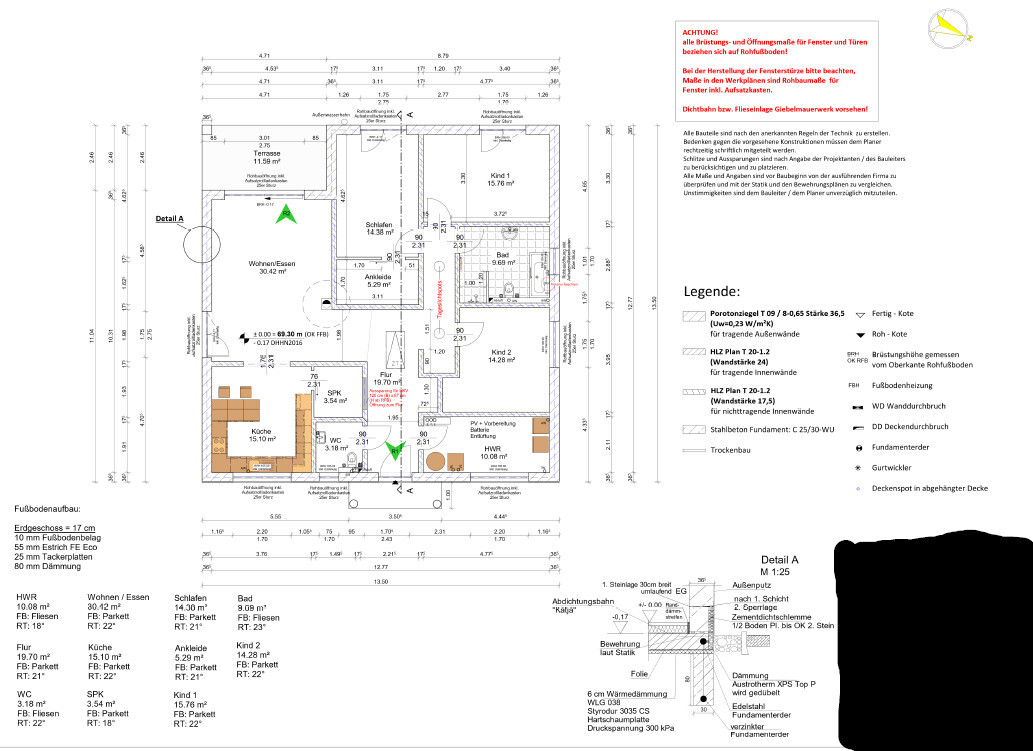
Now about the house. It will be a 144 sqm (1,550 sq ft) bungalow plus a 12 sqm (130 sq ft) covered terrace with the following additions:
- Ceiling height 3.00 m (9.8 ft)
- Electric roller shutters (including smart home integration)
- Double-sided laminated windows (wood-colored; RC3 security rating)
- Brine-to-water heat pump with ground collectors due to water protection area (Bosch Compress 7800i LW)
- Hydraulic balancing of the underfloor heating
- Controlled residential ventilation with heat recovery (Bosch)
- Motion detectors from a security company
- 13 kWp photovoltaic system, including battery preparation
- 10 m³ (2,650 gal) cistern for rainwater use
- Doorbell with video function
- Wallbox preparation for electric vehicle charging
- Exterior lighting
Floor plan attached.
We have not yet finalized financing (although discussions have taken place). So far, we have invested up to €30,000 (approximately $32,000) from our own savings during the planning phase. This is almost all of our equity. However, we continue to save about €2,750 (approximately $2,920) per month. The monthly mortgage payment is expected to be around €1,650 (about $1,750) plus additional costs of approximately €200-250 (about $210-265) (taking into account the photovoltaic system). This means when we move into the house, we will still have savings of at least €1,500 (about $1,590) per month.
The construction contract will be signed within the next few weeks. The prices (recently discussed with the company) correspond to the offer and commitment as of September 2020.
The price per square meter of the house (according to the latest offer and full specification) will be €2,700 (about $2,870). This includes everything, such as painting, flooring, etc. The overall costs are structured as follows:
House: €378,000 (about $402,000)
Land conversion including reclassification: €25,000 (about $26,600)
Additional building costs: €40,000 (about $42,500)
Outdoor facilities: €25,000 (about $26,600)
Total financing volume: €468,000 (about $498,000)
First, a brief introduction about us. He (42.5 years; controller in healthcare), she (38.5 years; full-time teacher), child (8.75 years; fully dependent). Our household net income is currently about €6,400 (approximately $6,800) plus performance bonuses, 13th-month salary, overtime, etc. We own a 1,462 sqm (15,735 sq ft) plot of land in Fichtenwalde. The remaining debt on the land is €37,000 (about $39,000). According to official land value guidelines, the land is valued at €146,200 (about $156,000) (€100 / sqm). The market price is around €400,000 to €600,000 (recent sale prices). We submitted the building permit application including the land conversion at the end of December. We expect approval by mid to late July.
The construction company is KB Brandis from Jüterbog. External site supervision will be handled by Bauherrenhilfe with 13 appointments.
Now about the house. It will be a 144 sqm (1,550 sq ft) bungalow plus a 12 sqm (130 sq ft) covered terrace with the following additions:
- Ceiling height 3.00 m (9.8 ft)
- Electric roller shutters (including smart home integration)
- Double-sided laminated windows (wood-colored; RC3 security rating)
- Brine-to-water heat pump with ground collectors due to water protection area (Bosch Compress 7800i LW)
- Hydraulic balancing of the underfloor heating
- Controlled residential ventilation with heat recovery (Bosch)
- Motion detectors from a security company
- 13 kWp photovoltaic system, including battery preparation
- 10 m³ (2,650 gal) cistern for rainwater use
- Doorbell with video function
- Wallbox preparation for electric vehicle charging
- Exterior lighting
Floor plan attached.
We have not yet finalized financing (although discussions have taken place). So far, we have invested up to €30,000 (approximately $32,000) from our own savings during the planning phase. This is almost all of our equity. However, we continue to save about €2,750 (approximately $2,920) per month. The monthly mortgage payment is expected to be around €1,650 (about $1,750) plus additional costs of approximately €200-250 (about $210-265) (taking into account the photovoltaic system). This means when we move into the house, we will still have savings of at least €1,500 (about $1,590) per month.
The construction contract will be signed within the next few weeks. The prices (recently discussed with the company) correspond to the offer and commitment as of September 2020.
The price per square meter of the house (according to the latest offer and full specification) will be €2,700 (about $2,870). This includes everything, such as painting, flooring, etc. The overall costs are structured as follows:
House: €378,000 (about $402,000)
Land conversion including reclassification: €25,000 (about $26,600)
Additional building costs: €40,000 (about $42,500)
Outdoor facilities: €25,000 (about $26,600)
Total financing volume: €468,000 (about $498,000)
N
Neubau202228 May 2022 18:12I was on site again this morning to empty the dehumidifiers. After 16 hours, they were only about 80% full. About an hour ago, I checked again after approximately 8 hours, and they were only around 30% full. The indoor humidity was between 35-42%. The house was only lukewarm. I will discuss this with the site manager on Monday. Is it normal for the water absorption to decrease so quickly? At the beginning, they were always full after 12 hours, sometimes even after just 9 hours, and the humidity was sometimes as high as 90%.
guckuck2 schrieb:
Why use drying units in this weather? And six of them at that… I’ve also been puzzled for days.
I checked because something about this felt wrong to me the whole time (not just the number of six units).
Quote from my blog: “Even for a drying unit, it’s still too early. According to the site manager, only after two weeks. The rental service specialist at Obi in Hamburg-Harburg also would not release one any earlier… :p”
Drying too early and too quickly is not good: the screed will cup significantly, and removing the moisture too fast damages the material.
P.S. Based on several recommendations, we had just one drying unit running for 140sqm (1507 sq ft). I don’t remember the output capacity.
N
Neubau202228 May 2022 22:33ypg schrieb:
I have also been confused for days.
I checked because I had a feeling all along that something was wrong here (not just the quantity of 6 units).
Quote from my blog: “It’s still too early for a dehumidifier. The site manager says only after two weeks. Even the rental service specialist at Obi in Hamburg-Harburg wouldn’t let us have one earlier... :p”
Drying too early and too fast is not good: the screed will cup significantly, and removing moisture too quickly is bad for the material.
P.S. Following advice from several sources, we used only one dehumidifier for 140sqm (1,506 sq ft). I don’t remember its capacity anymore. The drying schedule and specifications come directly from Kneif. Therefore, I would trust that. But do ask for clarification. What confuses me is how quickly the moisture level has dropped and how little water is being extracted.
Neubau2022 schrieb:
The drying schedule and specifications come directly from Knauf. That’s why I would trust them. But ask to be sure. What confuses me is that the moisture level drops so quickly at the bottom and so little water is absorbed. Maybe that’s exactly why—it’s not drying slowly enough. The top few millimeters of the surface are probably already dry to the touch, while the lower layers are still wet. In that case, there won’t be better airflow.
It’s like baking: too high a temperature creates a dried-out crust on the outside, but it stays soggy inside. Usually, the cake can’t be saved after that.
Neubau2022 schrieb:
The drying program and the specifications come directly from Kneif. So I would trust that. But do ask for clarification. What confuses me is that the moisture level drops so quickly at the bottom and so little water is being extracted. The chemical process already binds most of the water.
If you have now removed 300-500 liters (80-130 gallons) of water from the walls, plaster, and screed, the worst is over.
The heating program increases the temperature by 1-2°C (2-4°F) each day until it reaches a plateau.
Most likely, one building dehumidifier on the attic is now sufficient.
In the past, people simply ventilated for eight weeks, which also worked.
Today, there is time pressure because the tiler is expected to start after three weeks.
In the summer months, everything is more relaxed; it is more critical during winter!
N
Neubau202229 May 2022 05:31ypg schrieb:
Maybe exactly because it’s not drying slowly enough. The first few millimeters (mm) of the surface will probably already be dry to the touch, while the lower “layers” are still wet. That won’t improve the drying process.
It’s like baking: too high a temperature creates a dried-out crust on the outside, while the inside stays wet. Usually, the cake can’t be saved then. The screed will be sanded in a few days to allow the “interior” to dry as well.
Similar topics