
ᐅ Construction of a 144 sqm bungalow in Fichtenwalde (near Potsdam)
Created on: 16 May 2021 18:56
A
Acof1978
Then I would also like to introduce our building project here and keep you updated.
First, a brief introduction about us. He (42.5 years; controller in healthcare), she (38.5 years; full-time teacher), child (8.75 years; fully dependent). Our household net income is currently about €6,400 (approximately $6,800) plus performance bonuses, 13th-month salary, overtime, etc. We own a 1,462 sqm (15,735 sq ft) plot of land in Fichtenwalde. The remaining debt on the land is €37,000 (about $39,000). According to official land value guidelines, the land is valued at €146,200 (about $156,000) (€100 / sqm). The market price is around €400,000 to €600,000 (recent sale prices). We submitted the building permit application including the land conversion at the end of December. We expect approval by mid to late July.
The construction company is KB Brandis from Jüterbog. External site supervision will be handled by Bauherrenhilfe with 13 appointments.
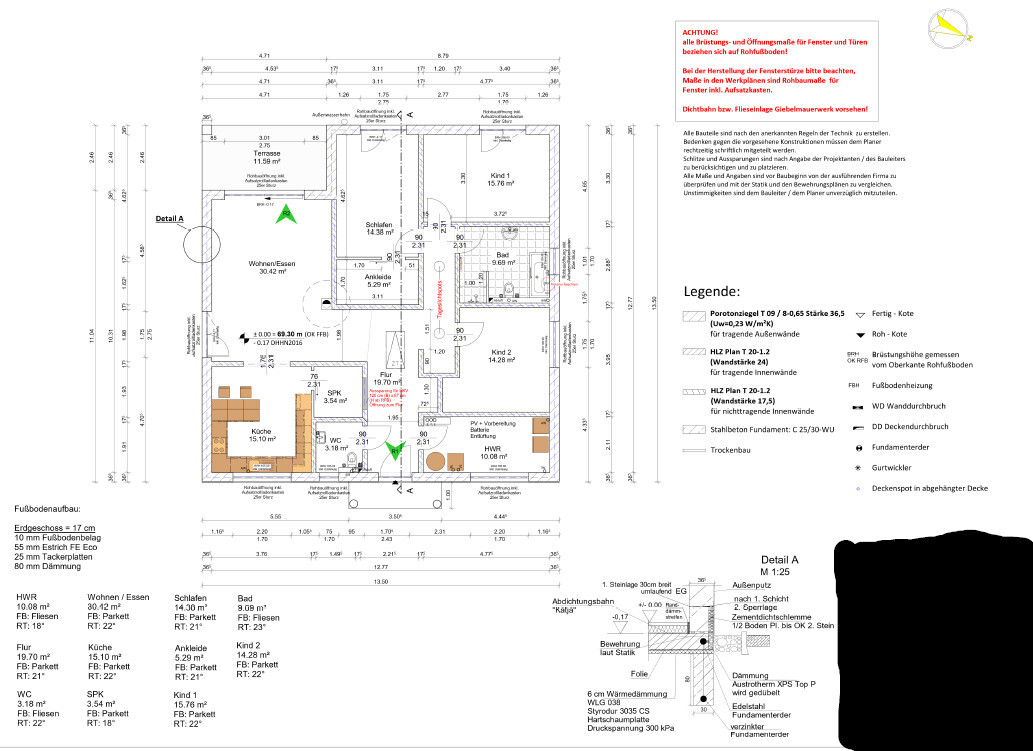
Now about the house. It will be a 144 sqm (1,550 sq ft) bungalow plus a 12 sqm (130 sq ft) covered terrace with the following additions:
- Ceiling height 3.00 m (9.8 ft)
- Electric roller shutters (including smart home integration)
- Double-sided laminated windows (wood-colored; RC3 security rating)
- Brine-to-water heat pump with ground collectors due to water protection area (Bosch Compress 7800i LW)
- Hydraulic balancing of the underfloor heating
- Controlled residential ventilation with heat recovery (Bosch)
- Motion detectors from a security company
- 13 kWp photovoltaic system, including battery preparation
- 10 m³ (2,650 gal) cistern for rainwater use
- Doorbell with video function
- Wallbox preparation for electric vehicle charging
- Exterior lighting
Floor plan attached.
We have not yet finalized financing (although discussions have taken place). So far, we have invested up to €30,000 (approximately $32,000) from our own savings during the planning phase. This is almost all of our equity. However, we continue to save about €2,750 (approximately $2,920) per month. The monthly mortgage payment is expected to be around €1,650 (about $1,750) plus additional costs of approximately €200-250 (about $210-265) (taking into account the photovoltaic system). This means when we move into the house, we will still have savings of at least €1,500 (about $1,590) per month.
The construction contract will be signed within the next few weeks. The prices (recently discussed with the company) correspond to the offer and commitment as of September 2020.
The price per square meter of the house (according to the latest offer and full specification) will be €2,700 (about $2,870). This includes everything, such as painting, flooring, etc. The overall costs are structured as follows:
House: €378,000 (about $402,000)
Land conversion including reclassification: €25,000 (about $26,600)
Additional building costs: €40,000 (about $42,500)
Outdoor facilities: €25,000 (about $26,600)
Total financing volume: €468,000 (about $498,000)
First, a brief introduction about us. He (42.5 years; controller in healthcare), she (38.5 years; full-time teacher), child (8.75 years; fully dependent). Our household net income is currently about €6,400 (approximately $6,800) plus performance bonuses, 13th-month salary, overtime, etc. We own a 1,462 sqm (15,735 sq ft) plot of land in Fichtenwalde. The remaining debt on the land is €37,000 (about $39,000). According to official land value guidelines, the land is valued at €146,200 (about $156,000) (€100 / sqm). The market price is around €400,000 to €600,000 (recent sale prices). We submitted the building permit application including the land conversion at the end of December. We expect approval by mid to late July.
The construction company is KB Brandis from Jüterbog. External site supervision will be handled by Bauherrenhilfe with 13 appointments.
Now about the house. It will be a 144 sqm (1,550 sq ft) bungalow plus a 12 sqm (130 sq ft) covered terrace with the following additions:
- Ceiling height 3.00 m (9.8 ft)
- Electric roller shutters (including smart home integration)
- Double-sided laminated windows (wood-colored; RC3 security rating)
- Brine-to-water heat pump with ground collectors due to water protection area (Bosch Compress 7800i LW)
- Hydraulic balancing of the underfloor heating
- Controlled residential ventilation with heat recovery (Bosch)
- Motion detectors from a security company
- 13 kWp photovoltaic system, including battery preparation
- 10 m³ (2,650 gal) cistern for rainwater use
- Doorbell with video function
- Wallbox preparation for electric vehicle charging
- Exterior lighting
Floor plan attached.
We have not yet finalized financing (although discussions have taken place). So far, we have invested up to €30,000 (approximately $32,000) from our own savings during the planning phase. This is almost all of our equity. However, we continue to save about €2,750 (approximately $2,920) per month. The monthly mortgage payment is expected to be around €1,650 (about $1,750) plus additional costs of approximately €200-250 (about $210-265) (taking into account the photovoltaic system). This means when we move into the house, we will still have savings of at least €1,500 (about $1,590) per month.
The construction contract will be signed within the next few weeks. The prices (recently discussed with the company) correspond to the offer and commitment as of September 2020.
The price per square meter of the house (according to the latest offer and full specification) will be €2,700 (about $2,870). This includes everything, such as painting, flooring, etc. The overall costs are structured as follows:
House: €378,000 (about $402,000)
Land conversion including reclassification: €25,000 (about $26,600)
Additional building costs: €40,000 (about $42,500)
Outdoor facilities: €25,000 (about $26,600)
Total financing volume: €468,000 (about $498,000)
M
motorradsilke10 Nov 2021 08:47Do you really need to have a cistern? I’m not a big fan of them unless they are required. Especially in sandy soil like in the Märkische Sand region, you can let rainwater infiltrate the ground. For watering, a cistern is not very useful on a property like yours. It won’t last long. And when you need water, no new water will be coming in.
motorradsilke schrieb:
Do you really need a cistern? I’m not a big fan of them if they aren’t required. Especially in sandy soil like in the Märkische region, you can just let the rainwater infiltrate naturally. It won’t be much use for watering a lot of land like yours. You won’t get far with it. And when you need water, there won’t be any replenishment.We don’t have to, but we want to. The cistern is 10m3 (10,000 liters / 2,640 gallons), and with a bungalow and a large roof area, quite a bit of water can be collected. Besides, in the summer there will probably be restrictions on using drinking water for the garden. From an economic point of view, it certainly isn’t cost-effective.
M
motorradsilke10 Nov 2021 09:29Tom1978 schrieb:
We don’t have to, but we want to. It’s 10 m³ (350 cubic feet), and with a bungalow and a large roof area, that adds up. Besides, there will likely be a ban on using drinking water for the garden in our area during summer. Economically, it certainly doesn’t make sense. If there is a ban on using drinking water for the garden, your cistern will run dry too. With 10 m³ (350 cubic feet), you can last 2 to 3 days if you are very economical. And then?
The more economical alternative would be to have your own well.
motorradsilke schrieb:
If there is a ban on using drinking water for the garden, your cistern will also be empty. With 10 m³ (353 cubic feet), you can manage for 2 to 3 days if you use water very sparingly. And then?
The economical alternative would be your own well. Not in our case. You would have to drill about 100 m (330 feet) deep, and we are also in a water protection area.
I’d rather water for 3 days longer than not at all or use drinking water.

Tom1978 schrieb:
Better to water for three days longer than not at all or with drinking water.Correct. I installed an 8 cubic meter (about 2,113 gallons) rainwater cistern buried next to our house. Our property is only 700 square meters (about 7,535 square feet) in size. We managed very well through the summer. It was only "almost" empty once. After a good rainfall, it’s full again immediately. We also connected all roof drainage, the carport, and the front paved areas. That adds up quickly.
The cistern is located about 3 meters (10 feet) from the house. It was easy to install from the street during construction. I would definitely do it again. 🙂
Since we built in a protected water catchment area, we could not drill a well or borehole. So the only option was an air-source heat pump. I would have liked to install horizontal ground collectors (trench collectors), but my wife wasn’t keen. Also, the property would not have been suitable, and she wouldn’t have been able to plant her trees anymore.
Similar topics