
Hello!
I'll start.
Heated area 200m2 (2,153 sq ft)
KfW 55 standard
Mechanical ventilation with heat recovery
Current outdoor temperature 6°C (43°F)
Heating energy consumption including hot water 35 kWh
Electricity consumption 9 kWh
COP 3.88
I'll start.
Heated area 200m2 (2,153 sq ft)
KfW 55 standard
Mechanical ventilation with heat recovery
Current outdoor temperature 6°C (43°F)
Heating energy consumption including hot water 35 kWh
Electricity consumption 9 kWh
COP 3.88
T
T_im_Norden9 Jan 2021 22:11Since your pump is probably set to automatic, it is not that simple.
In addition, the different lengths and therefore different pressures of the heating circuits must be taken into account.
In addition, the different lengths and therefore different pressures of the heating circuits must be taken into account.

T_im_Norden schrieb:
@Zaba12
There might still be some margin.
While 5 K (5°C (9°F)) is acceptable, heat pumps often operate with even less.Hmm, in xxxx, a temperature difference of 6-7 K (6-7°C (11-13°F)) is even targeted in heating mode.T
T_im_Norden9 Jan 2021 22:43Depends on the refrigerant, heat pump, minimum flow rate, and hydraulics.
tomtom79 schrieb:
Hmm, in xxxx they are even aiming for a temperature spread of 6-7K in heat operation.I haven’t read that regarding the heat pump over there until now. Achieving 6K would be a success after yesterday and today as well. That would mean a supply temperature of 30°C (86°F). The heat pump probably won’t start running today as long as no hot water is being produced. There are still 2 degrees missing to go below.
Hello, here are the csv and dta files. The temperature differential during heating operation was 5.8K. The maximum flow temperature was 32.0 degrees Celsius (89.6°F). The heating curve is set at 25/20.5/0.
In some rooms, due to the low heating curve, I increased the flow rate again towards the end of the heating cycle, so that the circuits on the ground floor and upper floor are at 1440 liters per hour (380 gallons per hour). If I include the basement with 3 x 0.5 liters per minute (0.13 gallons per minute), the total would be 1530 liters per hour (404 gallons per hour), just below the nominal capacity of 1600 liters per hour (423 gallons per hour).
The temperature differential in standby is now 0.4 (well, not great). I won’t be able to adjust the heating curve for the next two days because we are expecting two days of sunshine.
To the experts here: Can I still adjust the efficiency pump and pump optimization settings, or is the temperature differential still too high?
Any other ideas?
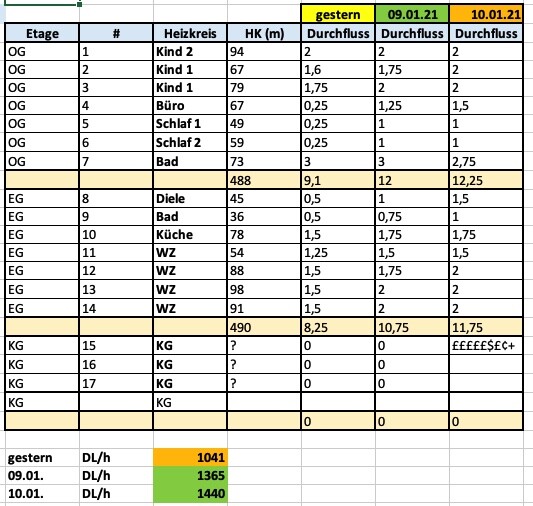
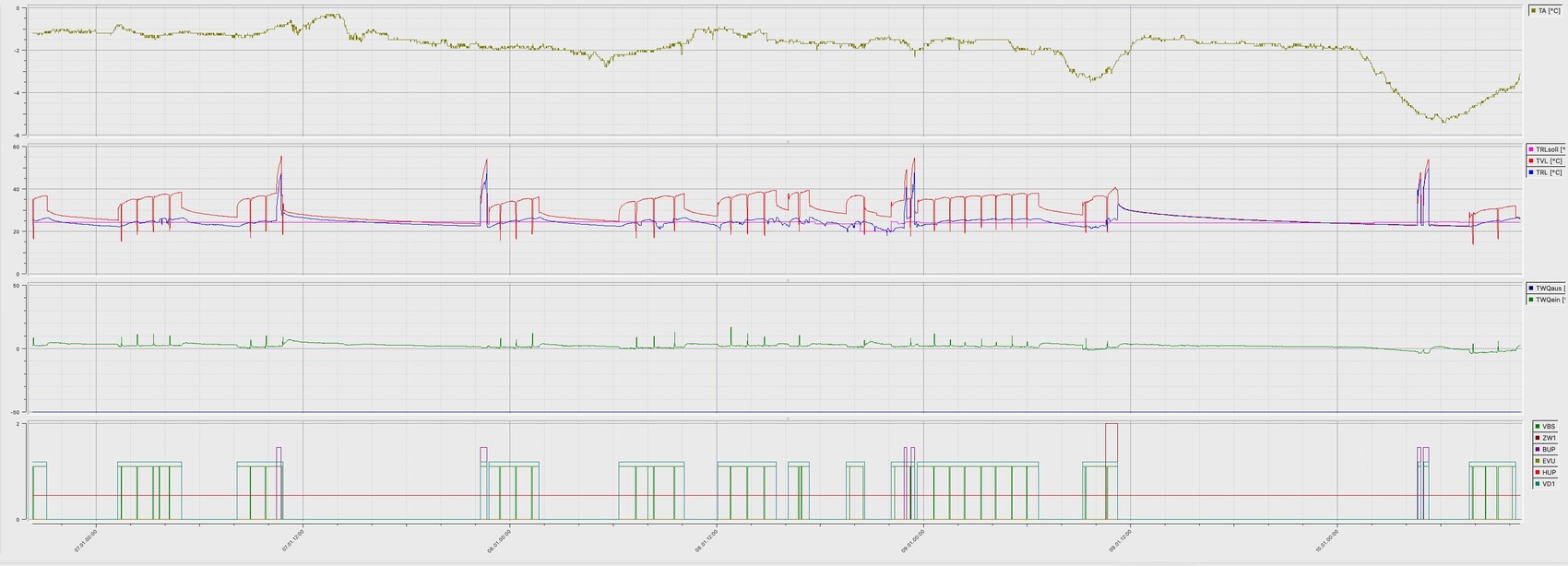

In some rooms, due to the low heating curve, I increased the flow rate again towards the end of the heating cycle, so that the circuits on the ground floor and upper floor are at 1440 liters per hour (380 gallons per hour). If I include the basement with 3 x 0.5 liters per minute (0.13 gallons per minute), the total would be 1530 liters per hour (404 gallons per hour), just below the nominal capacity of 1600 liters per hour (423 gallons per hour).
The temperature differential in standby is now 0.4 (well, not great). I won’t be able to adjust the heating curve for the next two days because we are expecting two days of sunshine.
To the experts here: Can I still adjust the efficiency pump and pump optimization settings, or is the temperature differential still too high?
Any other ideas?
D
Daniel-Sp10 Jan 2021 11:29You can set the pump optimization to 5 minutes.
The heating element is approved from -2°C (28°F), so you can probably lower it further.
Set the efficiency pump minimum to 5 V.
The heating element is approved from -2°C (28°F), so you can probably lower it further.
Set the efficiency pump minimum to 5 V.
Similar topics