
Hello, I have had the Weishaupt split heat pump LS 8 B R E since July, so far only used in summer mode. Today I switched it to heating mode, and the heat pump cycles on and off 6 times between 4 a.m. and 11 a.m. What options do I have to reduce this cycling?
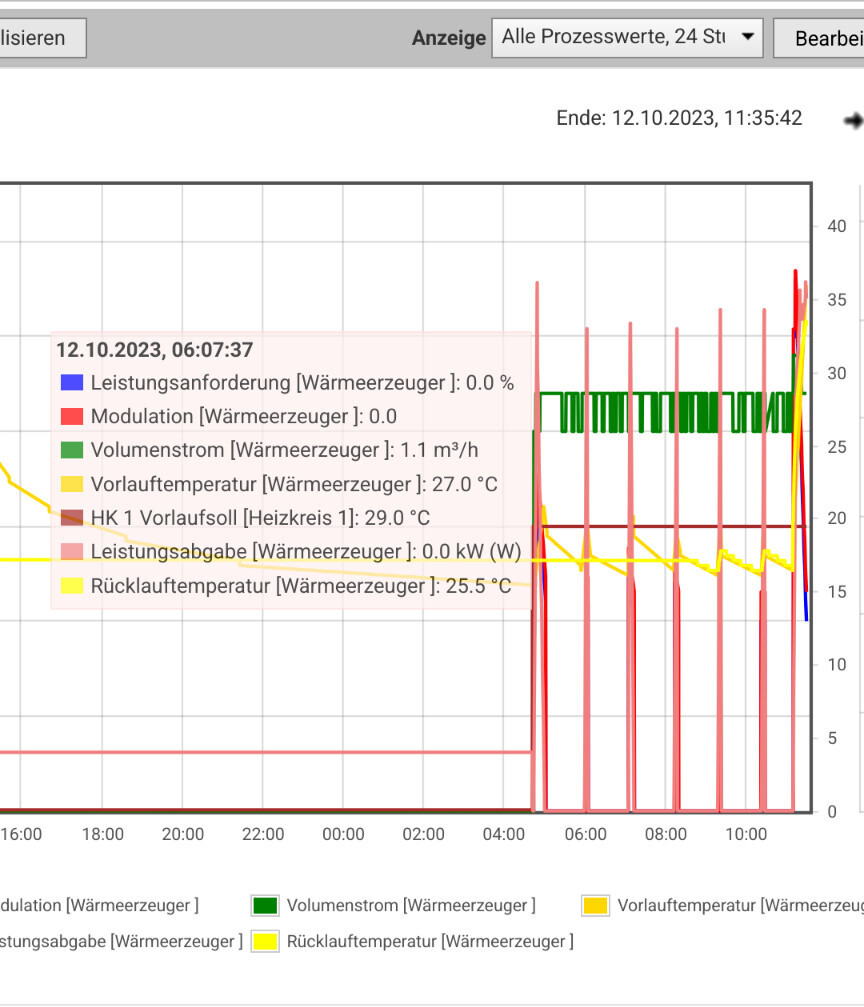
I am new to heat pumps. It is a 120m² (1,292 sq ft) mid-terrace house with 9 radiators, no buffer tank installed. What settings can I use to minimize the heat pump cycling? What settings do you use in the transition period? I would appreciate any tips.
Best regards
I am new to heat pumps. It is a 120m² (1,292 sq ft) mid-terrace house with 9 radiators, no buffer tank installed. What settings can I use to minimize the heat pump cycling? What settings do you use in the transition period? I would appreciate any tips.
Best regards
K
KarstenausNRW16 Oct 2023 15:57RotorMotor schrieb:
@KarstenausNRW how does a Pana prevent short cycling? Like any other heat pump: it doesn’t.
You can only reduce short cycling by having a perfectly designed heating system, possibly with a slightly underpowered heat pump. Short cycling during transitional seasons is simply normal.
For my system, I only set the supply and return temperatures along with the delta T = difference between supply and return. I also set the pump to auto. No heating integrals, no rest mode settings, or other fancy configurations.
There really isn’t much left to adjust on a Pana. Just a whisper mode = lower output for reduced outdoor noise, and a timer.
Keep it simple – that works well. Considering that modern heat pumps are designed for a minimum of about 50,000 to 80,000 cycles (switching between heating and hot water always counts as two cycles, even if the compressor doesn’t start completely cold), 10–15 cycles during transitional periods are perfectly normal. I see no practical reason to create countless adjustment options with fancy names.
50,000 cycles correspond to roughly 20 years of operation on a properly planned heating system (including hot water cycles).
R
RotorMotor16 Oct 2023 19:42KarstenausNRW schrieb:
Like any other heat pump: not at all I would have actually phrased it the other way around.
Every heat pump needs to have some kind of control.
KarstenausNRW schrieb:
I only set the supply and return temperatures along with the delta T = difference between supply and return. How is that supposed to work?
At least a heating curve is required.
And internally, there must be a way to allow temperatures to fluctuate within a certain range.
Do you have any information or logs about this, or is it more of a black box to you that simply works?
K
KarstenausNRW16 Oct 2023 20:01RotorMotor schrieb:
How is that supposed to work?
You definitely need at least a heating curve.
And internally, there should also be the option to allow temperatures to fluctuate within a certain range. By heating curve, I meant supply temperature / return temperature / spread:
This is how you set the heating curve. I’m not including a photo showing the spread = return temperature.
There are actually no further inputs or settings. How should temperatures "fluctuate"? Of course, there is the pump’s maximum output. You can also set it to fixed or automatic.
But in reality, there are no gimmicks—neither internal nor external. And why would there be?
With Pana, you don’t need expensive accessories for the cooling function either. You simply switch it on. It’s nonsense to sell additional accessories for that.
I don’t count dew point sensors as heat pump accessories. You can use them (sensibly), or just run the heat pump based on experience and information you find online.
That’s why I never understand all the heat pump settings threads in this forum. What the German manufacturers came up with is beyond me. Foreign (Asian) equipment is much simpler in design. And there, nobody wants fluctuating temperatures, integral heating controls, sleep modes, cycling protection, etc.
Turn the heating on, set it, and let it run.
R
RotorMotor16 Oct 2023 20:26Too bad, I was hoping you might know how they internally limit the cycling.
In your example, 25°C (77°F) at 15°C (59°F) outside.
This means the heat pump tries to reach a supply temperature of 25°C (77°F).
If the heat pump does not take any measures to avoid frequent cycling, the following would happen:
The heat pump turns on, the supply temperature rises above 25°C (77°F) after a short time, then the heat pump switches off, and the supply temperature drops to 24.9°C (76.8°F).
The heat pump switches on again, the supply temperature rises to 25.1°C (77.2°F), then switches off, and so on. This could happen within seconds or minutes.
So something has to be done:
Lockouts for a certain period.
Building up or breaking down an energy integral.
Allowing hysteresis, etc.
All these measures reduce the (high-frequency) on-off cycling of the compressor.
However, this reduction in cycling inevitably causes some temperature oscillations.
With the large mass of screed, this only becomes noticeable after several hours.
I was interested in what measures Geishas have integrated here.
For example, with the Arotherms, I see the biggest problem being that many people, influenced by the internet, are afraid of damage caused by cycling.
And Vaillant implemented the energy integral too short initially. With the new control boards, they have now doubled it.
KarstenausNRW schrieb:Ah, so you adjust the heating curve, not the supply temperature itself.
By heating curve, I meant supply temperature / return temperature / spread:
That’s how you set the heating curve.
KarstenausNRW schrieb:It’s quite simple: the heating curve defines a target supply temperature.
There actually aren’t any further inputs or information. How should temperatures “oscillate” otherwise?
In your example, 25°C (77°F) at 15°C (59°F) outside.
This means the heat pump tries to reach a supply temperature of 25°C (77°F).
If the heat pump does not take any measures to avoid frequent cycling, the following would happen:
The heat pump turns on, the supply temperature rises above 25°C (77°F) after a short time, then the heat pump switches off, and the supply temperature drops to 24.9°C (76.8°F).
The heat pump switches on again, the supply temperature rises to 25.1°C (77.2°F), then switches off, and so on. This could happen within seconds or minutes.
So something has to be done:
Lockouts for a certain period.
Building up or breaking down an energy integral.
Allowing hysteresis, etc.
All these measures reduce the (high-frequency) on-off cycling of the compressor.
However, this reduction in cycling inevitably causes some temperature oscillations.
With the large mass of screed, this only becomes noticeable after several hours.
I was interested in what measures Geishas have integrated here.
KarstenausNRW schrieb:I fully agree with you.
That’s why I never really understand all the heat pump setting threads here in the forum. What German manufacturers have come up with is a mystery to me. Foreign (Asian) devices are much simpler. There, nobody wants oscillating temperatures, heating integrals, sleep modes, lockouts, etc.
Just turn on the heating, set it, and let it run.
For example, with the Arotherms, I see the biggest problem being that many people, influenced by the internet, are afraid of damage caused by cycling.
And Vaillant implemented the energy integral too short initially. With the new control boards, they have now doubled it.
K
KarstenausNRW16 Oct 2023 21:28RotorMotor schrieb:
It's quite simple: the supply temperature setpoint comes from the heating curve.
In your case, for example, 25 degrees Celsius at 15 degrees Celsius outside.
This means the heat pump initially tries to reach a 25°C (77°F) supply temperature.
If the heat pump did not take any measures to avoid short cycling, the following would happen:
The heat pump turns on, the supply temperature rises, after a short time it exceeds 25°C (77°F), the heat pump switches off, supply temperature drops to 24.9°C (76.8°F).
The heat pump then switches on again, supply temperature rises to 25.1°C (77.2°F), the heat pump switches off, ... and this could happen within seconds or minutes.
That means something has to be done:
Lockouts for a specific time period.
Building up and breaking down an energy integral.
Allowing a hysteresis, etc.
All these measures reduce the (high-frequency) on/off cycling of the compressor.
However, this reduction in cycling always results in some degree of temperature fluctuation.
With the large thermal mass of screed, this only becomes noticeable after several hours.
I was interested in which measures the Geishas have integrated here. And this short cycling actually does not happen. On the one hand, I do not know whether (as was or is the case, for example, with Waterkotte, that I do know) average values from the last 6 / 12 / 24 hours are also taken into account.
On the other hand, it also does not short cycle because the return temperature is correspondingly high. Since the heat pump’s temperature lift (the model from the photo operates with 5°C (9°F)) requires a return temperature of 20°C (68°F). And that is not possible with the current daytime temperatures (and not yet at night or only very early in the morning).
Nothing is actively done by the Pana. If anything happens, it happens solely through the device. None of the mentioned points exist (this was also the case with my previous Waterkotte brine/water heat pump), at least no user inputs (and also not in the installer menu).
And that works excellently. Since the house is still too warm, my two Panas (I have one for each apartment) are not running yet. Otherwise, I would have checked how the cycles look.
And again, for the original poster: just let it run. Whether it is 12 or 11 cycles. Or 14 cycles. It really does not matter at all. It does no harm to the device whatsoever. I have already seen plenty of older heat pumps approaching 70,000–100,000 cycles (and still operating after over 20 years—just like any normal refrigerator).
Or switch from supply/return temperature control to an indoor temperature controlled regulation. Hopefully, that will also be available as an alternative.
R
RotorMotor16 Oct 2023 21:52I have done some research myself.
Panasonic seems to use hysteresis (meaning the difference between the supply temperature setpoint and the actual supply temperature) to control cycling.
This value can apparently be configured using "HeishaMon."
@GePrest have you checked how the behavior changes when you adjust the hysteresis?
Panasonic seems to use hysteresis (meaning the difference between the supply temperature setpoint and the actual supply temperature) to control cycling.
This value can apparently be configured using "HeishaMon."
@GePrest have you checked how the behavior changes when you adjust the hysteresis?
Similar topics