
Hello everyone,
We had a carpenter install a sliding door between the kitchen and the living/dining room. The door was supposed to fully disappear into the wall, but it actually sticks out about 10cm (4 inches) beyond the door frame. The installer’s explanation was that otherwise, the door couldn’t be pulled out of its slot since the recessed handle would always have to remain on the outside.
I thought there were small fold-out hooks or an additional recessed handle on the edge of the door panel for this purpose.
Unfortunately, we did not specify the sliding door details carefully, as I assumed it was standard practice for a built-in door like this to fully slide into the wall.
What are your thoughts?
And could a hook or recessed handle be retrofitted on the edge of the door panel with a reasonable amount of effort? Unfortunately, the guide rail at the bottom has already been screwed into the parquet flooring, so there would likely be visible drill holes left behind, as the rail would also have to be recessed into the wall.
Best regards
We had a carpenter install a sliding door between the kitchen and the living/dining room. The door was supposed to fully disappear into the wall, but it actually sticks out about 10cm (4 inches) beyond the door frame. The installer’s explanation was that otherwise, the door couldn’t be pulled out of its slot since the recessed handle would always have to remain on the outside.
I thought there were small fold-out hooks or an additional recessed handle on the edge of the door panel for this purpose.
Unfortunately, we did not specify the sliding door details carefully, as I assumed it was standard practice for a built-in door like this to fully slide into the wall.
What are your thoughts?
And could a hook or recessed handle be retrofitted on the edge of the door panel with a reasonable amount of effort? Unfortunately, the guide rail at the bottom has already been screwed into the parquet flooring, so there would likely be visible drill holes left behind, as the rail would also have to be recessed into the wall.
Best regards
MachsSelbst schrieb:
The usual daydreaming: "The craftsman should just know what I wanted..." No, you could also call that professional advice. If, in your opinion, that makes me one of those ridiculous daydreamers, I’m not bothered by it—especially considering your usual tone here. I actually take "daydreamer" as a compliment, thanks!
MachsSelbst schrieb:
Even a layperson should be expected to express their wishes somewhat clearly. The sentence "I want the sliding door to disappear into the wall" can easily be said and even written without mistakes by my 7-year-old daughter... so I expect an adult to be able to do the same. You stick to your smart-aleck wording to make the original poster look like an obvious fool who can’t even compare to your obviously gifted daughter (how could it be any different in your case?). Apparently, your daughter has already surpassed you in some areas...
MachsSelbst schrieb:
Accusing the carpenter of lying. Well. The carpenter said, "It can’t be done any other way," even though, as a carpenter, he probably knows it can be done differently. Let’s call it a "deliberate untruth," but basically, he didn’t treat his customer very fairly. To stick with my example: my dentist could have simply pulled some teeth because that’s all he knows or wants to do, while patients of other dentists get root canals and keep their teeth. You might be fine without teeth, why not, but there are other options. For me—and maybe this is odd—the problem isn’t that a mistake happened, but how the professional dealt with the customer and a difficult situation that could have been avoided. Sure, maybe the customer could have known better, but the expert MUST know if they are truly an expert.
MachsSelbst schrieb:
Perhaps this carpenter is very set in his ways and really can’t imagine another solution. Accusations like lying and fraud have to be made very carefully... True, these terms should be checked carefully, preferably by definition. You really should learn from your daughter how to read—there was no mention of "fraud" here, but that’s something you often add in other discussions, inserting words to create a desired impression. Whether one thinks "lie" is the right term is up to each person or can be clarified by looking it up. But the customer was told an untruth, and I find that improper in interpersonal dealings. By the way, a liar isn’t necessarily a fraudster. I admire anyone building a house or person who finds it funny to get a deliberately false answer to a question; I don’t like that, but daydreamers are probably weird anyway.
tomtom79 schrieb:
And that’s exactly the mistake—the door does disappear into the wall, but not completely. The text probably should have said “flush with the surface.” Oh, how great, you couldn’t expose a smart aleck any more accurately. But @MachsSelbst at least would have written it correctly, that the door later simply “disappeared” completely into nowhere, maybe even forever, who knows?
@haeusle-in-bw As you can see, opinions differ. I understand how you feel, but on the other hand, you shouldn’t let it bother you for too long, as such things tend to become less noticeable over time. During our current build, I also encountered several very frustrating issues, some of which were only pointed out by other tradespeople. But once it’s no longer the focus, it’s just a door or passageway that no longer gets much attention in the details. Everyone has some flaws in their build that could be considered blemishes. I would suggest waiting for a longer period and then seeing if it still bothers you. For us, many things that were initially annoying are no longer relevant today, and overall, we are happy with our home.
 ateliersiegel14 Dec 2024 09:43
I can easily imagine that it might be difficult to make this door "disappear," because you possibly won’t be able to access the "rear" part without opening a finished wall. And even if you can reach the back well, the track may not simply be adjustable to a longer length (if it is too short) and might need to be completely redone.
But rather than remain uncertain and dissatisfied, a conversation with the carpenter would be the best option, in my opinion.
But rather than remain uncertain and dissatisfied, a conversation with the carpenter would be the best option, in my opinion.

We have two fully recessed sliding doors made by the carpenter.
One (double-leaf) is usually left open, and it actually looks more elegant when nothing sticks out.
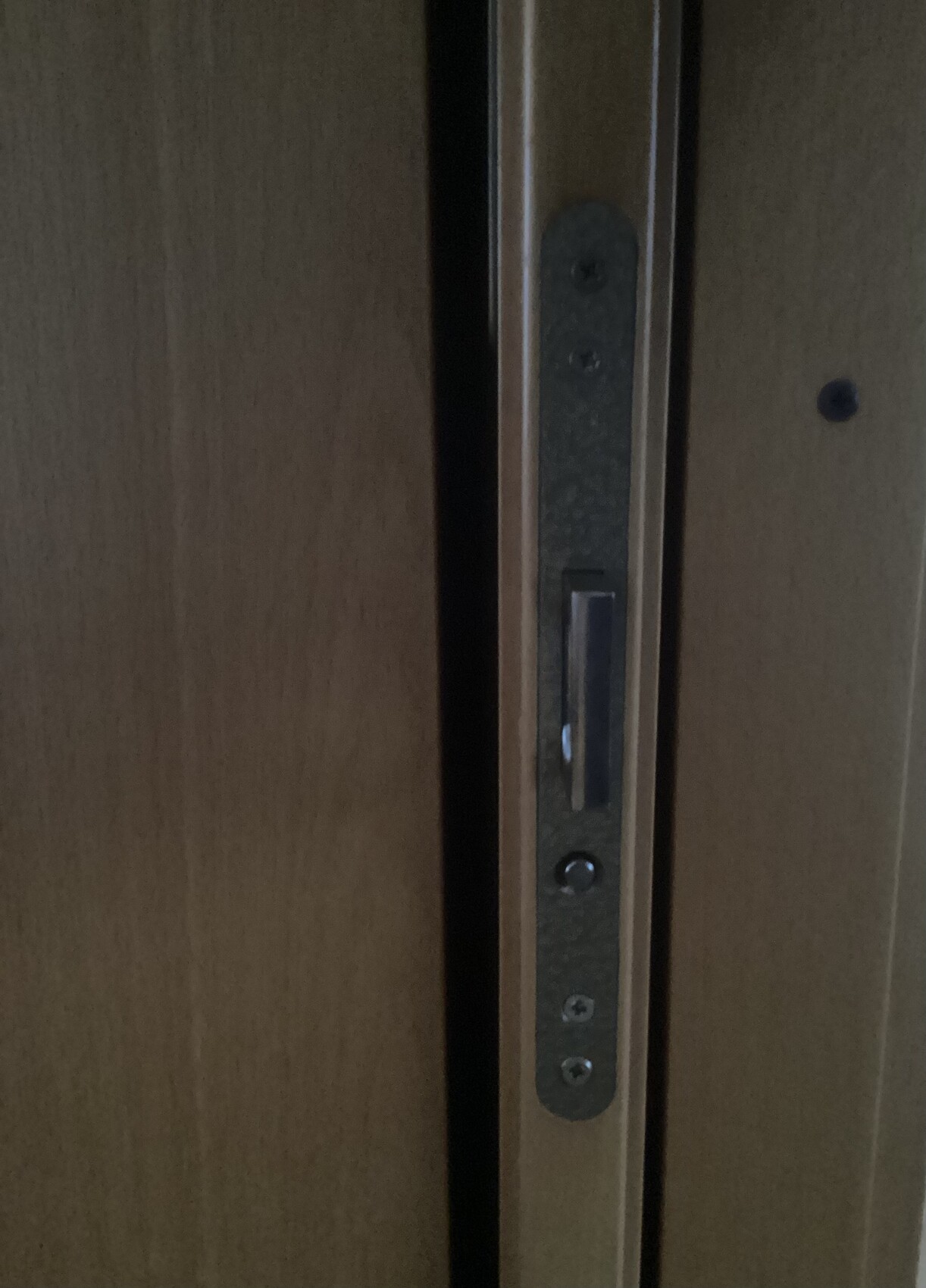
The other one, like yours, is a single-leaf door to the kitchen that is slid closed several times a day. In that case, the fully recessed option is rather annoying because the procedure—“press the button, pull the door closed using the fold-out latch, then push the latch back in, and finally close the door completely”—just takes too long.
We usually let the door stick out a little on purpose or fumble with the door panel inside the recess to be able to close it faster and avoid hurting our fingers on the latch (which can happen if you’re not careful or go too fast).
I would keep it as you have it and appreciate that the door can be closed quickly and that you can’t catch your fingers, as someone already mentioned (this often happens when you’re in a rush).
Attached is a photo of the door with the latch pulled out.
One (double-leaf) is usually left open, and it actually looks more elegant when nothing sticks out.
The other one, like yours, is a single-leaf door to the kitchen that is slid closed several times a day. In that case, the fully recessed option is rather annoying because the procedure—“press the button, pull the door closed using the fold-out latch, then push the latch back in, and finally close the door completely”—just takes too long.
We usually let the door stick out a little on purpose or fumble with the door panel inside the recess to be able to close it faster and avoid hurting our fingers on the latch (which can happen if you’re not careful or go too fast).
I would keep it as you have it and appreciate that the door can be closed quickly and that you can’t catch your fingers, as someone already mentioned (this often happens when you’re in a rush).
Attached is a photo of the door with the latch pulled out.
M
MachsSelbst14 Dec 2024 19:44Oh, a smart aleck. Sure, it’s possible to add more details, but since I just quickly typed this while watching TV, I think my wording is fine.
For a real requirement in a specifications document, one would put more thought into it. To be honest, it wasn’t worth it for me here—the principle should be clear.
The principle is:
You get what you order. No more, because no one does more than they are paid for.
Pretty straightforward, really. Sometimes I wonder what kind of work you all do. With that kind of naivety, we wouldn’t complete a single project with a profit...
For a real requirement in a specifications document, one would put more thought into it. To be honest, it wasn’t worth it for me here—the principle should be clear.
The principle is:
You get what you order. No more, because no one does more than they are paid for.
Pretty straightforward, really. Sometimes I wonder what kind of work you all do. With that kind of naivety, we wouldn’t complete a single project with a profit...
Similar topics