
ᐅ Irrigation – Detailed Planning and Fundamental Considerations
Created on: 23 Apr 2020 17:14
O
opalau
After completing the house construction, moving in, and with summer approaching, we are increasingly focusing on the garden. Since we currently have a barren plot, I will plan the irrigation system as soon as possible to start by digging the trenches.
A few months ago, I thought I was clever by having a well drilled. Unfortunately, I failed to research further and was only pleased with the low price of the driven well. Now I am beginning to suspect that this might not have been such a smart decision.
Once these basic questions are clarified, I would like to focus on detailed planning. I have already attached a first version. Our plot is relatively narrow and long—about 15 by 75 meters (50 by 246 feet)—but so far it does not seem to pose a major problem.
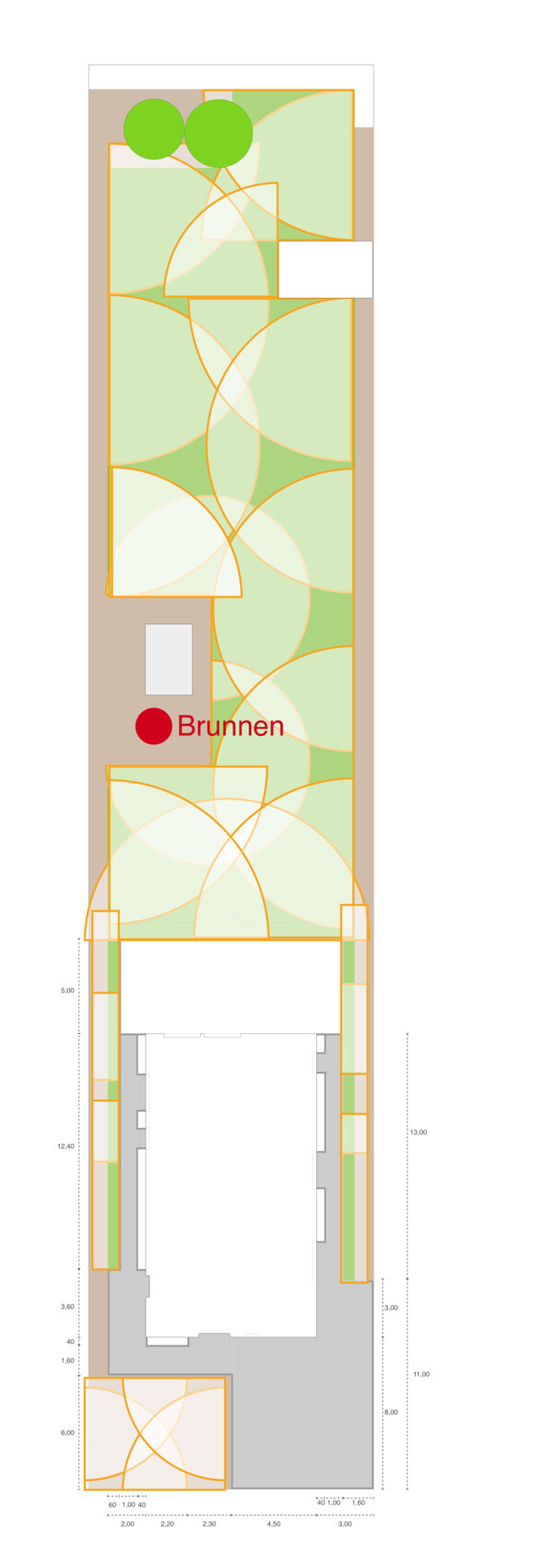
A few months ago, I thought I was clever by having a well drilled. Unfortunately, I failed to research further and was only pleased with the low price of the driven well. Now I am beginning to suspect that this might not have been such a smart decision.
- Apparently, you should not extract more than about 900 liters per hour (~240 gallons per hour) from a driven well to minimize the risk of incrustation. This is bad news for the number of sprinkler heads. I should have done better research beforehand…
- Yesterday, I made a first attempt by connecting the suction pump (Grundfos JP5), which the well driller "included." Using the “bucket method” and a pressure gauge set to 3.5 bar (2.8 bar for Hunter rotators plus 0.7 bar system loss), only a trickle comes out. (Without back pressure, my pump provides about 1800 liters per hour (~475 gallons per hour), with the valve closed about 3.9 bar is registered.) When I mentioned this to the well driller, he did not understand the problem and said that with 1800 liters per hour I could flood my property within a few hours. Am I misunderstanding the method?
- Assuming the situation is as poor as feared, what could be a possible solution? Getting a buffer tank (1000–2000 liters [260–530 gallons]), letting the suction pump keep it full, and then using a submersible pump in the tank to supply the irrigation system? Any other ideas?
Once these basic questions are clarified, I would like to focus on detailed planning. I have already attached a first version. Our plot is relatively narrow and long—about 15 by 75 meters (50 by 246 feet)—but so far it does not seem to pose a major problem.

@opalau You have already done many things correctly. Your irrigation plan looks well thought out (over-irrigation, coverage, etc.). Your well contractor doesn’t know much. 1800 liters distributed over one zone is not much. Watering twice a week for an hour with rotors means about 20 liters per m2 (2 gallons per ft2).
There is a mistake in your bucket method calculation. The volume is measured without backpressure (so in your case 1800 liters per hour). Due to losses, it will be somewhat less. With your pressure reducer, you have basically connected a maximum irrigation zone and are trying to add another one behind it.
Now, to your actual problem: 1800 liters per hour is not much, and you will have many zones. Considering line losses and some safety margin, you can expect a maximum of 1400 liters per hour. The idea of a buffer tank is very good. However, you should size it a bit larger so you can fill the buffer tank from the well gently on non-watering days or during the day.
For the tank, use an affordable submersible pump. That will give you more flow rate.
For example, available at the big supply store:
T.I.P. 30082 deep well pump stainless steel AJ 4 Plus 100/57 AUT with integrated electronic pump control, up to 6000 liters per hour flow rate
There is a mistake in your bucket method calculation. The volume is measured without backpressure (so in your case 1800 liters per hour). Due to losses, it will be somewhat less. With your pressure reducer, you have basically connected a maximum irrigation zone and are trying to add another one behind it.
Now, to your actual problem: 1800 liters per hour is not much, and you will have many zones. Considering line losses and some safety margin, you can expect a maximum of 1400 liters per hour. The idea of a buffer tank is very good. However, you should size it a bit larger so you can fill the buffer tank from the well gently on non-watering days or during the day.
For the tank, use an affordable submersible pump. That will give you more flow rate.
For example, available at the big supply store:
T.I.P. 30082 deep well pump stainless steel AJ 4 Plus 100/57 AUT with integrated electronic pump control, up to 6000 liters per hour flow rate
Hi @rick2018,
thank you for confirming that I made a conceptual mistake. (I just reread how it is described in the DVS guidelines, and I think I misunderstood the concept of "zapfen" there.)
In my setup, I mainly have half-circle and quarter-circle 3000-series rotors, so around 200–420 L/h (50–110 gallons per hour). I planned the above configuration with 6 zones and tried to avoid exceeding about 1000 L/h (260 gallons per hour) per zone.
I didn’t find 6 zones to be too bad. Is it really that problematic? I thought that in the early morning hours I could easily water half of the zones and then work through the rest in a 2-day cycle.
Or are there other reasons to have fewer but larger zones? What advantage do I get if the T.I.P. pump provides such a flow rate that I only have, for example, 3 zones, aside from it being faster and saving some Hunter equipment?
I’m a bit hesitant to make the overall system (2 pumps, float switch, etc.) too complex. Especially now that I have been reassured I can manage 1800 L/h (475 gallons per hour) minus losses and clogging buffer.
thank you for confirming that I made a conceptual mistake. (I just reread how it is described in the DVS guidelines, and I think I misunderstood the concept of "zapfen" there.)
In my setup, I mainly have half-circle and quarter-circle 3000-series rotors, so around 200–420 L/h (50–110 gallons per hour). I planned the above configuration with 6 zones and tried to avoid exceeding about 1000 L/h (260 gallons per hour) per zone.
I didn’t find 6 zones to be too bad. Is it really that problematic? I thought that in the early morning hours I could easily water half of the zones and then work through the rest in a 2-day cycle.
Or are there other reasons to have fewer but larger zones? What advantage do I get if the T.I.P. pump provides such a flow rate that I only have, for example, 3 zones, aside from it being faster and saving some Hunter equipment?
I’m a bit hesitant to make the overall system (2 pumps, float switch, etc.) too complex. Especially now that I have been reassured I can manage 1800 L/h (475 gallons per hour) minus losses and clogging buffer.
Your irrigation will run about 30 minutes to 1 hour per zone.
In theory, it’s sufficient to start irrigation after midnight (or later if using a 30-minute cycle).
Otherwise, you can split the zones over different days, as you already mentioned.
You shouldn’t need to irrigate more than 2-3 times per week.
Six zones is not much.
The booster pump was only intended if you use a cistern as a buffer.
Using a cistern as a buffer requires, as you have noticed, increased monitoring and financial investment.
Start with your existing pump and well. If problems arise, you can always replace the pump.
What type of pipe have you planned? PE-HD PN26 DN25?
With that, you can theoretically achieve around 3000 liters per hour (about 792 gallons per hour) at your pressure.
If you want to reduce pipe losses, you could consider using DN32 pipe instead.
Your system is mainly limited by the pump. Since you designed your zones for approximately 1000 liters per hour (about 264 gallons per hour), it should work.
In theory, it’s sufficient to start irrigation after midnight (or later if using a 30-minute cycle).
Otherwise, you can split the zones over different days, as you already mentioned.
You shouldn’t need to irrigate more than 2-3 times per week.
Six zones is not much.
The booster pump was only intended if you use a cistern as a buffer.
Using a cistern as a buffer requires, as you have noticed, increased monitoring and financial investment.
Start with your existing pump and well. If problems arise, you can always replace the pump.
What type of pipe have you planned? PE-HD PN26 DN25?
With that, you can theoretically achieve around 3000 liters per hour (about 792 gallons per hour) at your pressure.
If you want to reduce pipe losses, you could consider using DN32 pipe instead.
Your system is mainly limited by the pump. Since you designed your zones for approximately 1000 liters per hour (about 264 gallons per hour), it should work.

To be honest, I think this circular irrigation plan is kind of pointless. The large square sprinklers from Gardena already cover the entire width of your property. I believe with just two, you could cover the whole lawn area and precisely adjust the width and throw distance. You’ll need a bit of water pressure, of course.
It also depends on what you want to grow. A golf course lawn, which is mowed every day, obviously needs watering every day as well. However, that’s not really ideal—just to be clear.
A natural meadow can go 2 or 3 days without water and is much easier to maintain. You could nicely establish this in the rear part of the property. From my experience, trees and shrubs do best with a drip line directly at the trunk, especially while they are still growing in.
It also depends on what you want to grow. A golf course lawn, which is mowed every day, obviously needs watering every day as well. However, that’s not really ideal—just to be clear.
A natural meadow can go 2 or 3 days without water and is much easier to maintain. You could nicely establish this in the rear part of the property. From my experience, trees and shrubs do best with a drip line directly at the trunk, especially while they are still growing in.
Similar topics