
ᐅ Irrigation – Detailed Planning and Fundamental Considerations
Created on: 23 Apr 2020 17:14
O
opalau
After completing the house construction, moving in, and with summer approaching, we are increasingly focusing on the garden. Since we currently have a barren plot, I will plan the irrigation system as soon as possible to start by digging the trenches.
A few months ago, I thought I was clever by having a well drilled. Unfortunately, I failed to research further and was only pleased with the low price of the driven well. Now I am beginning to suspect that this might not have been such a smart decision.
Once these basic questions are clarified, I would like to focus on detailed planning. I have already attached a first version. Our plot is relatively narrow and long—about 15 by 75 meters (50 by 246 feet)—but so far it does not seem to pose a major problem.
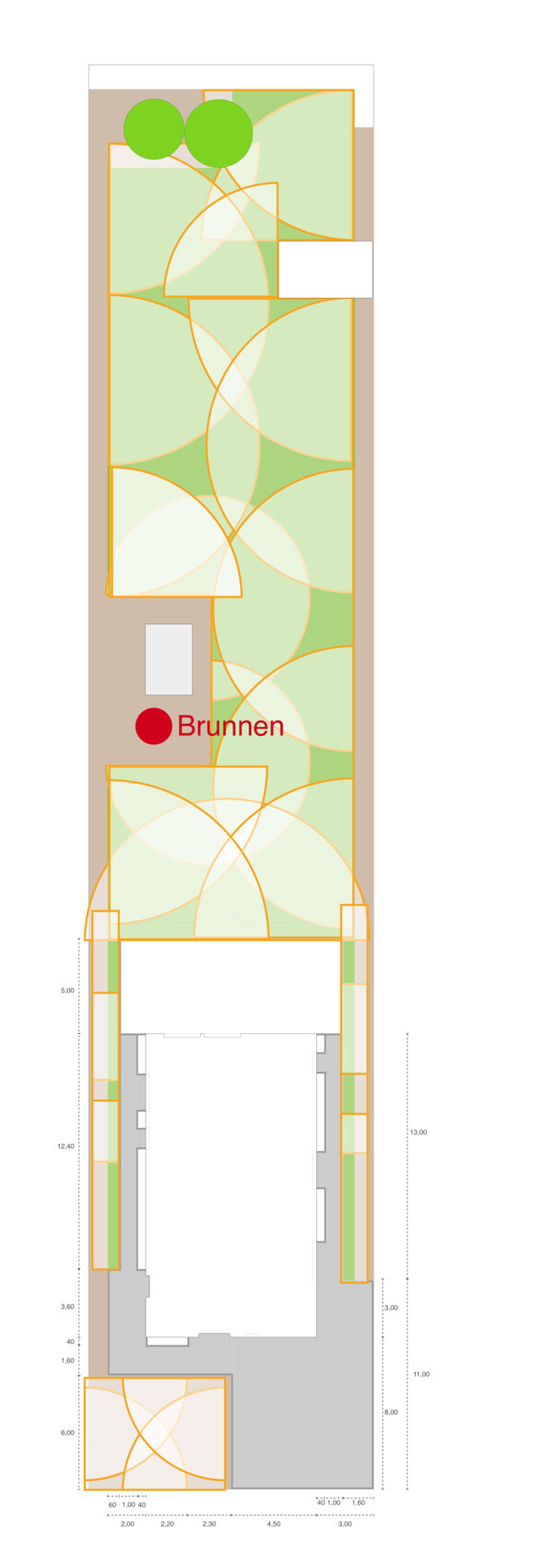
A few months ago, I thought I was clever by having a well drilled. Unfortunately, I failed to research further and was only pleased with the low price of the driven well. Now I am beginning to suspect that this might not have been such a smart decision.
- Apparently, you should not extract more than about 900 liters per hour (~240 gallons per hour) from a driven well to minimize the risk of incrustation. This is bad news for the number of sprinkler heads. I should have done better research beforehand…
- Yesterday, I made a first attempt by connecting the suction pump (Grundfos JP5), which the well driller "included." Using the “bucket method” and a pressure gauge set to 3.5 bar (2.8 bar for Hunter rotators plus 0.7 bar system loss), only a trickle comes out. (Without back pressure, my pump provides about 1800 liters per hour (~475 gallons per hour), with the valve closed about 3.9 bar is registered.) When I mentioned this to the well driller, he did not understand the problem and said that with 1800 liters per hour I could flood my property within a few hours. Am I misunderstanding the method?
- Assuming the situation is as poor as feared, what could be a possible solution? Getting a buffer tank (1000–2000 liters [260–530 gallons]), letting the suction pump keep it full, and then using a submersible pump in the tank to supply the irrigation system? Any other ideas?
Once these basic questions are clarified, I would like to focus on detailed planning. I have already attached a first version. Our plot is relatively narrow and long—about 15 by 75 meters (50 by 246 feet)—but so far it does not seem to pose a major problem.

rick2018 schrieb:
Trees of the specified species and age involve a high four-figure amount plus installation.And don’t forget about maintenance! Usually, it’s included, but there is a reason for the saying: "You don’t transplant an old tree." You can care for it for years, and it will probably still look unhealthy (no leaves, branches dying off, etc.).
No maintenance is included in that.
The trees we want aren’t huge yet, but they are already large specimens.
Some tree species really are no longer suitable for transplanting once they reach a certain size.
Very large trees tend to cost five to six figures (old specimen trees).
Regarding large trees, you are mistaken. Transport always takes place outside the growing season. Usually, there are no problems if the tree is properly prepared and cared for. Afterward, you can no longer tell what is newly planted in the garden and what isn’t.
Here is an example (not my house) about one year after landscaping. Can you tell what is new and what is old?

The trees we want aren’t huge yet, but they are already large specimens.
Some tree species really are no longer suitable for transplanting once they reach a certain size.
Very large trees tend to cost five to six figures (old specimen trees).
Regarding large trees, you are mistaken. Transport always takes place outside the growing season. Usually, there are no problems if the tree is properly prepared and cared for. Afterward, you can no longer tell what is newly planted in the garden and what isn’t.
Here is an example (not my house) about one year after landscaping. Can you tell what is new and what is old?
rick2018 schrieb:
Do you know what is new or old?
OMG! Luckily, taste is hard to argue about. Everything looks like new and just placed there, if you ask me.By now, the garden is fully grown and provides shelter and food for many animals. This is just a small section.
You have to like the type of park-like garden. @kaho674, you probably prefer wilder gardens.
It was also featured in a home design magazine a few years ago.
This garden feels like a vacation. There is always something blooming, and animals are active.
Without automatic irrigation and a gardener every day, such a garden cannot be maintained.
You have to like the type of park-like garden. @kaho674, you probably prefer wilder gardens.
It was also featured in a home design magazine a few years ago.
This garden feels like a vacation. There is always something blooming, and animals are active.
Without automatic irrigation and a gardener every day, such a garden cannot be maintained.
rick2018 schrieb:
You need to like the style of park-like gardens. @kaho674, you probably prefer wild gardens.
Yes, my ultimate goal is more along those lines:
I have to admit, though, that my partner is not completely convinced yet. So far, I only have small "islands" that I’m allowed to let grow wild. Well, I’m working on it. Just getting started. Slow and steady...
Similar topics