
ᐅ Make the water line from the rainwater cistern frost-proof
Created on: 23 Oct 2019 07:01
C
Changeling
I have a cistern with a pump that I used to water my garden during the summer. Since there wasn’t enough time in spring before moving in (and also because the final position of the outlet wasn’t decided yet), I simply connected a garden hose to the pump, which now runs above ground to the outlet (spigot). Here is a sketch:
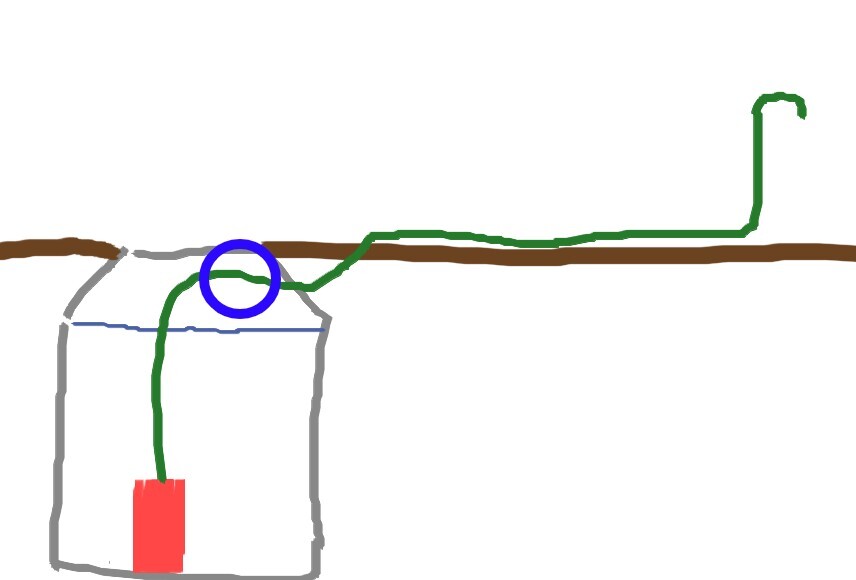
My question: How can I make this frost-proof? My idea was to install some kind of valve at the blue circle, which I would open in winter to drain all the water from the hose back into the cistern. The pump would of course be turned off (I don’t need water in winter).
Are there better solutions for this setup? How have you dealt with similar situations? I’d prefer not to completely remove the pump every winter unless it significantly extends the pump’s lifespan.
My question: How can I make this frost-proof? My idea was to install some kind of valve at the blue circle, which I would open in winter to drain all the water from the hose back into the cistern. The pump would of course be turned off (I don’t need water in winter).
Are there better solutions for this setup? How have you dealt with similar situations? I’d prefer not to completely remove the pump every winter unless it significantly extends the pump’s lifespan.

C
Changeling24 Oct 2019 06:57Thank you very much for the responses!
I’m still unsure whether to stick with the hose or install piping, since it won’t be decided until next year if we’ll add a garden shed and set up a tap there.
Either way, it looks like I’ll need the T-piece with a valve and to drain everything in winter, so I’ll proceed as described by @Gartenfreund and @rick2018. First, I’ll cut the hose at the blue circle and install the T-piece, then drain it in winter. A quick connector would probably be sufficient for the hose.
Later, when the planning and all water points are finalized, upgrading to piping sounds appealing. Many thanks to @rick2018 for the suggestion of “PE-HD pressure pipe.”
I’m still unsure whether to stick with the hose or install piping, since it won’t be decided until next year if we’ll add a garden shed and set up a tap there.
Either way, it looks like I’ll need the T-piece with a valve and to drain everything in winter, so I’ll proceed as described by @Gartenfreund and @rick2018. First, I’ll cut the hose at the blue circle and install the T-piece, then drain it in winter. A quick connector would probably be sufficient for the hose.
Later, when the planning and all water points are finalized, upgrading to piping sounds appealing. Many thanks to @rick2018 for the suggestion of “PE-HD pressure pipe.”
G
Grantlhaua24 Oct 2019 08:34I will control my pump through the smart home system anyway, so that my weather station automatically shuts off the pump when temperatures drop below freezing. Additionally, I am considering whether to also drain the pipes using an electronic valve.
Have you planned something similar?
Have you planned something similar?
You don’t need to control the pump through the smart home system, but the valves. The pump detects the pressure drop and then starts automatically. For the pump, just an on/off switch is enough. This can, of course, also be integrated into the smart home system.
With the weather station, you’ll stop watering before winter anyway. The individual zones then need to be drained. The easiest way is to use compressed air and cycle through the valves. It’s quick.
We are also planning an automatic irrigation system, but with a large pump and thick pipes...
There are a total of 28 valves/zones.
A valve will be installed at the outlet of the cistern/pump, but for manual operation. In autumn, it’s useful to check the cistern anyway to see if the bottom needs vacuuming...
An automatic valve in a 60mm (2.4 inch) pipe would be too expensive for me. Especially since, with only annual operation, it probably wouldn’t work reliably either.
With the weather station, you’ll stop watering before winter anyway. The individual zones then need to be drained. The easiest way is to use compressed air and cycle through the valves. It’s quick.
We are also planning an automatic irrigation system, but with a large pump and thick pipes...
There are a total of 28 valves/zones.
A valve will be installed at the outlet of the cistern/pump, but for manual operation. In autumn, it’s useful to check the cistern anyway to see if the bottom needs vacuuming...
An automatic valve in a 60mm (2.4 inch) pipe would be too expensive for me. Especially since, with only annual operation, it probably wouldn’t work reliably either.
C
Changeling24 Oct 2019 09:18I share Rick’s view—I don’t need a smart home system in this case. I will monitor the water level using a sensor, but the valve or quick coupling will be operated manually.
A large irrigation system is not planned at the moment, only 1 to 3 water outlets. Maybe later, if I get bored, but right now we are fully occupied with the construction.
A large irrigation system is not planned at the moment, only 1 to 3 water outlets. Maybe later, if I get bored, but right now we are fully occupied with the construction.
Similar topics