
ᐅ Irrigation – Detailed Planning and Fundamental Considerations
Created on: 23 Apr 2020 17:14
O
opalau
After completing the house construction, moving in, and with summer approaching, we are increasingly focusing on the garden. Since we currently have a barren plot, I will plan the irrigation system as soon as possible to start by digging the trenches.
A few months ago, I thought I was clever by having a well drilled. Unfortunately, I failed to research further and was only pleased with the low price of the driven well. Now I am beginning to suspect that this might not have been such a smart decision.
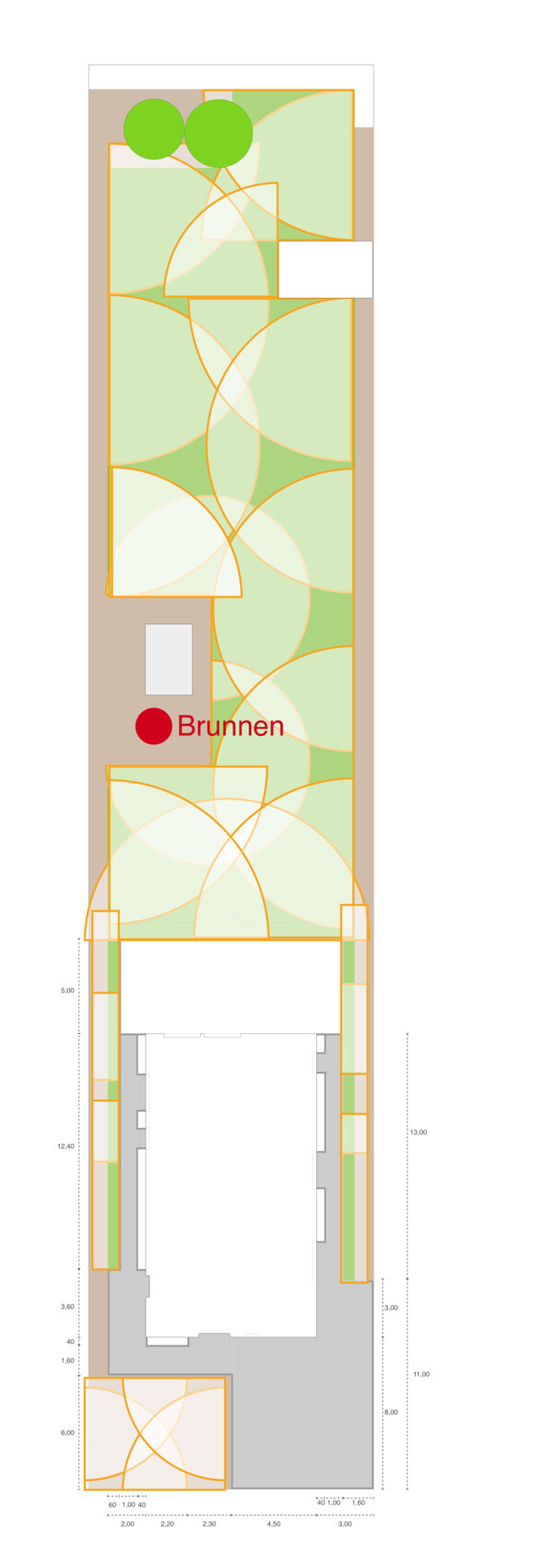
Once these basic questions are clarified, I would like to focus on detailed planning. I have already attached a first version. Our plot is relatively narrow and long—about 15 by 75 meters (50 by 246 feet)—but so far it does not seem to pose a major problem.
A few months ago, I thought I was clever by having a well drilled. Unfortunately, I failed to research further and was only pleased with the low price of the driven well. Now I am beginning to suspect that this might not have been such a smart decision.
- Apparently, you should not extract more than about 900 liters per hour (~240 gallons per hour) from a driven well to minimize the risk of incrustation. This is bad news for the number of sprinkler heads. I should have done better research beforehand…
- Yesterday, I made a first attempt by connecting the suction pump (Grundfos JP5), which the well driller "included." Using the “bucket method” and a pressure gauge set to 3.5 bar (2.8 bar for Hunter rotators plus 0.7 bar system loss), only a trickle comes out. (Without back pressure, my pump provides about 1800 liters per hour (~475 gallons per hour), with the valve closed about 3.9 bar is registered.) When I mentioned this to the well driller, he did not understand the problem and said that with 1800 liters per hour I could flood my property within a few hours. Am I misunderstanding the method?
- Assuming the situation is as poor as feared, what could be a possible solution? Getting a buffer tank (1000–2000 liters [260–530 gallons]), letting the suction pump keep it full, and then using a submersible pump in the tank to supply the irrigation system? Any other ideas?
Once these basic questions are clarified, I would like to focus on detailed planning. I have already attached a first version. Our plot is relatively narrow and long—about 15 by 75 meters (50 by 246 feet)—but so far it does not seem to pose a major problem.

@opalau
You don’t need valves with pressure regulation.
These are only used when operating valve boxes with high pressure (>6-8 bar (87-116 psi) or more). That is not the case for you (and most others).
This is done to achieve a high flow rate even over longer distances in the supply line.
Your pressure is within the working range of the sprinkler housings directly behind the pump, so you don’t need to reduce the pressure.
You can therefore use standard valves (32mm (1.25 inches)!).
For the sprinkler housings, use the pressure-regulating PROS-04-PRS40-CV. This regulates the pressure directly at the sprinkler head to 2.8 bar (41 psi). The maximum pressure your pump produces applies throughout the system. As long as the pressure in the line is above 2.8 bar (41 psi), each sprinkler head will have 2.8 bar (41 psi) regardless of its position in the line.
For drip irrigation, I recommend the XFS Dripline. It can be operated up to 4.14 bar (60 psi). Therefore, you do not need a pressure reducer and can connect it directly.
If the pressure is higher or you use a dripline that operates only at 1.8 bar (26 psi), install a pressure reducer directly before the start of the dripline (about 12 euros per zone).
Drip irrigation requires different fittings (16mm (0.63 inches) or 17mm (0.67 inches)). Simply connect your 32mm (1.25 inches) pipe with a reducing fitting to a 3/4" external thread (if unavailable, use internal thread and adapter) to the "drip fittings."
You don’t need valves with pressure regulation.
These are only used when operating valve boxes with high pressure (>6-8 bar (87-116 psi) or more). That is not the case for you (and most others).
This is done to achieve a high flow rate even over longer distances in the supply line.
Your pressure is within the working range of the sprinkler housings directly behind the pump, so you don’t need to reduce the pressure.
You can therefore use standard valves (32mm (1.25 inches)!).
For the sprinkler housings, use the pressure-regulating PROS-04-PRS40-CV. This regulates the pressure directly at the sprinkler head to 2.8 bar (41 psi). The maximum pressure your pump produces applies throughout the system. As long as the pressure in the line is above 2.8 bar (41 psi), each sprinkler head will have 2.8 bar (41 psi) regardless of its position in the line.
For drip irrigation, I recommend the XFS Dripline. It can be operated up to 4.14 bar (60 psi). Therefore, you do not need a pressure reducer and can connect it directly.
If the pressure is higher or you use a dripline that operates only at 1.8 bar (26 psi), install a pressure reducer directly before the start of the dripline (about 12 euros per zone).
Drip irrigation requires different fittings (16mm (0.63 inches) or 17mm (0.67 inches)). Simply connect your 32mm (1.25 inches) pipe with a reducing fitting to a 3/4" external thread (if unavailable, use internal thread and adapter) to the "drip fittings."
Just as additional experience: I also use Hunter MP systems myself, which work really well without any issues. I have 4 zones and can control each zone individually via solenoid valves through my home automation system. The installation is straightforward, and all components feel very sturdy.
Be sure to install the control cable inside an empty conduit. This way, you can replace it later without having to dig up the garden (and it will be protected from rodents chewing on it).
Label your valves so that you can immediately identify which valve controls which zone at the box.
In the Hydrawise app, you can name the zones and add symbols as well as pictures.
Label your valves so that you can immediately identify which valve controls which zone at the box.
In the Hydrawise app, you can name the zones and add symbols as well as pictures.
I mainly use Openhab plus Z-Wave.
I was actually planning to get a soil moisture sensor and automate it afterwards, but other projects currently have priority. For now, I still have to press a button in my app, which then runs the 4 zones once and waters with 15 liters per square meter (about 0.33 gallons per square foot). The frequency is still based on guesswork (usually about every 3 days during periods without rain), but it works quite well.
I was actually planning to get a soil moisture sensor and automate it afterwards, but other projects currently have priority. For now, I still have to press a button in my app, which then runs the 4 zones once and waters with 15 liters per square meter (about 0.33 gallons per square foot). The frequency is still based on guesswork (usually about every 3 days during periods without rain), but it works quite well.
Similar topics