
ᐅ Irrigation – Detailed Planning and Fundamental Considerations
Created on: 23 Apr 2020 17:14
O
opalau
After completing the house construction, moving in, and with summer approaching, we are increasingly focusing on the garden. Since we currently have a barren plot, I will plan the irrigation system as soon as possible to start by digging the trenches.
A few months ago, I thought I was clever by having a well drilled. Unfortunately, I failed to research further and was only pleased with the low price of the driven well. Now I am beginning to suspect that this might not have been such a smart decision.
Once these basic questions are clarified, I would like to focus on detailed planning. I have already attached a first version. Our plot is relatively narrow and long—about 15 by 75 meters (50 by 246 feet)—but so far it does not seem to pose a major problem.
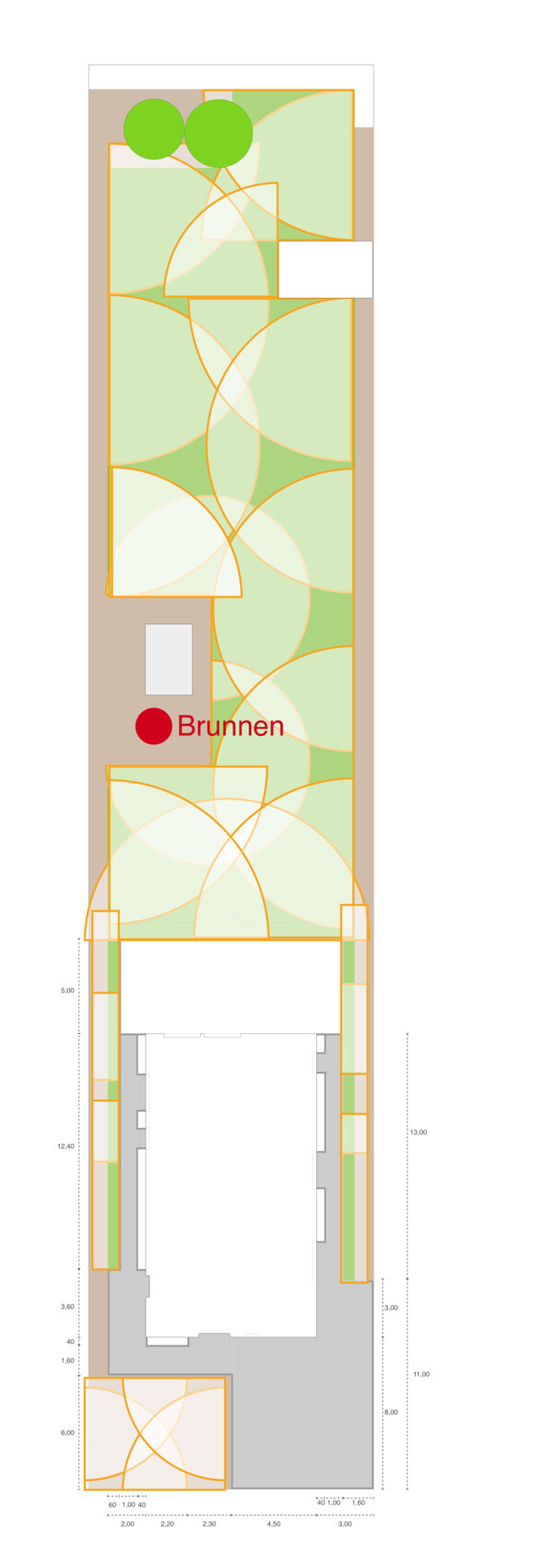
A few months ago, I thought I was clever by having a well drilled. Unfortunately, I failed to research further and was only pleased with the low price of the driven well. Now I am beginning to suspect that this might not have been such a smart decision.
- Apparently, you should not extract more than about 900 liters per hour (~240 gallons per hour) from a driven well to minimize the risk of incrustation. This is bad news for the number of sprinkler heads. I should have done better research beforehand…
- Yesterday, I made a first attempt by connecting the suction pump (Grundfos JP5), which the well driller "included." Using the “bucket method” and a pressure gauge set to 3.5 bar (2.8 bar for Hunter rotators plus 0.7 bar system loss), only a trickle comes out. (Without back pressure, my pump provides about 1800 liters per hour (~475 gallons per hour), with the valve closed about 3.9 bar is registered.) When I mentioned this to the well driller, he did not understand the problem and said that with 1800 liters per hour I could flood my property within a few hours. Am I misunderstanding the method?
- Assuming the situation is as poor as feared, what could be a possible solution? Getting a buffer tank (1000–2000 liters [260–530 gallons]), letting the suction pump keep it full, and then using a submersible pump in the tank to supply the irrigation system? Any other ideas?
Once these basic questions are clarified, I would like to focus on detailed planning. I have already attached a first version. Our plot is relatively narrow and long—about 15 by 75 meters (50 by 246 feet)—but so far it does not seem to pose a major problem.

rick2018 schrieb:
You can also plant large trees... otherwise, they’ll only provide shade for your grandchildren.
Unfortunately, this is often a misconception. Proper transplanting of large trees is a specialty on its own and not everyone can afford the tens of thousands extra. The result is also not always what you expect.On the other hand, if you choose the budget option with, let’s say, a 3m (10 ft) trunk height tree, you don’t gain any time at all. Quite the opposite. While our 3m (10 ft) tree is still struggling with the transplant shock, seedlings grown from seed have already surpassed it within 3 years and they look better, too. All of them are equally watered by drip irrigation.
I recommend reading about the importance of root tips for successful establishment – I believe it was in Wohlleben’s book. That’s why: don’t hesitate. Plant the seedlings directly into the ground right away.
@rick2018
I water about every three days, so roughly twice a week. Our water usually comes from the tap, but we are exempt from wastewater fees for outdoor water use. A well would basically never pay off for us. Last year, we used somewhere between 100 and 150 m³ (130 and 200 yd³) of water for our garden, but compared to yours, ours is much, much smaller. Our garden is roughly rectangular, and the sprinklers are arranged with overlapping coverage. The coverage is very even, and I’m quite satisfied with the MP Rotator sprinklers.
Weather station data and weather forecasts are already integrated into my Openhab system, but I haven’t programmed the logic yet. I need to spend a few hours on that since there are various examples available online, so it shouldn’t be too much work. I’m considering whether a soil moisture sensor would provide additional benefits, but your comment makes me lean toward first working with the data I already have. You seem to have studied this very thoroughly, so it makes sense for me to start with the same data, which luckily is already available.
I water about every three days, so roughly twice a week. Our water usually comes from the tap, but we are exempt from wastewater fees for outdoor water use. A well would basically never pay off for us. Last year, we used somewhere between 100 and 150 m³ (130 and 200 yd³) of water for our garden, but compared to yours, ours is much, much smaller. Our garden is roughly rectangular, and the sprinklers are arranged with overlapping coverage. The coverage is very even, and I’m quite satisfied with the MP Rotator sprinklers.
Weather station data and weather forecasts are already integrated into my Openhab system, but I haven’t programmed the logic yet. I need to spend a few hours on that since there are various examples available online, so it shouldn’t be too much work. I’m considering whether a soil moisture sensor would provide additional benefits, but your comment makes me lean toward first working with the data I already have. You seem to have studied this very thoroughly, so it makes sense for me to start with the same data, which luckily is already available.

@Pianist has a Graf Carat XXL made of plastic. It is buried between the pool and the retaining wall. This way, we can drain all the roofs and terrace surfaces into it. In my thread, there are pictures of the cistern and its location...
@ivenh0 A classic irrigation controller (except for golf courses) can only operate one zone at a time. Opensprinkler can do more, but usually that doesn’t help much. The problem is that there usually isn’t enough water flow to run two zones simultaneously. (For example, if you have 2 m3/h (70 ft3/hour) available and you design one zone for 1.8 m3/h (63 ft3/hour), running a second zone at the same time is not possible). How large are your zones and what is the maximum available flow? I wouldn’t base the controller choice solely on that. For typical single-family home gardens, it’s usually not an issue.
If you are technically skilled and want to deeply integrate it with home automation, you can use Opensprinkler. However, you might as well control it directly via the home automation system with actuators and a logic server.
Hydrawise is excellent as a standalone solution. It’s user-friendly, easy to set up, and automatically obtains weather data, so it can operate without any local sensors. It’s controlled via an app or web interface and allows intuitive naming with images or icons… For an average user, it’s a very good solution.
I think you are more technically experienced. Opensprinkler probably suits you better since you will likely want to integrate it further or combine it with home automation.
@Tego12 How large is your irrigation area? How long does each zone run? You don’t need soil moisture sensors—use the available weather data. I’ve designed and partially installed quite a few irrigation systems. My experience ranges from Gardena with manual hose faucet control to a fully developed 4000 m2 (43,000 ft2) garden with 45 irrigation zones and sophisticated control… Just reach out if you need assistance.
@kaho674 Of course transplanting large trees is not comparable. The costs for the tree and logistics are higher. For example, at my parents’ place, it took about 5 years for the giant sequoia to fully establish itself. A lot of care was involved. Two truck cranes were needed to plant it. The copper beech and other trees, however, were no problem.
If you want a mature tree in your garden during your lifetime, you can’t avoid large trees. Planting smaller trees is cheaper (both materials and logistics), and the risks of loss or damage are much lower. Since we will only plant one new tree, it will be “large” from the start. We haven’t made a final decision on the species yet. Currently favored are flowering crabapple, Japanese cherry, or bird cherry. All these species fit well in our climate zone, provide food for insects, and look good (in our opinion). The trees we looked at so far are between 25 and 30 years old.
@ivenh0 A classic irrigation controller (except for golf courses) can only operate one zone at a time. Opensprinkler can do more, but usually that doesn’t help much. The problem is that there usually isn’t enough water flow to run two zones simultaneously. (For example, if you have 2 m3/h (70 ft3/hour) available and you design one zone for 1.8 m3/h (63 ft3/hour), running a second zone at the same time is not possible). How large are your zones and what is the maximum available flow? I wouldn’t base the controller choice solely on that. For typical single-family home gardens, it’s usually not an issue.
If you are technically skilled and want to deeply integrate it with home automation, you can use Opensprinkler. However, you might as well control it directly via the home automation system with actuators and a logic server.
Hydrawise is excellent as a standalone solution. It’s user-friendly, easy to set up, and automatically obtains weather data, so it can operate without any local sensors. It’s controlled via an app or web interface and allows intuitive naming with images or icons… For an average user, it’s a very good solution.
I think you are more technically experienced. Opensprinkler probably suits you better since you will likely want to integrate it further or combine it with home automation.
@Tego12 How large is your irrigation area? How long does each zone run? You don’t need soil moisture sensors—use the available weather data. I’ve designed and partially installed quite a few irrigation systems. My experience ranges from Gardena with manual hose faucet control to a fully developed 4000 m2 (43,000 ft2) garden with 45 irrigation zones and sophisticated control… Just reach out if you need assistance.
@kaho674 Of course transplanting large trees is not comparable. The costs for the tree and logistics are higher. For example, at my parents’ place, it took about 5 years for the giant sequoia to fully establish itself. A lot of care was involved. Two truck cranes were needed to plant it. The copper beech and other trees, however, were no problem.
If you want a mature tree in your garden during your lifetime, you can’t avoid large trees. Planting smaller trees is cheaper (both materials and logistics), and the risks of loss or damage are much lower. Since we will only plant one new tree, it will be “large” from the start. We haven’t made a final decision on the species yet. Currently favored are flowering crabapple, Japanese cherry, or bird cherry. All these species fit well in our climate zone, provide food for insects, and look good (in our opinion). The trees we looked at so far are between 25 and 30 years old.
rick2018 schrieb:
Since we are only planting one new tree, it will be the same "size" right from the start. We haven’t made a final decision about the species yet.
How much budget are you planning for this?rick2018 schrieb:
It is a Graf Carat XXL made of plastic. It is buried between the pool and the retaining wall. This way, we can drain all the roofs and terrace areas into it. I took a look, those are really impressive units! And of course, the price will be appropriate. But it is still quite a substantial amount. Ultimately, it does make sense to have such a large rainwater storage tank because you then have enough water even during longer dry periods. It will never pay off financially, but rainwater is simply the best for irrigating the garden...
Similar topics