
Hello,
here I would like to share some experiences and data regarding my brine heat pump and deep drilling, based in part on the expert’s "questionnaire":
a) What is the soil composition on your property?
Up to 3m (10 feet) silty, fine sandy, clayey soil
Up to 4m (13 feet) slope debris, rock fragments
Then bedrock (mainly limestone)
b) How deep was the drilling?
Drilled twice to a depth of 72m (236 feet)
c) How much did the drilling cost?
€10,400 including double U-probes DN25
Grouting material with 2.0 W/mK thermal conductivity
Permitting process (building permit / planning permission)
Pressure-tight house entry at the basement and underground routing of supply lines (about 25m (82 feet))
Filling/draining equipment, filling, pressure testing, etc. (all inclusive)
d) How much did the system cost?
System: Tecalor TTc 05 with heating output at B0/W35 of 5.8 kW and coefficient of performance (COP) of 4.8
Cost: €9,800
e) Were there any difficulties during installation, if so, what kind?
Because the water used to flush out the drilled material during drilling seeped away, a "small compressor" was needed to blow it out with air. However, it had to be placed on a neighbor’s property who had not yet started building. The machine was the size and approximate weight of a 20-ton truck but was off-road capable. This caused a 2-day delay because the compressor first had to be transported to our site. No additional costs were charged.
f) How is the daily operation?
"Like a refrigerator." Once the parameters on the heating system are correctly set, the only thing that should be done is occasionally reading the information/data such as operating hours and source temperature. Otherwise, it runs "on its own," just like any heating system. When the door is closed, the unit is virtually inaudible. Very discreet since, apart from the cabinet in the utility room, nothing else is visible (all brine pipes are underground).
e) What are the operating costs for which living area?
Currently, a living area of 180sqm (1937 sqft) is heated, plus an additional 65sqm (700 sqft) of cellar space within the insulated thermal envelope (these rooms are around 15-16°C (59-61°F) on the coldest days). From September 2014 to September 2015, 2,000 kWh of electricity was consumed for heating and hot water (2 adults, 1 baby, 1 toddler). The house is a KfW-70 standard building according to the 2009 energy saving regulations, which already met the required technical standards before the central ventilation system with enthalpy heat exchanger was installed (we decided to add this after the initial applications).
f) to be continued ....
Note regarding the comparison of the coefficient of performance (COP):
Since optimizing the heating curve and settings at the end of last year, the system has had a COP of about 5.5. Operating hours are around 1200; the deep borehole was drilled approximately 20% deeper than initially recommended by the companies, at our own request.
here I would like to share some experiences and data regarding my brine heat pump and deep drilling, based in part on the expert’s "questionnaire":
a) What is the soil composition on your property?
Up to 3m (10 feet) silty, fine sandy, clayey soil
Up to 4m (13 feet) slope debris, rock fragments
Then bedrock (mainly limestone)
b) How deep was the drilling?
Drilled twice to a depth of 72m (236 feet)
c) How much did the drilling cost?
€10,400 including double U-probes DN25
Grouting material with 2.0 W/mK thermal conductivity
Permitting process (building permit / planning permission)
Pressure-tight house entry at the basement and underground routing of supply lines (about 25m (82 feet))
Filling/draining equipment, filling, pressure testing, etc. (all inclusive)
d) How much did the system cost?
System: Tecalor TTc 05 with heating output at B0/W35 of 5.8 kW and coefficient of performance (COP) of 4.8
Cost: €9,800
e) Were there any difficulties during installation, if so, what kind?
Because the water used to flush out the drilled material during drilling seeped away, a "small compressor" was needed to blow it out with air. However, it had to be placed on a neighbor’s property who had not yet started building. The machine was the size and approximate weight of a 20-ton truck but was off-road capable. This caused a 2-day delay because the compressor first had to be transported to our site. No additional costs were charged.
f) How is the daily operation?
"Like a refrigerator." Once the parameters on the heating system are correctly set, the only thing that should be done is occasionally reading the information/data such as operating hours and source temperature. Otherwise, it runs "on its own," just like any heating system. When the door is closed, the unit is virtually inaudible. Very discreet since, apart from the cabinet in the utility room, nothing else is visible (all brine pipes are underground).
e) What are the operating costs for which living area?
Currently, a living area of 180sqm (1937 sqft) is heated, plus an additional 65sqm (700 sqft) of cellar space within the insulated thermal envelope (these rooms are around 15-16°C (59-61°F) on the coldest days). From September 2014 to September 2015, 2,000 kWh of electricity was consumed for heating and hot water (2 adults, 1 baby, 1 toddler). The house is a KfW-70 standard building according to the 2009 energy saving regulations, which already met the required technical standards before the central ventilation system with enthalpy heat exchanger was installed (we decided to add this after the initial applications).
f) to be continued ....
Note regarding the comparison of the coefficient of performance (COP):
Since optimizing the heating curve and settings at the end of last year, the system has had a COP of about 5.5. Operating hours are around 1200; the deep borehole was drilled approximately 20% deeper than initially recommended by the companies, at our own request.
September
4 people, 190 m² (2,045 sq ft) living space, KFW55 Energy Saving Ordinance 2014
Heating: 4 kWh electricity (unfortunately, I can only limit the AT shutdown temperature to 10°C (50°F), so the heating probably turned on already)
Water: 24 kWh electricity
Household electricity: 140 kWh electricity
4 people, 190 m² (2,045 sq ft) living space, KFW55 Energy Saving Ordinance 2014
Heating: 4 kWh electricity (unfortunately, I can only limit the AT shutdown temperature to 10°C (50°F), so the heating probably turned on already)
Water: 24 kWh electricity
Household electricity: 140 kWh electricity
October
4 people, 190 m² (2,045 sq ft) living space, KFW55 Energy Saving Regulation 2014
Heating: 123 kWh electricity (according to heating display – actual including all submeter readings about ~15% higher)
Water: 29 kWh electricity
Household electricity: 155 kWh electricity
4 people, 190 m² (2,045 sq ft) living space, KFW55 Energy Saving Regulation 2014
Heating: 123 kWh electricity (according to heating display – actual including all submeter readings about ~15% higher)
Water: 29 kWh electricity
Household electricity: 155 kWh electricity
Yes, I always boil my eggs in brine in the morning.
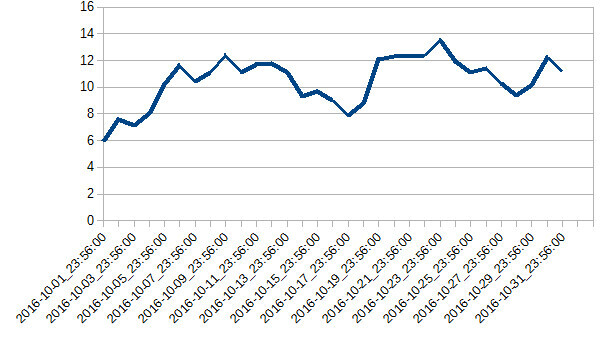
Here is a chart showing how cold it was at my location (ground level, sheltered from wind in the shade). The values represent degree days, which are useful for comparing heating requirements between buildings in different regions. In my case, the heating energy needed over the past two years has been almost exactly proportional to the degree days. So if the value on October 16 is, for example, 10, this means that the average temperature difference between inside and outside over the day was 10°C (18°F) (I log both outdoor and indoor temperatures). Indoors, the temperature remains fairly constant at around 21°C (70°F), with only minor variations of less than 1 degree.
This results in an average outdoor temperature of 10.5°C (51°F) for October at my location.
How cold or warm is it where you are?
Here is a chart showing how cold it was at my location (ground level, sheltered from wind in the shade). The values represent degree days, which are useful for comparing heating requirements between buildings in different regions. In my case, the heating energy needed over the past two years has been almost exactly proportional to the degree days. So if the value on October 16 is, for example, 10, this means that the average temperature difference between inside and outside over the day was 10°C (18°F) (I log both outdoor and indoor temperatures). Indoors, the temperature remains fairly constant at around 21°C (70°F), with only minor variations of less than 1 degree.
This results in an average outdoor temperature of 10.5°C (51°F) for October at my location.
How cold or warm is it where you are?
Similar topics