
ᐅ Floor plan of a single-family home with an optional accessory apartment
Created on: 24 May 2025 12:41
B
Bauherr8899
Hello dear community,
we are planning to build a single-family house and have already thought further ahead. We would like to be able to divide our house into two separate living units if needed. This way, an older child could move into the apartment above while we continue living on the ground floor, or we could rent out the upper unit if necessary. The ground floor should be accessible without barriers, with a shower in the bathroom. I would really appreciate your opinions on the floor plan I have drawn and any suggestions for improvement. Here is the floor plan:
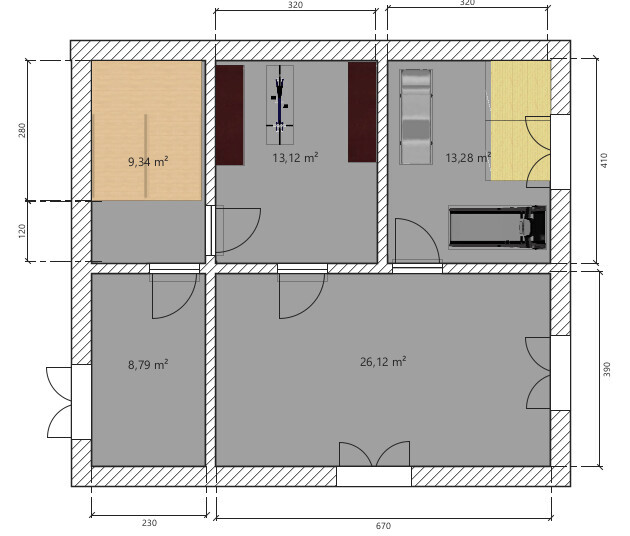
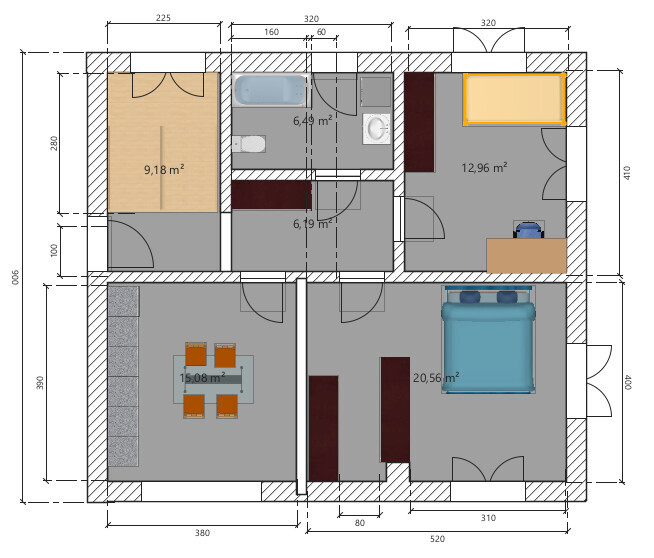
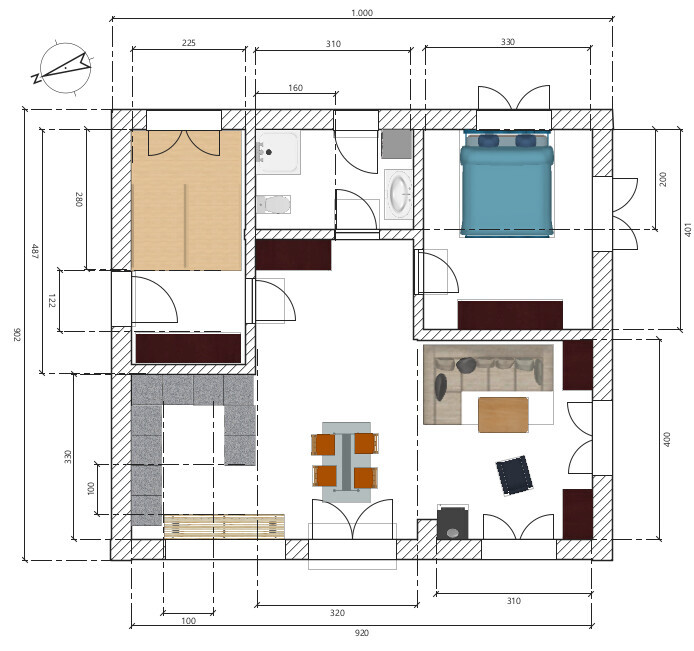
we are planning to build a single-family house and have already thought further ahead. We would like to be able to divide our house into two separate living units if needed. This way, an older child could move into the apartment above while we continue living on the ground floor, or we could rent out the upper unit if necessary. The ground floor should be accessible without barriers, with a shower in the bathroom. I would really appreciate your opinions on the floor plan I have drawn and any suggestions for improvement. Here is the floor plan:

Bauherr8899 schrieb:
Here again, separated between single-family house and two-family house, I hope this helps to better understand the floor plan.This makes it clearer but could still be improved.https://www.instagram.com/11antgmxde/
https://www.linkedin.com/company/bauen-jetzt/
Bauherr8899 schrieb:
I only remember the comment from several relatives who say that the house has become too big for them without children and that it means too much work,Since many have commented on this sentence here, I believe it is not completely accurate as it stands. There are quite different truths behind the statement. "The comment from several…"Which generation exactly complained? The parents of four children who eventually moved out? The parents of two children who also eventually moved out? The house remains the same size and does not get bigger; with empty children's rooms, you just close the door and hope the first relationship breaks up so the child returns home. The only thing that creates "too much" work is the children themselves. People are actually glad when the "Mama hotel" finally gets a break. Is it the large living room that is no longer filled with life? It is also possible to move out at an older age, but many relatives do not, because they would have to part with memories and furniture. And what else should they have done? Build a small living room for their family? Forego children and then build a smaller house? Perhaps a house with two tiny apartments, where the upper apartment is initially used as children's bedrooms and later rented out? Cozy living with tenants where you start to get elderly? No. There is a lot of theory and idealism—very little is actually implemented, in my opinion.
By the way, I belong to the generation that would prefer their parents to live in a smaller home (though larger than one level of this design would be fine). Unfortunately, they don't want to move. They say: we have enjoyed this beautiful large house for 45 years, so we can manage the next five as well. They don’t consider moving; even less so the work involved. And you know what? No one talks about the size. The little dust in unused rooms is now managed by a cleaning service. They themselves no longer do more than they are willing to do. And whatever is no longer possible, the tenant won’t do either. I bet almost no one rents out to a tenant from a distance who cleans and maintains the place, while the owner takes care of gardening and banking services.
W
wiltshire29 May 2025 07:25ypg schrieb:
When the kids’ rooms are empty, people just close the door and hope the first relationships fail so the child will come back home. Wow, that never occurred to me.
Simply closing the door and leaving the kids’ rooms as a sort of utility space is considered a burden by many—especially since these rooms still need to be maintained in some way.
ypg schrieb:
The only thing that creates “too much” work is the children themselves. You’re glad that “Hotel Mama” can finally take a break. “Hotel Mama” is a classic example. From my own experience, I can say that there are definitely more ways of living than just that.
ypg schrieb:
People can move out even in old age, but many relatives don’t because they can’t part with memories and furniture. What else could they have done? Many people live with their memories in houses that are too large, caught between overwhelm and nostalgia.
The question of what they should have done is something that those who plan to build a house for multiple life stages try to answer.
ypg schrieb:
There is a lot of theory and idealism behind this—but in practice, very little is implemented, I think. What you call theory and idealism, I understand more as an attitude in this context. I know several role models in our family and circle of friends who have shown and still show that you can look ahead, make decisions, and let go of burdens well into old age. And yes, many people say “that’s not possible because…”—and it’s not only older generations who say this.
ypg schrieb:
By the way, I belong to the generation that would prefer their parents to live in a smaller apartment. I don’t know if that’s a generational issue. I have a close friend (also in her mid to late 50s like me) who shares the same view you described. We spoke about it a lot while our parents were still alive since we had very different perspectives on the topic. It was a valuable exchange.
ypg schrieb:
I bet hardly anyone hires a tenant from a distance who cleans and cares for the house, has the gardener take care of the garden, and handles the banking services. Hehe. Actually, that was my parents’ model—my dad wanted to stay in the house, my mom found it too big. A guest room and two kids’ rooms were converted into an apartment, with a staircase leading to the upper floor. At first, tenants moved in. Later, the apartment was reconnected to the house with a door so that the person living there who helped out could get there faster. Banking services were outsourced to a company specializing in reducing complexity in the daily lives of elderly people. When my father passed away, my mother sold the house within a few months and moved to an assisted living facility.
wiltshire schrieb:
Wow, I wouldn’t have thought of that.That’s exactly why I’m asking!ypg schrieb:
Which generation was complaining?These generations really exist. Back then, people thought more “in terms of family” and lived a simpler life. But that doesn’t apply to everyone. Times have simply changed.
I no longer belong to that generation. Neither do you, as you yourself said.
In the end, I don’t care how someone wants to live here: some like it big, others small... but because “friends say, relatives groan, acquaintances advise,” it’s always worth considering whether the advice or comments actually make sense or if they’re just casually said by people who are different from yourself.
If I had followed my grandmother’s advice back then, I would have a huge laundry room in the basement now, because she once said a large room for laundry was priceless. Nowadays, I manage very well without a basement or laundry room.
My father told me 35 years ago, when house hunting, to make sure there was a pub in town. That was normal back then: if you had a pub around the corner, it was an advantage. That advice comes from a time before food delivery apps existed.
Location, location, location... many advised me to pay attention to location. But location has become subjective and has less influence in some areas since delivery services replaced busy inner cities and home office jobs replaced many train tickets.
Still, advice or comments are not worthless because not everyone is the same.
Now returning to the “several relatives commenting that the house has become too big for them.”
What does that mean for someone building a house? Actually, nothing.
My husband and I have 132 square meters (1,420 square feet) for two people. With a child, we had 116 square meters (1,248 square feet).
Yes, we have comfort, space, and roominess. And I love it. It would never occur to me to say it’s too big.
Others, however, can simply close the doors to “unused rooms” if they want to.
There is no one-size-fits-all solution for “in old age.”
My mother-in-law has a large network of helpers, ranging from service providers and acquaintances to young people.
My parents have the same.
At my parents’ place, the space requirements are much higher than when the children were younger – and due to poor childcare options at my sister’s, sometimes there are more people living in the house than before. She is often there during holidays, works from home, and the children stay with grandma, neighbors, or us.
Still, you should ask yourself, “Do I want to accept disadvantages now for a maybe later?”
“Do I really want strangers in the house? Someone who ends up paying rent just often enough so that you can’t legally evict them?”
Keep in mind that having children move in is one thing – that can usually be resolved with an additional meter (utility connection). Adding another floor or external staircases is becoming more common. However, the floor plan should fit the current needs. The upper floor is very far from the present situation.
My mother-in-law has a large network of helpers, ranging from service providers and acquaintances to young people.
My parents have the same.
At my parents’ place, the space requirements are much higher than when the children were younger – and due to poor childcare options at my sister’s, sometimes there are more people living in the house than before. She is often there during holidays, works from home, and the children stay with grandma, neighbors, or us.
Still, you should ask yourself, “Do I want to accept disadvantages now for a maybe later?”
“Do I really want strangers in the house? Someone who ends up paying rent just often enough so that you can’t legally evict them?”
Keep in mind that having children move in is one thing – that can usually be resolved with an additional meter (utility connection). Adding another floor or external staircases is becoming more common. However, the floor plan should fit the current needs. The upper floor is very far from the present situation.
Bauherr8899 schrieb:
Regarding the enclosed staircase. There should be the "option" for a granny flat. This option is already understood by the forum community. However, an enclosed staircase significantly limits family life. It separates.
Bauherr8899 schrieb:
From my point of view, this is a normal house, with the staircase directly in the entrance area rather than, as is often the case, located in the middle of the single-family home? In that case, it’s not a house where family members can live closely together. A staircase within the living unit is right in the middle. You can quickly go upstairs or downstairs.
Bauherr8899 schrieb:
A door to a separate apartment can be integrated upstairs and downstairs. Before that, it’s a single-family home, so access to the staircase can be without a door. As mentioned above, it is a single-family home with limitations for the first roughly 20 years.
Bauherr8899 schrieb:
We want to build a single-family home and have already considered the future further ahead. If you know your future needs, that would be very convenient, but no one can really define them so clearly.
nordanney schrieb:
Stop planning for the distant future. It just costs money and reduces living quality. Repeated: I agree with that.
Bauherr8899 schrieb:
I don’t see the separation of heating and electrical systems as complicated, since I would need it anyway—whether for a single-family house or a two-family house. A single-family home with a granny flat is legally different from a two-family house.
What you want is more like a granny flat, which requires simpler technical systems. A two-family house would need to be technically separated to qualify as such, which doesn’t necessarily mean two heating systems.
But it doesn’t really matter what you call the separate unit. Today, it’s harder to understand or justify the separation. The question “Are you already living or still just dwelling?” is very relevant nowadays and describes a home that is more than just a roof over your head.
Similar topics