
Hello everyone,
I am currently planning a redesign of our living room and would like to separate the living area from the dining area (or play area for our daughter).
We prefer an open style (like panels), ideally combined with storage space for toys.
We were thinking of something like this:
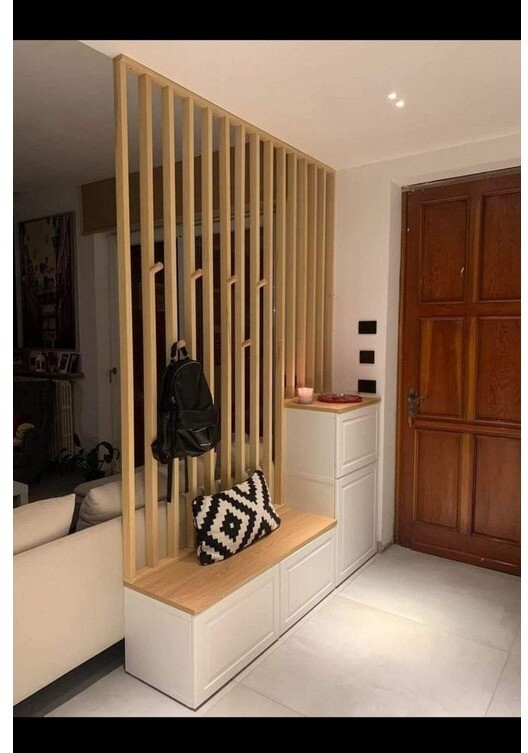
DIY skills: I gained a lot of experience during the house build two years ago and am open to trying new things.
However, the project should not require too much craftsmanship and should be doable for a hobbyist.
Does anyone have experience with panel-style room dividers? Which systems are practical and feasible—preferably combined with a suitable shelf for storage?
The panels from the local hardware store come with mounting brackets for gluing to the ceiling and floor—I’m not sure what to think about that... Since we have underfloor heating, gluing to the floor might make sense—but I would prefer if the panels were screwed directly to the shelving unit.
Also, I find the floor and ceiling brackets visually quite unappealing.
Of course, the whole thing should be as affordable as possible—we need about 1.20m (4 feet) in width.
I would appreciate any input that could support such a DIY project.
Most of all, I am interested in how to fix the panels to shelving units or possibly also to the floor and ceiling.
I am currently planning a redesign of our living room and would like to separate the living area from the dining area (or play area for our daughter).
We prefer an open style (like panels), ideally combined with storage space for toys.
We were thinking of something like this:
DIY skills: I gained a lot of experience during the house build two years ago and am open to trying new things.
However, the project should not require too much craftsmanship and should be doable for a hobbyist.
Does anyone have experience with panel-style room dividers? Which systems are practical and feasible—preferably combined with a suitable shelf for storage?
The panels from the local hardware store come with mounting brackets for gluing to the ceiling and floor—I’m not sure what to think about that... Since we have underfloor heating, gluing to the floor might make sense—but I would prefer if the panels were screwed directly to the shelving unit.
Also, I find the floor and ceiling brackets visually quite unappealing.
Of course, the whole thing should be as affordable as possible—we need about 1.20m (4 feet) in width.
I would appreciate any input that could support such a DIY project.
Most of all, I am interested in how to fix the panels to shelving units or possibly also to the floor and ceiling.
Kallax is simply much more affordable, while Metod offers more variety with drawers, doors, inserts, sizes, and so on.
As always, it comes down to "What do I want?" and how much am I willing to spend or put in myself; ultimately, it should look good in the living area, which is my top priority.
If you decide to go with Kallax for cost reasons, I’ve seen it creatively painted or customized with spray paint, so in the end, you don’t even think of it as Kallax anymore.
Imagination beyond the hardware store or furniture retailer is very important in this case.
As always, it comes down to "What do I want?" and how much am I willing to spend or put in myself; ultimately, it should look good in the living area, which is my top priority.
If you decide to go with Kallax for cost reasons, I’ve seen it creatively painted or customized with spray paint, so in the end, you don’t even think of it as Kallax anymore.
Imagination beyond the hardware store or furniture retailer is very important in this case.

The basic carcasses are also not expensive with Metod. The drawer systems and fronts are just costly. However, you can either buy these gradually or enhance them creatively yourself (for example, take the cheapest front and paint it). I think the biggest advantage is that you can design the compartment layout more flexibly. With Kallax, only these squares are possible, and they are fixed.
I believe investing money in METOD would be sensible and cost-effective. Using DIY panels is also a relatively affordable option. For a prefabricated panel wall of just 1.2 meters (4 feet), the price can already be around 500€. With MDF panels from a hardware store that you cut yourself, the cost is significantly lower, especially since I don't need the full height and can cut the panels to size myself.
Tolentino schrieb:
The basic carcasses are not expensive with Metod either. The drawer systems and fronts are the costly parts. But you can either buy those gradually or customize them yourself (use the cheapest front and paint it). I think the biggest advantage is that you can design the compartments more flexibly. With Kallax, you only have those fixed square compartments. I agree. With a total length of about 1.2m (4 feet), the cost of fronts for 2 or at most 3 carcasses won’t be a big deal. Much cheaper than most other options anyway 🙂
I’m also imagining a stepped system... For example, 40, 60, 80 cm (16, 24, 31.5 inches) heights, then extended in length by increments of 40 cm (16 inches)... Similar to the picture. But I’ll need to measure everything carefully on site to figure out what makes the most sense.

If the cabinets are supposed to support the structure, I definitely wouldn’t use Kallax or something similar. It is mostly hollow inside with occasional honeycomb structures – it won’t hold anything. Metod is designed for much heavier loads and is made from solid particleboard throughout.
nordanney schrieb:
Kallax is noticeably flimsier.No, it isn’t, or at least not more than other Ikea products. We have built Ikea kitchens and used Kallax units in various places for the kids, and nothing is flimsy. Of course, as always, it depends on the context and the overall project whether something fits or appeals.
I’ve seen Kallax painted with gold paint, even tiled, or coated with textured plaster—like I said, “hacks” can give you ideas if your own imagination reaches its limits.
Most recently, for example, we integrated a Pax unit in the kitchen due to specific requirements. Open systems (Haller/Kallax to name two price extremes) have the advantage that you can use or fill them from both sides, partially or fully, and don’t need an additional panel for the back like with Metod/Pax, etc.
As I said, stability isn’t an issue (depending on requirements), or not more or less so with these models. I have lots of ideas about this, but I also believe Prager91 already knows what he wants.
Similar topics