
Hello everyone,
I would like to gather your opinions, experiences, and tips regarding wells for garden irrigation.
We are planning to sow lawn in spring, about 450 m² (4900 sq ft). I would like to set up automatic irrigation using Hunter or Rainbird systems.
The existing water connection from the house is too weak (18 l/min, 1100 l/h [4.75 gpm, 290 gph]).
There is no cistern since we have always wanted a well.
In the neighborhood (about 50 meters (55 yards) away), there are already wells, with water at approximately 7 meters (23 feet) depth.
Now the question about the type of well: driven well or drilled well?
Driven well:
- What are your experiences: how much flow (volume per hour) can be taken from a driven well without overloading it? Is such a well suitable for automatic irrigation?
- Which pumps would you recommend for that?
- What did it cost you? Either price per meter or all-in cost?
Drilled well:
- I have not received any quotes yet, but according to my research, it is significantly more expensive than a driven well. However, capacity should not be a problem, right?
- I recently read a tip from Rick in the well topic about pump types. Are these suitable for automatic irrigation?
- What did it cost you? Either price per meter or all-in cost?
What are your general experiences with wells?
I was thinking to place the well as far away from the house as possible to avoid any ground settlement over the years caused by water or sand extraction.
If that is not an issue, I could theoretically use the existing soakaway pit (already 4 meters (13 feet) deep and lined with concrete rings) and drive a well there. The advantage would be gaining 4 meters (13 feet) of depth security, as the pump would be located at about -4 meters (-13 feet). The disadvantage is that it is close to the garage and located on a paved area — potential risk of settlement?
I am attaching a sketch of the property.
Thank you in advance!
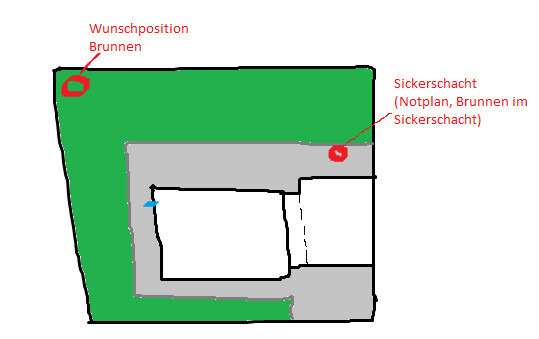
I would like to gather your opinions, experiences, and tips regarding wells for garden irrigation.
We are planning to sow lawn in spring, about 450 m² (4900 sq ft). I would like to set up automatic irrigation using Hunter or Rainbird systems.
The existing water connection from the house is too weak (18 l/min, 1100 l/h [4.75 gpm, 290 gph]).
There is no cistern since we have always wanted a well.
In the neighborhood (about 50 meters (55 yards) away), there are already wells, with water at approximately 7 meters (23 feet) depth.
Now the question about the type of well: driven well or drilled well?
Driven well:
- What are your experiences: how much flow (volume per hour) can be taken from a driven well without overloading it? Is such a well suitable for automatic irrigation?
- Which pumps would you recommend for that?
- What did it cost you? Either price per meter or all-in cost?
Drilled well:
- I have not received any quotes yet, but according to my research, it is significantly more expensive than a driven well. However, capacity should not be a problem, right?
- I recently read a tip from Rick in the well topic about pump types. Are these suitable for automatic irrigation?
- What did it cost you? Either price per meter or all-in cost?
What are your general experiences with wells?
I was thinking to place the well as far away from the house as possible to avoid any ground settlement over the years caused by water or sand extraction.
If that is not an issue, I could theoretically use the existing soakaway pit (already 4 meters (13 feet) deep and lined with concrete rings) and drive a well there. The advantage would be gaining 4 meters (13 feet) of depth security, as the pump would be located at about -4 meters (-13 feet). The disadvantage is that it is close to the garage and located on a paved area — potential risk of settlement?
I am attaching a sketch of the property.
Thank you in advance!
M
motorradsilke26 Feb 2021 07:30We have a well that is probably located directly beneath the house (it was already there when we took over the house, but we forgot to ask the previous owners, and then they passed away shortly after; our house has also been extended multiple times). There is no settling happening there.
For the new construction, we will likely drill a new well, but it will be located close to the house again (2 m (6.5 ft) distance). I’m not worried about settling because the water is drawn from about 8 m (26 ft) deep, and not in amounts that would cause the soil above to shift. I can’t explain this scientifically, but I’ve never heard of such an issue occurring. My son also has his well right next to his house, and there are no problems there either.
If the well is large enough, I would definitely use the infiltration shaft. You can install the pump and storage tank in there, keeping them frost-free. This means you don’t need to remove or drain the pump during winter.
For the new construction, we will likely drill a new well, but it will be located close to the house again (2 m (6.5 ft) distance). I’m not worried about settling because the water is drawn from about 8 m (26 ft) deep, and not in amounts that would cause the soil above to shift. I can’t explain this scientifically, but I’ve never heard of such an issue occurring. My son also has his well right next to his house, and there are no problems there either.
If the well is large enough, I would definitely use the infiltration shaft. You can install the pump and storage tank in there, keeping them frost-free. This means you don’t need to remove or drain the pump during winter.
Hello FF2677
If the water level is really at 7 meters (23 feet), drilling can be done in half a day by yourself.
Driving a well point is, of course, cheaper, but it yields very little water.
I would do it myself. Rent a drill rod and a plunger for a weekend. Use the blue well pipes and 3 meters (10 feet) of filter pipes. If you do it correctly, the cavity should stay quite small, and settlement shouldn’t be a concern.
If there’s already a shaft of 4 meters (13 feet), you should use that. The rest can be done with a small shovel.
If you hire someone, make sure they use the blue pipes. They often try to save money by using sewer pipes (KG pipes). That’s cheap, but definitely poor workmanship.
Steven
If the water level is really at 7 meters (23 feet), drilling can be done in half a day by yourself.
Driving a well point is, of course, cheaper, but it yields very little water.
I would do it myself. Rent a drill rod and a plunger for a weekend. Use the blue well pipes and 3 meters (10 feet) of filter pipes. If you do it correctly, the cavity should stay quite small, and settlement shouldn’t be a concern.
If there’s already a shaft of 4 meters (13 feet), you should use that. The rest can be done with a small shovel.
If you hire someone, make sure they use the blue pipes. They often try to save money by using sewer pipes (KG pipes). That’s cheap, but definitely poor workmanship.
Steven
M
Myrna_Loy26 Feb 2021 12:27Is there already a permit in place? Depending on the state, wells may require a permit (building permit / planning permission).
For example, in our area, only existing wells on older farm properties are still allowed to operate. New wells are not approved because we are becoming a water shortage area. And, of course, the municipality also wants to profit from the water supply.
For example, in our area, only existing wells on older farm properties are still allowed to operate. New wells are not approved because we are becoming a water shortage area. And, of course, the municipality also wants to profit from the water supply.
Steven schrieb:
Hello FF2677
If the water is really at 7 meters (23 feet), drilling can be done in half a day by yourself.
Driving the well is, of course, cheaper but usually yields very little water.
I would do it myself—rent drilling rods and a plunger pump for a weekend. Use the blue well pipes and 3 meters (10 feet) of filter pipe. If you do it properly, the cavity should stay quite small, and you shouldn’t have to worry about settlement.
If there is already a shaft 4 meters (13 feet) deep, you should use it. The rest can be done with a small shovel.
If you hire someone, make sure they use the blue pipes. They often try to save money by using PVC pipes (known as KG pipes in some regions). It’s cheap but obviously substandard work.
Steven The soakaway is placed on a gravel bed and is probably filled with gravel for about 1 meter (3 feet) on the inside. So digging there yourself is not possible.
Regarding drilling yourself:
- We built with a basement, and up to a depth of 3 to 3.5 meters (10–11.5 feet), it was all just clay—meaning I would easily get through that with a hand drill.
- But I don’t know what is below that or how well you can work the drill at greater depths.
- I imagine driving the well might be complicated again.
But having a well with a submersible pump would of course be a dream.
Did you drill yourself? What water quantities do you get at what pressure and drilling depth?
Hello
Gravel is not a problem. You just have to drill "inside the pipe." That means you attach a PVC sewer pipe, about 150mm (6 inches) in diameter. You drill and push the PVC pipe down. This way, you bring up the stones and seal the sides. Clay works the same way. Clay is pretty easy.
Lean clay is not hard at all. It's actually the easiest method.
Steven
Gravel is not a problem. You just have to drill "inside the pipe." That means you attach a PVC sewer pipe, about 150mm (6 inches) in diameter. You drill and push the PVC pipe down. This way, you bring up the stones and seal the sides. Clay works the same way. Clay is pretty easy.
Lean clay is not hard at all. It's actually the easiest method.
Steven
Similar topics