
Hello everyone,
I would like to gather your opinions, experiences, and tips regarding wells for garden irrigation.
We are planning to sow lawn in spring, about 450 m² (4900 sq ft). I would like to set up automatic irrigation using Hunter or Rainbird systems.
The existing water connection from the house is too weak (18 l/min, 1100 l/h [4.75 gpm, 290 gph]).
There is no cistern since we have always wanted a well.
In the neighborhood (about 50 meters (55 yards) away), there are already wells, with water at approximately 7 meters (23 feet) depth.
Now the question about the type of well: driven well or drilled well?
Driven well:
- What are your experiences: how much flow (volume per hour) can be taken from a driven well without overloading it? Is such a well suitable for automatic irrigation?
- Which pumps would you recommend for that?
- What did it cost you? Either price per meter or all-in cost?
Drilled well:
- I have not received any quotes yet, but according to my research, it is significantly more expensive than a driven well. However, capacity should not be a problem, right?
- I recently read a tip from Rick in the well topic about pump types. Are these suitable for automatic irrigation?
- What did it cost you? Either price per meter or all-in cost?
What are your general experiences with wells?
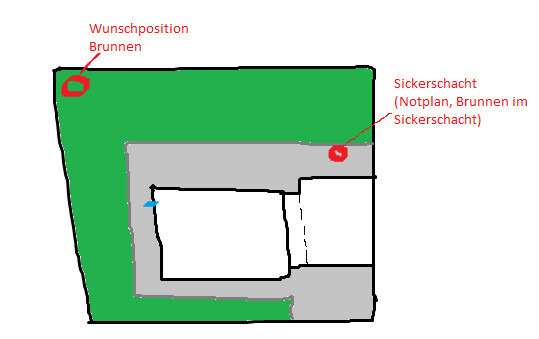
I was thinking to place the well as far away from the house as possible to avoid any ground settlement over the years caused by water or sand extraction.
If that is not an issue, I could theoretically use the existing soakaway pit (already 4 meters (13 feet) deep and lined with concrete rings) and drive a well there. The advantage would be gaining 4 meters (13 feet) of depth security, as the pump would be located at about -4 meters (-13 feet). The disadvantage is that it is close to the garage and located on a paved area — potential risk of settlement?
I am attaching a sketch of the property.
Thank you in advance!
I would like to gather your opinions, experiences, and tips regarding wells for garden irrigation.
We are planning to sow lawn in spring, about 450 m² (4900 sq ft). I would like to set up automatic irrigation using Hunter or Rainbird systems.
The existing water connection from the house is too weak (18 l/min, 1100 l/h [4.75 gpm, 290 gph]).
There is no cistern since we have always wanted a well.
In the neighborhood (about 50 meters (55 yards) away), there are already wells, with water at approximately 7 meters (23 feet) depth.
Now the question about the type of well: driven well or drilled well?
Driven well:
- What are your experiences: how much flow (volume per hour) can be taken from a driven well without overloading it? Is such a well suitable for automatic irrigation?
- Which pumps would you recommend for that?
- What did it cost you? Either price per meter or all-in cost?
Drilled well:
- I have not received any quotes yet, but according to my research, it is significantly more expensive than a driven well. However, capacity should not be a problem, right?
- I recently read a tip from Rick in the well topic about pump types. Are these suitable for automatic irrigation?
- What did it cost you? Either price per meter or all-in cost?
What are your general experiences with wells?
I was thinking to place the well as far away from the house as possible to avoid any ground settlement over the years caused by water or sand extraction.
If that is not an issue, I could theoretically use the existing soakaway pit (already 4 meters (13 feet) deep and lined with concrete rings) and drive a well there. The advantage would be gaining 4 meters (13 feet) of depth security, as the pump would be located at about -4 meters (-13 feet). The disadvantage is that it is close to the garage and located on a paved area — potential risk of settlement?
I am attaching a sketch of the property.
Thank you in advance!

I need to take a closer look at this in detail, but zones with 6000 l/h or 3000 l/h can be ruled out right away. Even if the well can provide that, the pump won’t handle it. Plus, you have to consider pipe losses...
It will probably be no more than 2000 liters.
The sprinklers should have the same precipitation rates. Slower saturation is better. With the lower flow rate, you also have the option to create larger zones.
The total volume of water is controlled by the runtime.
Use rotators. They are less affected by wind, provide more uniform distribution, and (almost) all heads have the same precipitation rate, etc.
Use the PRO-Spray PROS-04-PRS40 housings.
You can use them anywhere. You don’t need to worry about the layout. The housing always regulates the pressure down to 2.8 bar (40 psi). Then just add the appropriate head.
A demanding lawn requires up to 15–20 l/week/m² (0.4–0.5 gallons/week/ft²).
It will probably be no more than 2000 liters.
The sprinklers should have the same precipitation rates. Slower saturation is better. With the lower flow rate, you also have the option to create larger zones.
The total volume of water is controlled by the runtime.
Use rotators. They are less affected by wind, provide more uniform distribution, and (almost) all heads have the same precipitation rate, etc.
Use the PRO-Spray PROS-04-PRS40 housings.
You can use them anywhere. You don’t need to worry about the layout. The housing always regulates the pressure down to 2.8 bar (40 psi). Then just add the appropriate head.
A demanding lawn requires up to 15–20 l/week/m² (0.4–0.5 gallons/week/ft²).
I took a look at it now.
Overall, it’s very good. How is the boundary on the left side? Can you irrigate beyond it or not?
For the upper area, I would use Hunter MP3500. For the 270° sprinkler, an MP3000.
That way, you would have:
3 x MP3500 (set to 90°) = 3 x 0.29 m³/h (10.2 ft³/h) = 0.87 m³/h (30.7 ft³/h)
2 x MP3500 (set to 180°) = 2 x 0.65 m³/h (22.9 ft³/h) = 1.3 m³/h (45.9 ft³/h)
1 x MP3000 (set to 270°) = 0.63 m³/h (22.3 ft³/h)
From this, I would create two zones: one for the sprinklers along the property boundary and one for those along the terrace.
The narrow tip area is a bit trickier. You would need to provide measurements for that.
I would work with a combination of rectangular nozzles and corner nozzles. In any case, the water consumption is not large enough to require a third zone. As you can see, the MP rotors save you almost 3000 l/h (792 gallons per hour). With so few zones, a longer irrigation time is not an issue.
They are also noticeably quieter.
Especially with your soil type, slow soaking is important.
Large gear-driven sprinklers make sense for large open areas (with a suitable pump and water supply). But not for installations like most single-family homes.
Regarding your drip irrigation, grouping zones only makes sense if the water requirements and sun exposure are similar.
Pressure-compensated drip tubing (e.g. Hunter XFS) can be used up to a maximum of 100 meters (330 feet). However, these are values rarely reached in practice. With your pump, you do not need a pressure reducer for the drip irrigation.
Don’t skimp on the valves.
I would also add a valve box for a garden hose outlet. You can branch this off before the valve box, so no additional valve is necessary.
How do you want to control it? If you want standalone, Hydrawise is a good option. It also doesn’t require its own weather station. I’ve installed it in three recent setups. Very easy to use with the app.
Opensprinkler gives you even more options (which won’t really be relevant for your setup).
Or you can integrate it directly into the home automation system...
Overall, it’s very good. How is the boundary on the left side? Can you irrigate beyond it or not?
For the upper area, I would use Hunter MP3500. For the 270° sprinkler, an MP3000.
That way, you would have:
3 x MP3500 (set to 90°) = 3 x 0.29 m³/h (10.2 ft³/h) = 0.87 m³/h (30.7 ft³/h)
2 x MP3500 (set to 180°) = 2 x 0.65 m³/h (22.9 ft³/h) = 1.3 m³/h (45.9 ft³/h)
1 x MP3000 (set to 270°) = 0.63 m³/h (22.3 ft³/h)
From this, I would create two zones: one for the sprinklers along the property boundary and one for those along the terrace.
The narrow tip area is a bit trickier. You would need to provide measurements for that.
I would work with a combination of rectangular nozzles and corner nozzles. In any case, the water consumption is not large enough to require a third zone. As you can see, the MP rotors save you almost 3000 l/h (792 gallons per hour). With so few zones, a longer irrigation time is not an issue.
They are also noticeably quieter.
Especially with your soil type, slow soaking is important.
Large gear-driven sprinklers make sense for large open areas (with a suitable pump and water supply). But not for installations like most single-family homes.
Regarding your drip irrigation, grouping zones only makes sense if the water requirements and sun exposure are similar.
Pressure-compensated drip tubing (e.g. Hunter XFS) can be used up to a maximum of 100 meters (330 feet). However, these are values rarely reached in practice. With your pump, you do not need a pressure reducer for the drip irrigation.
Don’t skimp on the valves.
I would also add a valve box for a garden hose outlet. You can branch this off before the valve box, so no additional valve is necessary.
How do you want to control it? If you want standalone, Hydrawise is a good option. It also doesn’t require its own weather station. I’ve installed it in three recent setups. Very easy to use with the app.
Opensprinkler gives you even more options (which won’t really be relevant for your setup).
Or you can integrate it directly into the home automation system...
Hello @rick2018,
I want to say THANK YOU very, very much!
I wasn’t aware that the rotors have such a low flow rate consumption. That would definitely work in my favor. Over the next few days, I will implement your suggestion using the specified rotors as a plan and share it here.
After that, I will still have many questions 🙂 regarding valves, controls, and so on...
I want to say THANK YOU very, very much!
I wasn’t aware that the rotors have such a low flow rate consumption. That would definitely work in my favor. Over the next few days, I will implement your suggestion using the specified rotors as a plan and share it here.
After that, I will still have many questions 🙂 regarding valves, controls, and so on...
I planned the system today at noon using Hunter MP rotors.
- On the positive side at first glance: significantly lower flow rates compared to spray heads and presumably more even coverage due to consistent pressure everywhere—2.8 bar (40.6 psi).
- On the negative side: fixed throw distances (4.1 - 5.7 - 9.1 - 10.7 meters (13.5 - 18.7 - 29.9 - 35.1 feet), depending on whether it’s MP1000, MP2000, MP3000, or MP3500), so planning with spray heads and their many nozzles is more flexible.
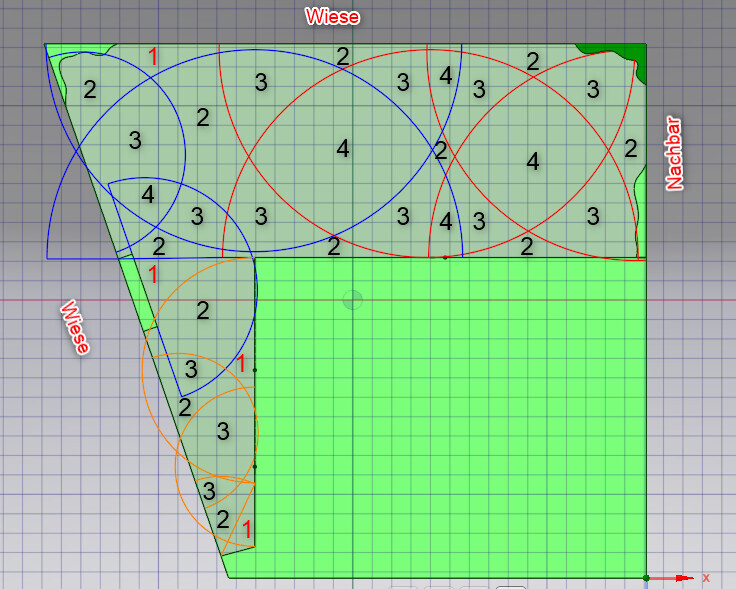
I marked the corresponding zones in the same colors:
- Red zone (4x MP3500; 2 are 90° sectors, 2 are 180° sectors)
=> (31.34 liters/min = 1880 liters/hour (8.28 gallons/min = 496 gallons/hour))
- Blue zone (2x MP3500, both 180° sectors, 2x MP2000 both 180° sectors)
=> (27.5 liters/min = 1650 liters/hour (7.26 gallons/min = 435 gallons/hour))
- Orange zone (1x MP2000 at 180°; 3x MP1000, 2 at 180°, 1 at 45°)
=> (6.9 liters/min = 400 liters/hour (1.82 gallons/min = 106 gallons/hour))
However, I still have some areas where rotors don’t overlap (marked with red 1, where only one rotor waters that area). From experience, is this critical?
PS: As I understand it, I can’t use different gear-driven rotors in the same zone due to the risk of varying pressure loss. But using different MP rotors should be okay, right? Since they all limit pressure to 2.8 bar (40.6 psi) anyway.
- On the positive side at first glance: significantly lower flow rates compared to spray heads and presumably more even coverage due to consistent pressure everywhere—2.8 bar (40.6 psi).
- On the negative side: fixed throw distances (4.1 - 5.7 - 9.1 - 10.7 meters (13.5 - 18.7 - 29.9 - 35.1 feet), depending on whether it’s MP1000, MP2000, MP3000, or MP3500), so planning with spray heads and their many nozzles is more flexible.
I marked the corresponding zones in the same colors:
- Red zone (4x MP3500; 2 are 90° sectors, 2 are 180° sectors)
=> (31.34 liters/min = 1880 liters/hour (8.28 gallons/min = 496 gallons/hour))
- Blue zone (2x MP3500, both 180° sectors, 2x MP2000 both 180° sectors)
=> (27.5 liters/min = 1650 liters/hour (7.26 gallons/min = 435 gallons/hour))
- Orange zone (1x MP2000 at 180°; 3x MP1000, 2 at 180°, 1 at 45°)
=> (6.9 liters/min = 400 liters/hour (1.82 gallons/min = 106 gallons/hour))
However, I still have some areas where rotors don’t overlap (marked with red 1, where only one rotor waters that area). From experience, is this critical?
PS: As I understand it, I can’t use different gear-driven rotors in the same zone due to the risk of varying pressure loss. But using different MP rotors should be okay, right? Since they all limit pressure to 2.8 bar (40.6 psi) anyway.
Status update:
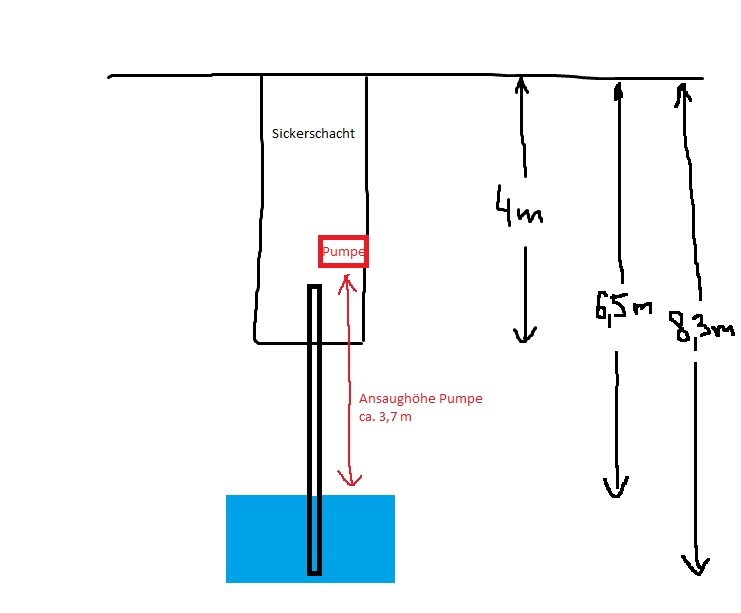
The well driller has been here and drove the pipe (1 1/4 inch) into the soakaway shaft. At a depth between 5.5 - 6 meters (18 - 20 feet) from the top of the ground, there was a tricky layer of gravel. Water appeared at 6.5 meters (21 feet). We drove the pipe in to 8.3 meters (27 feet), with only the last 60 cm (2 feet) of the pipe having holes for suction. This means the pipe is submerged 1.8 meters (6 feet) in water, with a 1.2 meter (4 feet) reserve in case the groundwater level drops in the high summer.
This cost 600€ including the pipe. Working time was about 4-5 hours.
He then connected a diaphragm pump for clearing the water, which delivered about 4,000 - 4,500 liters per hour.
So the well is already supplying enough water. However, there is still a lot of sand coming through. I have now bought a cheap pump from Aldi for the start. Although a pre-filter is already installed, I expect the pump to fail after a short time. Once the well is fully cleared, a proper pump will be installed.
Now it’s time to select the remaining components. The following are currently under consideration:
1. From pump to manifold: PE HD pipe 20 mm (about 1 meter / 3 feet)
2. Manifold from Rainbird
3. Solenoid valves from Hunter (between 4-6 units)
4. From solenoid valves to the rotors: PE HD pipe 20 mm (xx meters)
5. MP Rotators from Hunter
6. Drip irrigation tubing ??? I have not researched this yet
7. Controller — Hunter solenoid valves require 24V AC. What is recommended for 6 zones? Is it better to buy a ready-made system or to build one using a Raspberry Pi with openHAB?
Regarding the PE HD pipes, I’m still unsure if 20 mm is sufficient. I will soon measure the pipe lengths and simulate pressure losses for my line lengths. I want to maintain at least 2.8 bar (40 psi) at each rotator to ensure uniform irrigation.
The well driller has been here and drove the pipe (1 1/4 inch) into the soakaway shaft. At a depth between 5.5 - 6 meters (18 - 20 feet) from the top of the ground, there was a tricky layer of gravel. Water appeared at 6.5 meters (21 feet). We drove the pipe in to 8.3 meters (27 feet), with only the last 60 cm (2 feet) of the pipe having holes for suction. This means the pipe is submerged 1.8 meters (6 feet) in water, with a 1.2 meter (4 feet) reserve in case the groundwater level drops in the high summer.
This cost 600€ including the pipe. Working time was about 4-5 hours.
He then connected a diaphragm pump for clearing the water, which delivered about 4,000 - 4,500 liters per hour.
So the well is already supplying enough water. However, there is still a lot of sand coming through. I have now bought a cheap pump from Aldi for the start. Although a pre-filter is already installed, I expect the pump to fail after a short time. Once the well is fully cleared, a proper pump will be installed.
Now it’s time to select the remaining components. The following are currently under consideration:
1. From pump to manifold: PE HD pipe 20 mm (about 1 meter / 3 feet)
2. Manifold from Rainbird
3. Solenoid valves from Hunter (between 4-6 units)
4. From solenoid valves to the rotors: PE HD pipe 20 mm (xx meters)
5. MP Rotators from Hunter
6. Drip irrigation tubing ??? I have not researched this yet
7. Controller — Hunter solenoid valves require 24V AC. What is recommended for 6 zones? Is it better to buy a ready-made system or to build one using a Raspberry Pi with openHAB?
Regarding the PE HD pipes, I’m still unsure if 20 mm is sufficient. I will soon measure the pipe lengths and simulate pressure losses for my line lengths. I want to maintain at least 2.8 bar (40 psi) at each rotator to ensure uniform irrigation.
Similar topics