
Hello everyone,
I would like to gather your opinions, experiences, and tips regarding wells for garden irrigation.
We are planning to sow lawn in spring, about 450 m² (4900 sq ft). I would like to set up automatic irrigation using Hunter or Rainbird systems.
The existing water connection from the house is too weak (18 l/min, 1100 l/h [4.75 gpm, 290 gph]).
There is no cistern since we have always wanted a well.
In the neighborhood (about 50 meters (55 yards) away), there are already wells, with water at approximately 7 meters (23 feet) depth.
Now the question about the type of well: driven well or drilled well?
Driven well:
- What are your experiences: how much flow (volume per hour) can be taken from a driven well without overloading it? Is such a well suitable for automatic irrigation?
- Which pumps would you recommend for that?
- What did it cost you? Either price per meter or all-in cost?
Drilled well:
- I have not received any quotes yet, but according to my research, it is significantly more expensive than a driven well. However, capacity should not be a problem, right?
- I recently read a tip from Rick in the well topic about pump types. Are these suitable for automatic irrigation?
- What did it cost you? Either price per meter or all-in cost?
What are your general experiences with wells?
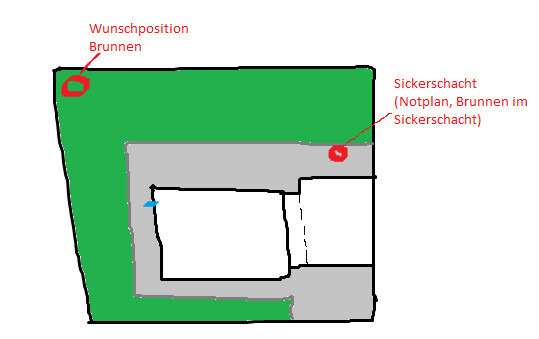
I was thinking to place the well as far away from the house as possible to avoid any ground settlement over the years caused by water or sand extraction.
If that is not an issue, I could theoretically use the existing soakaway pit (already 4 meters (13 feet) deep and lined with concrete rings) and drive a well there. The advantage would be gaining 4 meters (13 feet) of depth security, as the pump would be located at about -4 meters (-13 feet). The disadvantage is that it is close to the garage and located on a paved area — potential risk of settlement?
I am attaching a sketch of the property.
Thank you in advance!
I would like to gather your opinions, experiences, and tips regarding wells for garden irrigation.
We are planning to sow lawn in spring, about 450 m² (4900 sq ft). I would like to set up automatic irrigation using Hunter or Rainbird systems.
The existing water connection from the house is too weak (18 l/min, 1100 l/h [4.75 gpm, 290 gph]).
There is no cistern since we have always wanted a well.
In the neighborhood (about 50 meters (55 yards) away), there are already wells, with water at approximately 7 meters (23 feet) depth.
Now the question about the type of well: driven well or drilled well?
Driven well:
- What are your experiences: how much flow (volume per hour) can be taken from a driven well without overloading it? Is such a well suitable for automatic irrigation?
- Which pumps would you recommend for that?
- What did it cost you? Either price per meter or all-in cost?
Drilled well:
- I have not received any quotes yet, but according to my research, it is significantly more expensive than a driven well. However, capacity should not be a problem, right?
- I recently read a tip from Rick in the well topic about pump types. Are these suitable for automatic irrigation?
- What did it cost you? Either price per meter or all-in cost?
What are your general experiences with wells?
I was thinking to place the well as far away from the house as possible to avoid any ground settlement over the years caused by water or sand extraction.
If that is not an issue, I could theoretically use the existing soakaway pit (already 4 meters (13 feet) deep and lined with concrete rings) and drive a well there. The advantage would be gaining 4 meters (13 feet) of depth security, as the pump would be located at about -4 meters (-13 feet). The disadvantage is that it is close to the garage and located on a paved area — potential risk of settlement?
I am attaching a sketch of the property.
Thank you in advance!

I believe the well contractor mentioned a diameter of 1 3/4 inches.
I am now assuming a pressure loss of 0.7 bar due to piping, and 0.7 bar due to height difference. With the Tipp pump, I would then have about 3 bar at the sprinkler, and with the Gardena pump around 3.5 bar.
I have now also found information on the influence of the nozzle and pressure on flow rate and range for gear-driven sprinklers from Hunter.
I will prepare two designs: one with gear-driven sprinklers and one with rotors. I will then present both.
What is typically used for, for example, tree irrigation?
I am now assuming a pressure loss of 0.7 bar due to piping, and 0.7 bar due to height difference. With the Tipp pump, I would then have about 3 bar at the sprinkler, and with the Gardena pump around 3.5 bar.
I have now also found information on the influence of the nozzle and pressure on flow rate and range for gear-driven sprinklers from Hunter.
I will prepare two designs: one with gear-driven sprinklers and one with rotors. I will then present both.
What is typically used for, for example, tree irrigation?
I have already roughly estimated a pressure loss of about 0.7 bar due to pipe friction, plus 0.7 bar loss from a 7-meter (23-foot) height difference. So, in total, 1.5 bar of losses.
If the pump generates 5 bar, the pressure right at the sprinkler would be 3.5 bar.
Everything depends on the estimated 0.7 bar. When I do the detailed planning, I will calculate the losses more precisely.
If the pump generates 5 bar, the pressure right at the sprinkler would be 3.5 bar.
Everything depends on the estimated 0.7 bar. When I do the detailed planning, I will calculate the losses more precisely.
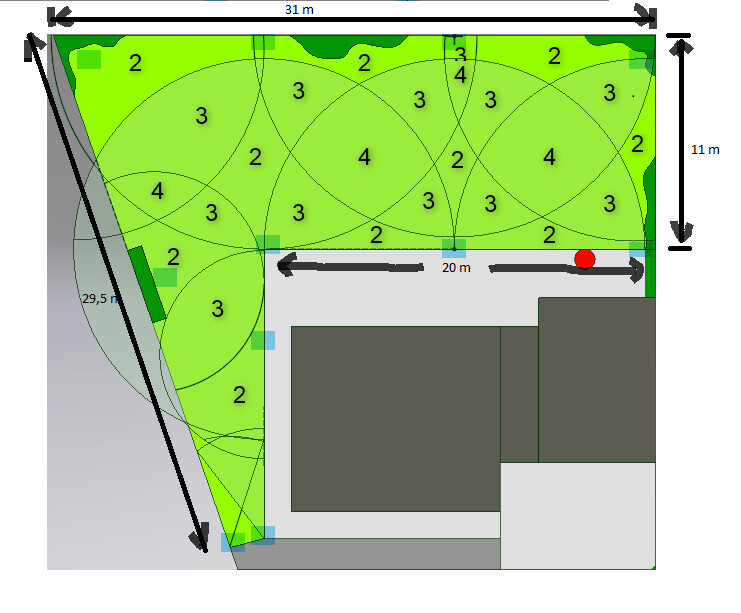
So, first attempt with Hunter PGJ gear-driven rotors. I will plan with rotators separately.
The setup would be:
- 6 PGJ with 3.0 nozzles (at 3.5 bar: 13 liters/min and 9.4 m (31 feet) throw distance)
- 1 PGJ with 5.0 nozzle (at 3.5 bar: 20 liters/min and 11 m (36 feet) throw distance)
- 4 PGJ with 0.75 nozzle (at 3.5 bar: 3.2 liters/min and 5 m (16 feet) throw distance)
The 4 PGJ with 0.75 nozzles would form one zone (13 liters/min => 800 liters/hour),
The remaining 7 PGJ (100 liters/min => 6000 liters/hour) would be split into 2 zones (if the well can supply that).
=> This would allow me to use a 4-valve box (3 zones with sprinklers), and the 4th zone would be for drip irrigation. I have several flower beds (dark green). Is it feasible to use one large drip hose for that?
The numbers inside the zones indicate the number of overlaps.
What I haven’t considered at all so far is the precipitation rate. We have a clay soil with about 20 cm (8 inches) of topsoil on top.
Are there any recommendations? I want to avoid runoff because the water cannot infiltrate fast enough (zones with 4 overlaps?).
The setup would be:
- 6 PGJ with 3.0 nozzles (at 3.5 bar: 13 liters/min and 9.4 m (31 feet) throw distance)
- 1 PGJ with 5.0 nozzle (at 3.5 bar: 20 liters/min and 11 m (36 feet) throw distance)
- 4 PGJ with 0.75 nozzle (at 3.5 bar: 3.2 liters/min and 5 m (16 feet) throw distance)
The 4 PGJ with 0.75 nozzles would form one zone (13 liters/min => 800 liters/hour),
The remaining 7 PGJ (100 liters/min => 6000 liters/hour) would be split into 2 zones (if the well can supply that).
=> This would allow me to use a 4-valve box (3 zones with sprinklers), and the 4th zone would be for drip irrigation. I have several flower beds (dark green). Is it feasible to use one large drip hose for that?
The numbers inside the zones indicate the number of overlaps.
What I haven’t considered at all so far is the precipitation rate. We have a clay soil with about 20 cm (8 inches) of topsoil on top.
Are there any recommendations? I want to avoid runoff because the water cannot infiltrate fast enough (zones with 4 overlaps?).
Similar topics