
Hello everyone,
I would like to gather your opinions, experiences, and tips regarding wells for garden irrigation.
We are planning to sow lawn in spring, about 450 m² (4900 sq ft). I would like to set up automatic irrigation using Hunter or Rainbird systems.
The existing water connection from the house is too weak (18 l/min, 1100 l/h [4.75 gpm, 290 gph]).
There is no cistern since we have always wanted a well.
In the neighborhood (about 50 meters (55 yards) away), there are already wells, with water at approximately 7 meters (23 feet) depth.
Now the question about the type of well: driven well or drilled well?
Driven well:
- What are your experiences: how much flow (volume per hour) can be taken from a driven well without overloading it? Is such a well suitable for automatic irrigation?
- Which pumps would you recommend for that?
- What did it cost you? Either price per meter or all-in cost?
Drilled well:
- I have not received any quotes yet, but according to my research, it is significantly more expensive than a driven well. However, capacity should not be a problem, right?
- I recently read a tip from Rick in the well topic about pump types. Are these suitable for automatic irrigation?
- What did it cost you? Either price per meter or all-in cost?
What are your general experiences with wells?
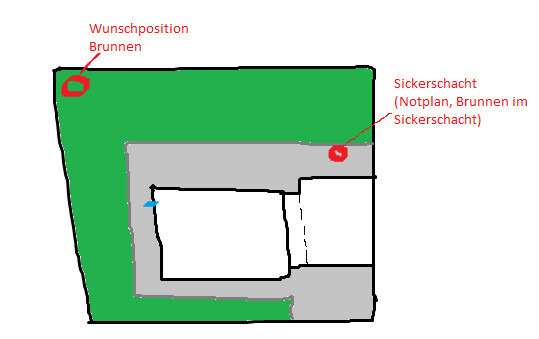
I was thinking to place the well as far away from the house as possible to avoid any ground settlement over the years caused by water or sand extraction.
If that is not an issue, I could theoretically use the existing soakaway pit (already 4 meters (13 feet) deep and lined with concrete rings) and drive a well there. The advantage would be gaining 4 meters (13 feet) of depth security, as the pump would be located at about -4 meters (-13 feet). The disadvantage is that it is close to the garage and located on a paved area — potential risk of settlement?
I am attaching a sketch of the property.
Thank you in advance!
I would like to gather your opinions, experiences, and tips regarding wells for garden irrigation.
We are planning to sow lawn in spring, about 450 m² (4900 sq ft). I would like to set up automatic irrigation using Hunter or Rainbird systems.
The existing water connection from the house is too weak (18 l/min, 1100 l/h [4.75 gpm, 290 gph]).
There is no cistern since we have always wanted a well.
In the neighborhood (about 50 meters (55 yards) away), there are already wells, with water at approximately 7 meters (23 feet) depth.
Now the question about the type of well: driven well or drilled well?
Driven well:
- What are your experiences: how much flow (volume per hour) can be taken from a driven well without overloading it? Is such a well suitable for automatic irrigation?
- Which pumps would you recommend for that?
- What did it cost you? Either price per meter or all-in cost?
Drilled well:
- I have not received any quotes yet, but according to my research, it is significantly more expensive than a driven well. However, capacity should not be a problem, right?
- I recently read a tip from Rick in the well topic about pump types. Are these suitable for automatic irrigation?
- What did it cost you? Either price per meter or all-in cost?
What are your general experiences with wells?
I was thinking to place the well as far away from the house as possible to avoid any ground settlement over the years caused by water or sand extraction.
If that is not an issue, I could theoretically use the existing soakaway pit (already 4 meters (13 feet) deep and lined with concrete rings) and drive a well there. The advantage would be gaining 4 meters (13 feet) of depth security, as the pump would be located at about -4 meters (-13 feet). The disadvantage is that it is close to the garage and located on a paved area — potential risk of settlement?
I am attaching a sketch of the property.
Thank you in advance!
Information about the drilled well:
The neighbor said theirs was drilled 7.5 meters (25 feet) deep.
Yield 4500 liters per hour (1200 gallons per hour) 😳
It cost 600 € two years ago...
This afternoon, I was already mentally preparing to drill myself. Now, after the conversation, I'm back to 50/50.
The neighbor said theirs was drilled 7.5 meters (25 feet) deep.
Yield 4500 liters per hour (1200 gallons per hour) 😳
It cost 600 € two years ago...
This afternoon, I was already mentally preparing to drill myself. Now, after the conversation, I'm back to 50/50.
Hello everyone,
in the past few days, a well driller visited who has already drilled wells in the neighborhood. He said it would be possible to drill a well inside the soakaway shaft.
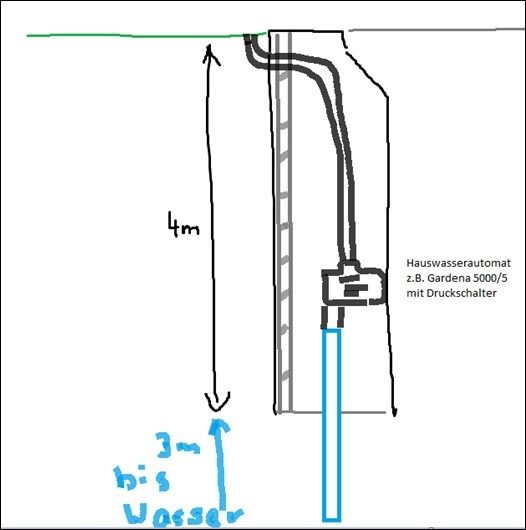
The water table is at 7 meters (23 feet). The soakaway shaft is 4 meters (13 feet) deep, so he would only need to drill 3 to 4 meters (10 to 13 feet) down. Based on his experience, we should be able to extract 3 to 4 m³/h. He is asking for 600. He is only available in 2 to 3 months, but I have already confirmed with him.
Now I am in the process of planning and preparing everything.
- Electrical wiring is already installed in the shaft
- Now a 4-meter (13 feet) deep fixed ladder needs to be installed, which I will attach to the shaft wall
- Decision to be made about the type of pump: pressure booster pump (house water booster pump) or domestic water system (pressure tank system)? From what I’ve read so far, a pressure booster pump with a pressure switch (either integrated or separate) is recommended
- Pump position: not directly on the bottom of the shaft because last summer I didn’t observe whether water rises there during heavy rainfall or if it still infiltrates immediately.
So I would hang the pump about 1 meter (3 feet) above the bottom (meaning the pump would have to suck water from 4 meters (13 feet) down and then pump it up 3 meters (10 feet))
This is how I imagine it: The pump runs continuously and pumps against a closed valve. => If the valve is closed, no water flows, but pressure builds up. I control this closed valve or valves remotely using actuators from Hunter and open or close them remotely. When the valve is opened, the centrifugal pump in the soakaway shaft pumps water into the respective zone feeding the gear-driven sprinklers. Valve closed -> irrigation stops.
=> Is this approach feasible? Does the pump wear out quickly because it is running continuously? How is the water filling process for the centrifugal pump? I have never had a centrifugal pump before. Is the water fill a one-time operation when commissioning, or does it need to be done weekly or monthly? That would be inconvenient because I would have to enter the shaft regularly. Is an expansion tank like those used for heating systems necessary? Is this setup even feasible with a drilled well and a centrifugal pump? Or is this only possible with drilled boreholes and a high-pressure pump?
I would appreciate suggestions or corrections.
Thanks in advance.
Attached is the sketch of the shaft
in the past few days, a well driller visited who has already drilled wells in the neighborhood. He said it would be possible to drill a well inside the soakaway shaft.
The water table is at 7 meters (23 feet). The soakaway shaft is 4 meters (13 feet) deep, so he would only need to drill 3 to 4 meters (10 to 13 feet) down. Based on his experience, we should be able to extract 3 to 4 m³/h. He is asking for 600. He is only available in 2 to 3 months, but I have already confirmed with him.
Now I am in the process of planning and preparing everything.
- Electrical wiring is already installed in the shaft
- Now a 4-meter (13 feet) deep fixed ladder needs to be installed, which I will attach to the shaft wall
- Decision to be made about the type of pump: pressure booster pump (house water booster pump) or domestic water system (pressure tank system)? From what I’ve read so far, a pressure booster pump with a pressure switch (either integrated or separate) is recommended
- Pump position: not directly on the bottom of the shaft because last summer I didn’t observe whether water rises there during heavy rainfall or if it still infiltrates immediately.
So I would hang the pump about 1 meter (3 feet) above the bottom (meaning the pump would have to suck water from 4 meters (13 feet) down and then pump it up 3 meters (10 feet))
This is how I imagine it: The pump runs continuously and pumps against a closed valve. => If the valve is closed, no water flows, but pressure builds up. I control this closed valve or valves remotely using actuators from Hunter and open or close them remotely. When the valve is opened, the centrifugal pump in the soakaway shaft pumps water into the respective zone feeding the gear-driven sprinklers. Valve closed -> irrigation stops.
=> Is this approach feasible? Does the pump wear out quickly because it is running continuously? How is the water filling process for the centrifugal pump? I have never had a centrifugal pump before. Is the water fill a one-time operation when commissioning, or does it need to be done weekly or monthly? That would be inconvenient because I would have to enter the shaft regularly. Is an expansion tank like those used for heating systems necessary? Is this setup even feasible with a drilled well and a centrifugal pump? Or is this only possible with drilled boreholes and a high-pressure pump?
I would appreciate suggestions or corrections.
Thanks in advance.
Attached is the sketch of the shaft

@rick2018: Thanks for the tip, I’m now considering the Tipp 4400.
I had the idea to also install the valve box in a chamber.
Now I want to roughly determine the number of zones. What I’m still unsure about is the throw radius of the sprinklers — that is, the spacing between them.
For example, if I use the Hunter I20, the throw radius is listed as 4.9–14 meters (16–46 feet). What mainly affects the throw radius in practice? The chosen nozzle or the pressure in the line from the pump?
How should I proceed in this example? If the throw radius varies between 4.9 and 14 meters (16 and 46 feet), at what distance should I place the next sprinkler?
I had the idea to also install the valve box in a chamber.
Now I want to roughly determine the number of zones. What I’m still unsure about is the throw radius of the sprinklers — that is, the spacing between them.
For example, if I use the Hunter I20, the throw radius is listed as 4.9–14 meters (16–46 feet). What mainly affects the throw radius in practice? The chosen nozzle or the pressure in the line from the pump?
How should I proceed in this example? If the throw radius varies between 4.9 and 14 meters (16 and 46 feet), at what distance should I place the next sprinkler?
Use a proper well pump like the Tipp 30082 AJ4 plus.
The Tipp 4400 is not very effective in terms of pressure and flow rate.
I recommend the sprinklers from the MP Rotator series. They all have the same housing (preferably the pressure-regulated ones) and only different heads.
Models like the i20 or similar have higher water consumption and require more planning (flow rate, precipitation rate, etc.).
I have already shared quite a bit about sprinkler arrangement in other threads.
The sprinklers need to cover each other. For example, with a throw radius of 5 meters (16 feet), the next sprinkler should be positioned at about 5 meters (16 feet).
With pressure-regulated housings, only the sprinkler head matters, allowing more uniform coverage.
You should have at least 2.8 bar (41 psi) at each sprinkler. It’s best to use DN32 PE-HD pipes (about 1.25 inch diameter) for the plumbing. The valves should have the same diameter to reduce losses in the pipes.
With a sketch, it would be easier to provide more precise advice.
The Tipp 4400 is not very effective in terms of pressure and flow rate.
I recommend the sprinklers from the MP Rotator series. They all have the same housing (preferably the pressure-regulated ones) and only different heads.
Models like the i20 or similar have higher water consumption and require more planning (flow rate, precipitation rate, etc.).
I have already shared quite a bit about sprinkler arrangement in other threads.
The sprinklers need to cover each other. For example, with a throw radius of 5 meters (16 feet), the next sprinkler should be positioned at about 5 meters (16 feet).
With pressure-regulated housings, only the sprinkler head matters, allowing more uniform coverage.
You should have at least 2.8 bar (41 psi) at each sprinkler. It’s best to use DN32 PE-HD pipes (about 1.25 inch diameter) for the plumbing. The valves should have the same diameter to reduce losses in the pipes.
With a sketch, it would be easier to provide more precise advice.
I will add a sketch later.
Regarding the pump: since I will have a dug well, I cannot use submersible pumps, only domestic water pressure systems. The TIP4400 operates at a maximum of 4.4 bar (64 psi) and 4200 liters per hour (1109 gallons per hour), while the Gardena 5000/5 runs at 5 bar (73 psi) and 5000 liters per hour (1320 gallons per hour). As the well is not finished yet, I don’t know the maximum flow rate I can get, regardless of the pump.
Based on the well builder’s experience, the flow rate should be between 3000 and 4000 liters per hour (792 to 1056 gallons per hour). Therefore, both pumps would work, with the main difference being the pressure in the pipeline.
Regarding the pump: since I will have a dug well, I cannot use submersible pumps, only domestic water pressure systems. The TIP4400 operates at a maximum of 4.4 bar (64 psi) and 4200 liters per hour (1109 gallons per hour), while the Gardena 5000/5 runs at 5 bar (73 psi) and 5000 liters per hour (1320 gallons per hour). As the well is not finished yet, I don’t know the maximum flow rate I can get, regardless of the pump.
Based on the well builder’s experience, the flow rate should be between 3000 and 4000 liters per hour (792 to 1056 gallons per hour). Therefore, both pumps would work, with the main difference being the pressure in the pipeline.
Similar topics