
Hello everyone,
I would like to gather your opinions, experiences, and tips regarding wells for garden irrigation.
We are planning to sow lawn in spring, about 450 m² (4900 sq ft). I would like to set up automatic irrigation using Hunter or Rainbird systems.
The existing water connection from the house is too weak (18 l/min, 1100 l/h [4.75 gpm, 290 gph]).
There is no cistern since we have always wanted a well.
In the neighborhood (about 50 meters (55 yards) away), there are already wells, with water at approximately 7 meters (23 feet) depth.
Now the question about the type of well: driven well or drilled well?
Driven well:
- What are your experiences: how much flow (volume per hour) can be taken from a driven well without overloading it? Is such a well suitable for automatic irrigation?
- Which pumps would you recommend for that?
- What did it cost you? Either price per meter or all-in cost?
Drilled well:
- I have not received any quotes yet, but according to my research, it is significantly more expensive than a driven well. However, capacity should not be a problem, right?
- I recently read a tip from Rick in the well topic about pump types. Are these suitable for automatic irrigation?
- What did it cost you? Either price per meter or all-in cost?
What are your general experiences with wells?
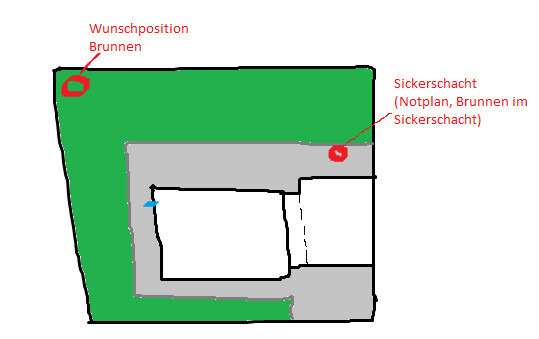
I was thinking to place the well as far away from the house as possible to avoid any ground settlement over the years caused by water or sand extraction.
If that is not an issue, I could theoretically use the existing soakaway pit (already 4 meters (13 feet) deep and lined with concrete rings) and drive a well there. The advantage would be gaining 4 meters (13 feet) of depth security, as the pump would be located at about -4 meters (-13 feet). The disadvantage is that it is close to the garage and located on a paved area — potential risk of settlement?
I am attaching a sketch of the property.
Thank you in advance!
I would like to gather your opinions, experiences, and tips regarding wells for garden irrigation.
We are planning to sow lawn in spring, about 450 m² (4900 sq ft). I would like to set up automatic irrigation using Hunter or Rainbird systems.
The existing water connection from the house is too weak (18 l/min, 1100 l/h [4.75 gpm, 290 gph]).
There is no cistern since we have always wanted a well.
In the neighborhood (about 50 meters (55 yards) away), there are already wells, with water at approximately 7 meters (23 feet) depth.
Now the question about the type of well: driven well or drilled well?
Driven well:
- What are your experiences: how much flow (volume per hour) can be taken from a driven well without overloading it? Is such a well suitable for automatic irrigation?
- Which pumps would you recommend for that?
- What did it cost you? Either price per meter or all-in cost?
Drilled well:
- I have not received any quotes yet, but according to my research, it is significantly more expensive than a driven well. However, capacity should not be a problem, right?
- I recently read a tip from Rick in the well topic about pump types. Are these suitable for automatic irrigation?
- What did it cost you? Either price per meter or all-in cost?
What are your general experiences with wells?
I was thinking to place the well as far away from the house as possible to avoid any ground settlement over the years caused by water or sand extraction.
If that is not an issue, I could theoretically use the existing soakaway pit (already 4 meters (13 feet) deep and lined with concrete rings) and drive a well there. The advantage would be gaining 4 meters (13 feet) of depth security, as the pump would be located at about -4 meters (-13 feet). The disadvantage is that it is close to the garage and located on a paved area — potential risk of settlement?
I am attaching a sketch of the property.
Thank you in advance!

The tip pump I mentioned also works well with wells and provides sufficient delivery height. It really offers excellent value for the price. We recently installed another one at a friend's place. Only if the water is very sandy do you need pumps that can handle larger and more particles.
You can use a well to supply irrigation (if there is enough water available). I personally use Wilo pumps. I also have different sizes, and the budget was not exactly tight.
We also have a well, but it is only occasionally pumped into the cistern. It has been officially documented for 130 years. Initially, we were prohibited from using it (with a permanently installed pump). After extensive documentation, phone calls, and so on, we now have written permission to use it. We won’t need to rely on it anytime soon anyway, as the cistern is full to the brim with 76,000 liters (20,066 gallons).
You can use a well to supply irrigation (if there is enough water available). I personally use Wilo pumps. I also have different sizes, and the budget was not exactly tight.
We also have a well, but it is only occasionally pumped into the cistern. It has been officially documented for 130 years. Initially, we were prohibited from using it (with a permanently installed pump). After extensive documentation, phone calls, and so on, we now have written permission to use it. We won’t need to rely on it anytime soon anyway, as the cistern is full to the brim with 76,000 liters (20,066 gallons).
I am currently researching how to drill a well myself... At the same time, I will bother the neighbors in the new housing development and conduct tests with them to see what kind of output can be achieved from a drilled well in this area.
To be honest, I’m not very keen on drilling myself 🙂 Spending a few weeks digging like a mole doesn’t sound appealing. Having someone else drill the well sounds more tempting 🙂 But if the yield is too low, I might have no choice but to drill myself...
@rick2018: What flow rate per hour should the well provide to properly plan irrigation for a 450 m² (4,844 ft²) area? If the output is too low, should the number of irrigation zones be increased? Hypothetically: only 2 sprinklers per zone and run them sequentially?
Thanks to everyone and best regards
To be honest, I’m not very keen on drilling myself 🙂 Spending a few weeks digging like a mole doesn’t sound appealing. Having someone else drill the well sounds more tempting 🙂 But if the yield is too low, I might have no choice but to drill myself...
@rick2018: What flow rate per hour should the well provide to properly plan irrigation for a 450 m² (4,844 ft²) area? If the output is too low, should the number of irrigation zones be increased? Hypothetically: only 2 sprinklers per zone and run them sequentially?
Thanks to everyone and best regards
@FF2677
It would of course be ideal if the output capacity exceeds the pump’s maximum flow rate.
Circuits that are too large are not always beneficial either (shadow zones, etc.).
If there is insufficient flow, simply reduce the circuit lengths.
Anything from 2000 to 3000 liters per hour (560 to 790 gallons per hour) is already comfortable.
I run with 20,000 liters per hour (5300 gallons per hour) in the distribution circuit :p
It would of course be ideal if the output capacity exceeds the pump’s maximum flow rate.
Circuits that are too large are not always beneficial either (shadow zones, etc.).
If there is insufficient flow, simply reduce the circuit lengths.
Anything from 2000 to 3000 liters per hour (560 to 790 gallons per hour) is already comfortable.
I run with 20,000 liters per hour (5300 gallons per hour) in the distribution circuit :p
rick2018 schrieb:
@FF2677
It would be great if the delivered volume exceeds the pump’s maximum capacity.
Too large loops aren’t always ideal either (shadow zones, etc.).
If there is insufficient flow, simply reduce the size of the loops.
Anything from 2000–3000 liters/hour (530–790 gallons/hour) is already comfortable.
I operate at 20,000 liters/hour (5300 gallons/hour) in the distribution circuit :p 20,000 liters/hour (5300 gallons/hour) – wow… that would be enough for an entire street here 😱.
G
Gartenfreund1 Mar 2021 06:34My suggestion is to choose a drilled well (we also have one) instead of a driven well.
If you look at various forums about wells and related problems, there are literally thousands of posts where people have issues with suction pumps or domestic water systems. You often read that something is leaking somewhere, so no water is being delivered, or that you constantly have to refill water on the suction side just to get anything drawn. In contrast, there are only very few posts about problems with pressure pumps.
Sure, a drilled well costs more than a driven well, but apparently, this higher investment pays off in the long run due to less trouble and lower repair costs.
One more thing: if you choose a drilled well, make sure the inner diameter of the well casing is not so small that the pump barely fits inside by diameter. It should be at least one size larger.
If you look at various forums about wells and related problems, there are literally thousands of posts where people have issues with suction pumps or domestic water systems. You often read that something is leaking somewhere, so no water is being delivered, or that you constantly have to refill water on the suction side just to get anything drawn. In contrast, there are only very few posts about problems with pressure pumps.
Sure, a drilled well costs more than a driven well, but apparently, this higher investment pays off in the long run due to less trouble and lower repair costs.
One more thing: if you choose a drilled well, make sure the inner diameter of the well casing is not so small that the pump barely fits inside by diameter. It should be at least one size larger.
Similar topics