
Hello everyone,
I would like to gather your opinions, experiences, and tips regarding wells for garden irrigation.
We are planning to sow lawn in spring, about 450 m² (4900 sq ft). I would like to set up automatic irrigation using Hunter or Rainbird systems.
The existing water connection from the house is too weak (18 l/min, 1100 l/h [4.75 gpm, 290 gph]).
There is no cistern since we have always wanted a well.
In the neighborhood (about 50 meters (55 yards) away), there are already wells, with water at approximately 7 meters (23 feet) depth.
Now the question about the type of well: driven well or drilled well?
Driven well:
- What are your experiences: how much flow (volume per hour) can be taken from a driven well without overloading it? Is such a well suitable for automatic irrigation?
- Which pumps would you recommend for that?
- What did it cost you? Either price per meter or all-in cost?
Drilled well:
- I have not received any quotes yet, but according to my research, it is significantly more expensive than a driven well. However, capacity should not be a problem, right?
- I recently read a tip from Rick in the well topic about pump types. Are these suitable for automatic irrigation?
- What did it cost you? Either price per meter or all-in cost?
What are your general experiences with wells?
I was thinking to place the well as far away from the house as possible to avoid any ground settlement over the years caused by water or sand extraction.
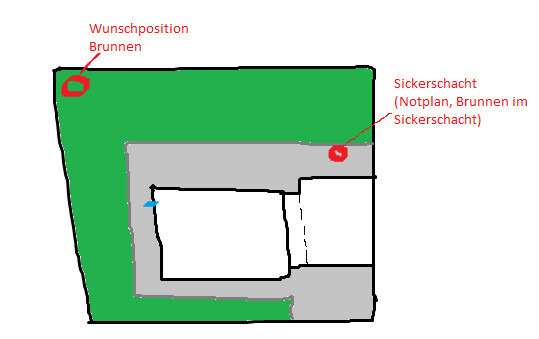
If that is not an issue, I could theoretically use the existing soakaway pit (already 4 meters (13 feet) deep and lined with concrete rings) and drive a well there. The advantage would be gaining 4 meters (13 feet) of depth security, as the pump would be located at about -4 meters (-13 feet). The disadvantage is that it is close to the garage and located on a paved area — potential risk of settlement?
I am attaching a sketch of the property.
Thank you in advance!
I would like to gather your opinions, experiences, and tips regarding wells for garden irrigation.
We are planning to sow lawn in spring, about 450 m² (4900 sq ft). I would like to set up automatic irrigation using Hunter or Rainbird systems.
The existing water connection from the house is too weak (18 l/min, 1100 l/h [4.75 gpm, 290 gph]).
There is no cistern since we have always wanted a well.
In the neighborhood (about 50 meters (55 yards) away), there are already wells, with water at approximately 7 meters (23 feet) depth.
Now the question about the type of well: driven well or drilled well?
Driven well:
- What are your experiences: how much flow (volume per hour) can be taken from a driven well without overloading it? Is such a well suitable for automatic irrigation?
- Which pumps would you recommend for that?
- What did it cost you? Either price per meter or all-in cost?
Drilled well:
- I have not received any quotes yet, but according to my research, it is significantly more expensive than a driven well. However, capacity should not be a problem, right?
- I recently read a tip from Rick in the well topic about pump types. Are these suitable for automatic irrigation?
- What did it cost you? Either price per meter or all-in cost?
What are your general experiences with wells?
I was thinking to place the well as far away from the house as possible to avoid any ground settlement over the years caused by water or sand extraction.
If that is not an issue, I could theoretically use the existing soakaway pit (already 4 meters (13 feet) deep and lined with concrete rings) and drive a well there. The advantage would be gaining 4 meters (13 feet) of depth security, as the pump would be located at about -4 meters (-13 feet). The disadvantage is that it is close to the garage and located on a paved area — potential risk of settlement?
I am attaching a sketch of the property.
Thank you in advance!
Alex124 schrieb:
Hi,
where do you live? I could lend you my drilling device, which fits disassembled into any station wagon. If there’s no large rock, this can be done on a Saturday.Hi, pretty much halfway between Stuttgart and Munich. What drilling diameter do you have?
Thank you very much!!!
How much water can you extract from the drilled well?
Hmm, that's a pity, it’s probably a bit too far away (Koblenz).
I have diameters of 20cm (8 inches) and 10cm (4 inches). Since my pump only handles 10,000 liters per hour, I’m not sure how much more it could manage.
The best solution we’ve done so far with a friend was to excavate a well and install concrete rings. With a pump from the fire department, they handled 30,000 liters easily. However, most people should be fine with a drilled well at 5,000 liters. I wouldn’t recommend driving it in (pile driving), it’s neither here nor there.
I have diameters of 20cm (8 inches) and 10cm (4 inches). Since my pump only handles 10,000 liters per hour, I’m not sure how much more it could manage.
The best solution we’ve done so far with a friend was to excavate a well and install concrete rings. With a pump from the fire department, they handled 30,000 liters easily. However, most people should be fine with a drilled well at 5,000 liters. I wouldn’t recommend driving it in (pile driving), it’s neither here nor there.
Alex124 schrieb:
hmm too bad, it’s probably a bit too far away (Koblenz).
I have diameters of 20cm (8 inches) and 10cm (4 inches). Since my pump only manages 10,000 liters per hour, I don’t really know how much more it could handle.
The best setup we’ve done so far at a friend’s place was digging out a well and installing concrete rings. With a fire department pump, we easily managed 30,000 liters. Most people should be fine with a drilled well using 5,000 liters, though. I wouldn’t recommend driving rods into the ground—it’s not really effective. Yes, it’s a bit of a distance.
From what I understand so far about drilling your own well:
- You drill down with drill rod extensions until you reach water.
- Then you lower the blue pipes with the filter, and at the very end, you secure the blue pipe with wooden beams, add some weight, and start “plunschen” (manual pumping/jerking).
- For example, if I find water at 7 meters (23 feet), I’d continue “plunschen” for another 3 meters (10 feet).
- Pipe setup from bottom to top: 1 meter (3 feet) pipe with a seal, 2 meters (6.5 feet) filter section, 7 meters (23 feet) pipe (what filter size should be used here?).
- Should I build a pulley with a ladder over the borehole for “plunschen,” or can it be done without that?
- Also unclear is that some people mention working with “KG pipes” (PVC drainage pipes). Does that make sense? What are the advantages, and how does one proceed with that?
PS: Alex124, thanks again for your kind offer!
Hi, I can only reply briefly right now.
The KG pipe is used just as a support pipe to prevent too much soil from collapsing into the hole down to the groundwater. Whether you need it or not depends on the local conditions. Ideally, it extends about 4 meters (13 feet) below the water level. The pipe setup is a matter of preference; I would leave it open at the bottom. From bottom to top in the water: 1 meter (3 feet) of pipe, 2 meters (6.5 feet) of filter section with 0.3mm (0.01 inch) slits, then 1 meter (3 feet) of pipe.
Lowering the pipe without assistance like a winch, pulley, etc., will be very difficult—you probably won’t manage it alone. Don’t exhaust yourself. Make sure you have enough weights. The load can easily reach half a ton. It’s better to install a protective steel ring at the bottom of the pipe to prevent damage at that point.
The KG pipe is used just as a support pipe to prevent too much soil from collapsing into the hole down to the groundwater. Whether you need it or not depends on the local conditions. Ideally, it extends about 4 meters (13 feet) below the water level. The pipe setup is a matter of preference; I would leave it open at the bottom. From bottom to top in the water: 1 meter (3 feet) of pipe, 2 meters (6.5 feet) of filter section with 0.3mm (0.01 inch) slits, then 1 meter (3 feet) of pipe.
Lowering the pipe without assistance like a winch, pulley, etc., will be very difficult—you probably won’t manage it alone. Don’t exhaust yourself. Make sure you have enough weights. The load can easily reach half a ton. It’s better to install a protective steel ring at the bottom of the pipe to prevent damage at that point.
FF2677 schrieb:
- what is still unclear, some write about working inside the KG pipe...? Hello
This is a so-called casing pipe. It is necessary when you have soil or gravel that keeps collapsing or sliding in. No matter how much you drill, you won’t get any deeper without it. That’s why you use a casing pipe (for example, a 175mm (7 inch) KG pipe), and you drill through this casing pipe. You remove material, bring it up, and the casing pipe sinks deeper before any other material can collapse inside. Once you reach water, you have to pump inside the well pipe anyway. This works the same way: material mixed with water enters the pump, you bring it up, and the well pipe sinks deeper.
I would use one meter (3 feet) of standard well pipe, then 2 to 3 filter pipes, and the rest regular well pipe. The bottom well pipe remains open at the bottom. Once finished, you pour in special granulate. This seals downward to prevent material being pulled in and contaminating the inside of the pipe.
That was the short summary.
Steven