
Our construction will start in 1 to 2 weeks, and we need to finalize the placement of the recessed ceiling lights in the prefabricated ceiling.
Currently, we have planned them as follows (see image):
Hallway: 6 units
Living room: 9 units
Kitchen: 8 units
Different lighting concepts will be used in the other rooms.
Is this number sufficient with this layout, or should the spacing be reduced?
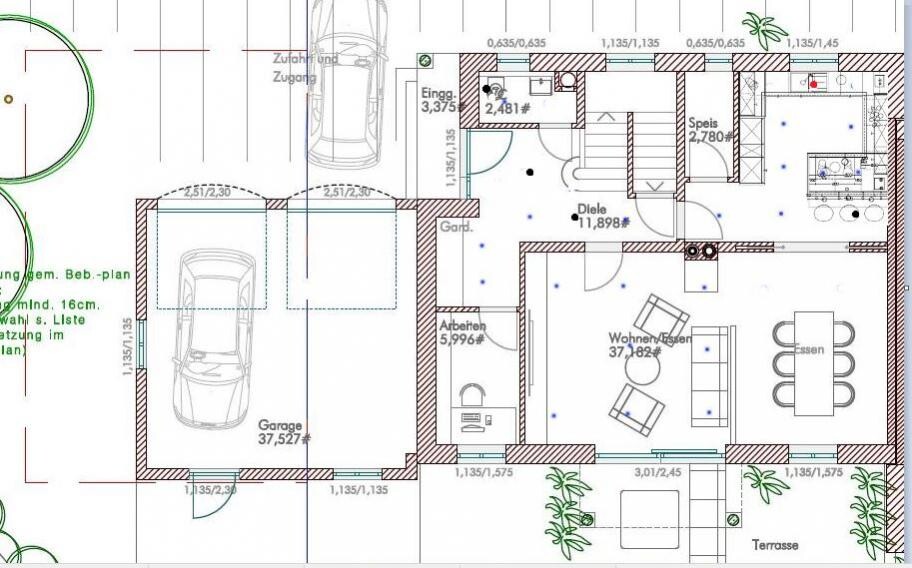
Currently, we have planned them as follows (see image):
Hallway: 6 units
Living room: 9 units
Kitchen: 8 units
Different lighting concepts will be used in the other rooms.
Is this number sufficient with this layout, or should the spacing be reduced?

Our posts overlapped. As I said, according to our electrician, the cost is well over 500 Euro. And we only did the substructure ourselves. The electrician connects everything and also handles the inspection and so on. But it doesn't really matter... If I say upfront that 500 Euro is a "drop in the bucket," then it keeps going like that, and in the end, you go over budget and have to finance more... no, no, no... not with us. No offense.

That’s exactly why good planning always includes a sufficient buffer for these extras. But we’re getting off topic. Do what you think is best.
Perhaps as an additional note: You seem to be planning to use so-called retrofit solutions, meaning LED bulbs that were originally designed for halogen fixtures (such as GU10 solutions). While these have improved quite a bit, they still have some disadvantages compared to LED solutions developed from scratch. On the plus side, they are available at a lower cost. The issue isn’t about whether one or two lamps hang in the hallway, but how to provide adequate and sensible lighting for the rooms overall.
Regarding the peanuts (this comes from English and is spelled that way): No one mentioned small amounts of money, not even me. However, my overarching goal—as probably many others here—is to build my dream home, and compromises of any kind don’t fit into that. That doesn’t mean I have unlimited funds, but I do have a financial buffer available.
Good luck
K1300S
Perhaps as an additional note: You seem to be planning to use so-called retrofit solutions, meaning LED bulbs that were originally designed for halogen fixtures (such as GU10 solutions). While these have improved quite a bit, they still have some disadvantages compared to LED solutions developed from scratch. On the plus side, they are available at a lower cost. The issue isn’t about whether one or two lamps hang in the hallway, but how to provide adequate and sensible lighting for the rooms overall.
Regarding the peanuts (this comes from English and is spelled that way): No one mentioned small amounts of money, not even me. However, my overarching goal—as probably many others here—is to build my dream home, and compromises of any kind don’t fit into that. That doesn’t mean I have unlimited funds, but I do have a financial buffer available.
Good luck
K1300S

K1300S schrieb:
Perhaps as an addition: You are apparently planning to use so-called retrofit solutions, meaning LED bulbs that were originally designed for halogen fixtures (such as GU10 solutions). While these have improved significantly, they still have some disadvantages compared to LED solutions developed from scratch. Unlike the newly developed options, this "retrofit" variant does have the advantage that you can replace the light bulbs if needed, without having to discard the entire fixture. However, thanks to our consumer society, this seems to have become less important.
I also would argue that at least 95% of home builders cannot afford their dream home but instead build a house full of compromises according to their budget. If you belong to the remaining 5%, you can consider yourself lucky.
On one hand, there are indeed genuine LED solutions with replaceable LED modules, but on the other hand, I consider this option only theoretically necessary. By the time the 50,000 operating hours are used up, so many things will have changed anyway that I would rather install something new and modern right away. It’s also a matter of trends.
That aside, we’re not talking about golden faucets here—nor huge expenses, especially relative to the house price. Ultimately, it probably comes down to the level of expectation regarding which solution is acceptable.
Good luck
K1300S
That aside, we’re not talking about golden faucets here—nor huge expenses, especially relative to the house price. Ultimately, it probably comes down to the level of expectation regarding which solution is acceptable.
Good luck
K1300S
Hello everyone, dear K1300S,
I assume that your LED solution is based on a constant current or constant voltage driver to operate the LED.
The advantage of this system is that the LEDs can be dimmed somewhat better than retrofit LEDs, but only in the lower percentage range, up to about 30%, and below 30%, hardly any light reaches the floor anyway.
Moreover, this “future system” is simply still too expensive.
When you look at the individual components needed, you quickly start to question where you are supposed to save electricity costs again.
Regarding your huge sums, I think the costs can escalate quite quickly here.
My Osram LEDs cost €10 (about US$11) each (7.5W), and the solution you mentioned, for example from Brumberg, costs around €60 (about US$66) per unit and does not offer the color tone or brightness I expected (I tested it myself, because my neighbor insisted on installing them).
For 33 units, that’s already a €1,650 (about US$1,815) difference. On top of that, every lamp or every third lamp from Brumberg also requires a corresponding driver that costs around €15 (about US$16). And if you only have a 3-wire cable in your ceiling, you can’t use this system because of the necessary drivers (my neighbor had this problem).
By the way, I still have 23 units of the Brumberg lamps, because my neighbor made a wrong purchase. If you’re really into this “new” technology, send me a private message—I can sell them to you.
My tip:
Install a 5-wire cable in every junction box and run the supply line individually from the electrical panel, not from the switch. Also use a 5-wire connection from the switch to the panel.
Then, in 10 years, you can easily upgrade if these systems become available at the price of an incandescent bulb.
About the space:
What you’re saying is simply not true. These overpriced HaloxP boxes are significantly smaller than the solution I suggested, both in height and diameter.
There is enough space to install a transformer or constant current/constant voltage dimmer, and I also have more air volume for cooling.
I fully understand Kisska86’s point, and you don’t have to take everything the industry presents as golden.
In the past, for example, metal biscuit tins were used and cast into the ceiling. Those houses are still standing...
Of course, you should discuss such an approach with a structural engineer.
An installation box should cost me €40 (about US$44); I have 33 pieces, so a total of €1,320 (about US$1,450). I had only €40 (about US$44) material cost for everything else, plus a full Saturday of work, about 10 hours, let’s say $200 labor cost for me.
So I keep a good €1,000 (about US$1,100), which I gladly invest in other things instead of just letting it disappear in the ceiling.
Kisska86:
Yes, that job was a bit sweat-inducing for me too, but after the first two holes, it went fairly quickly. My approach:
Start with the hole saw, and when I noticed it hit metal, I stopped. Then I used a rotary hammer with a chisel attachment to chip out the drilled section. Since I already had the circular cut, there was only minimal chipping, and the concrete came out surprisingly easily.
From above, I also removed the rebar with a small angle grinder. Then I drilled again.
If my tone in the first paragraphs was a bit harsh, I apologize.
I’m just tired of hearing all these miracle solutions from every direction that cost a fortune, while at the same time being told, “Those few bucks don’t matter anymore.”
Cheers
I assume that your LED solution is based on a constant current or constant voltage driver to operate the LED.
The advantage of this system is that the LEDs can be dimmed somewhat better than retrofit LEDs, but only in the lower percentage range, up to about 30%, and below 30%, hardly any light reaches the floor anyway.
Moreover, this “future system” is simply still too expensive.
When you look at the individual components needed, you quickly start to question where you are supposed to save electricity costs again.
Regarding your huge sums, I think the costs can escalate quite quickly here.
My Osram LEDs cost €10 (about US$11) each (7.5W), and the solution you mentioned, for example from Brumberg, costs around €60 (about US$66) per unit and does not offer the color tone or brightness I expected (I tested it myself, because my neighbor insisted on installing them).
For 33 units, that’s already a €1,650 (about US$1,815) difference. On top of that, every lamp or every third lamp from Brumberg also requires a corresponding driver that costs around €15 (about US$16). And if you only have a 3-wire cable in your ceiling, you can’t use this system because of the necessary drivers (my neighbor had this problem).
By the way, I still have 23 units of the Brumberg lamps, because my neighbor made a wrong purchase. If you’re really into this “new” technology, send me a private message—I can sell them to you.
My tip:
Install a 5-wire cable in every junction box and run the supply line individually from the electrical panel, not from the switch. Also use a 5-wire connection from the switch to the panel.
Then, in 10 years, you can easily upgrade if these systems become available at the price of an incandescent bulb.
About the space:
What you’re saying is simply not true. These overpriced HaloxP boxes are significantly smaller than the solution I suggested, both in height and diameter.
There is enough space to install a transformer or constant current/constant voltage dimmer, and I also have more air volume for cooling.
I fully understand Kisska86’s point, and you don’t have to take everything the industry presents as golden.
In the past, for example, metal biscuit tins were used and cast into the ceiling. Those houses are still standing...
Of course, you should discuss such an approach with a structural engineer.
An installation box should cost me €40 (about US$44); I have 33 pieces, so a total of €1,320 (about US$1,450). I had only €40 (about US$44) material cost for everything else, plus a full Saturday of work, about 10 hours, let’s say $200 labor cost for me.
So I keep a good €1,000 (about US$1,100), which I gladly invest in other things instead of just letting it disappear in the ceiling.
Kisska86:
Yes, that job was a bit sweat-inducing for me too, but after the first two holes, it went fairly quickly. My approach:
Start with the hole saw, and when I noticed it hit metal, I stopped. Then I used a rotary hammer with a chisel attachment to chip out the drilled section. Since I already had the circular cut, there was only minimal chipping, and the concrete came out surprisingly easily.
From above, I also removed the rebar with a small angle grinder. Then I drilled again.
If my tone in the first paragraphs was a bit harsh, I apologize.
I’m just tired of hearing all these miracle solutions from every direction that cost a fortune, while at the same time being told, “Those few bucks don’t matter anymore.”
Cheers
Thanks, Elektro1!!! I completely agree with you, and especially when it comes to house construction, I often feel like I’m being ripped off to a large extent (sorry for the wording)... Quotes for the same trade can vary by up to 100% between different providers... Well, that’s probably another topic! Oh, and thanks for the tip about the cable. I will pass it on to my husband.
Similar topics