
Hello everyone!
I have been working on planning the LED spotlights in the bathroom of our new build for hours now. I originally thought that 5 spots would be enough, arranged symmetrically. But then the distances between some spots are quite large (140cm (55 inches) and 158cm (62 inches)). I hope you can see all the necessary information on my sketch. Sorry for the poor quality.
Do you have any ideas on how to do it better or differently? Should I just add 2 more spots?
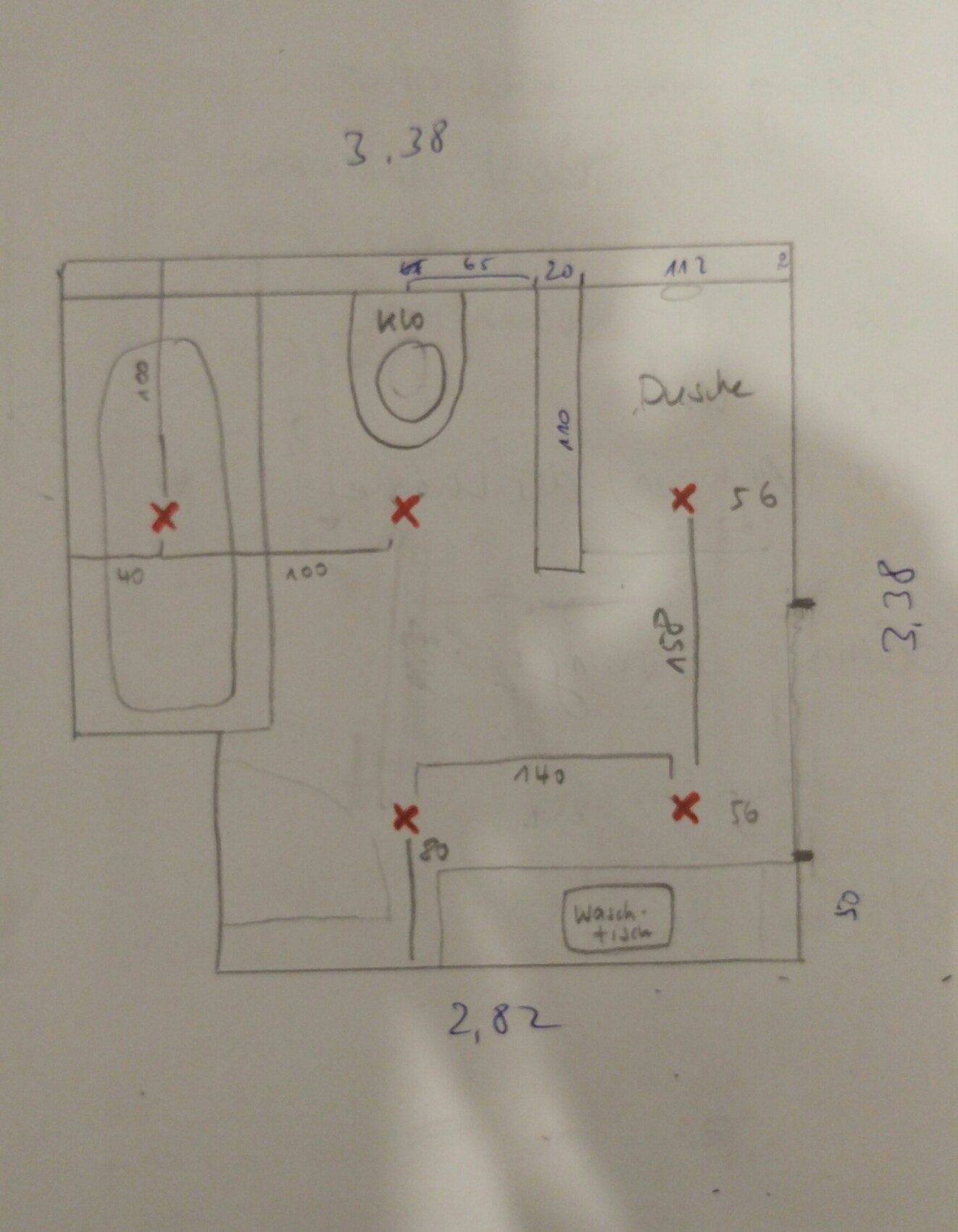
I have been working on planning the LED spotlights in the bathroom of our new build for hours now. I originally thought that 5 spots would be enough, arranged symmetrically. But then the distances between some spots are quite large (140cm (55 inches) and 158cm (62 inches)). I hope you can see all the necessary information on my sketch. Sorry for the poor quality.
Do you have any ideas on how to do it better or differently? Should I just add 2 more spots?
Hello Anna MM
We discussed this topic in detail about two years ago,
perhaps some of our considerations can also help you.
Light intensity and comfort = function
1) The safe, obstacle-free path to the bathroom at night:
A motion sensor switches on dim, warm light under the vanity cabinet.
When a person goes to the bathroom at night, they don’t want to be suddenly awoken by bright light; the light comes on without a switch.
2) Do you really want the classic ceiling spots that come from the old era of incandescent bulbs?
We chose layered lighting and used the reflection from the walls.
- Use the light from the mirror cabinet as part of the lighting; Swiss bathrooms use just one mirror cabinet to illuminate the entire bathroom. The trick is that the light sources release light fully into the room instead of simply being masked as usual.
Also, the light color switches from comfortable warm white to daylight when the lady of the house wants to apply makeup.
Pay attention to glare-free lighting: who wants to see a “spotlight” while shaving in the morning? It ruins the mood right away. Unfortunately, there is a lot of poor quality lighting on the market.
- Instead of ceiling spots, have you considered wall lights? Light as not just floodlights, but also as a design element when switching on and off.
- Regarding spots: a niche above the cistern or wall projection can be lit from above — the ideal place for a flower or another decoration piece. This adds color accents and atmosphere.
- Oh yes, when the bathroom needs cleaning, it should also be properly bright.
Then old-fashioned fluorescent lamps help, which you can also buy dimmable (and if desired, even with an electronic ballast controllable over 0-1 V for luxury setups). As others have said: you don’t always want very bright daylight color.
In the bathtub, prefer warm tones; for cleaning, daylight colors.
3) Notes on lighting levels
- For work areas: 400 lux
- For detailed tasks/surface work (weekly cleaning): 1000 lux
The light intensity at the surface depends on the distance from the light source; examples:
Wall light
540 lumens at 7 W LED, we installed 2 sets of 2 each.
Specification: 70 to 100 lumens per watt for the bare LED.
The cover usually blocks 50 to 80% of that.
Ceiling fixture, round, dimmable, daylight (true white)
3 to 4 compact fluorescent lamps of 36 W each, 2900 lumens per lamp.
At a ceiling height of 2.7 m (9 feet), this results in about 1000 lux on the floor.
Beware of the specifications: only the light emitted into the room by the fixture is usable; manufacturers often exaggerate here.
Hope this helps.
Oh yes...
most electricians don’t really know lighting design.
Go to a “lighting store” and ask about color temperature — based on the answer, you can usually tell if you will get good advice there.
Enjoy your new comfortable bathroom with plenty of light and few shadows.
We discussed this topic in detail about two years ago,
perhaps some of our considerations can also help you.
Light intensity and comfort = function
1) The safe, obstacle-free path to the bathroom at night:
A motion sensor switches on dim, warm light under the vanity cabinet.
When a person goes to the bathroom at night, they don’t want to be suddenly awoken by bright light; the light comes on without a switch.
2) Do you really want the classic ceiling spots that come from the old era of incandescent bulbs?
We chose layered lighting and used the reflection from the walls.
- Use the light from the mirror cabinet as part of the lighting; Swiss bathrooms use just one mirror cabinet to illuminate the entire bathroom. The trick is that the light sources release light fully into the room instead of simply being masked as usual.
Also, the light color switches from comfortable warm white to daylight when the lady of the house wants to apply makeup.
Pay attention to glare-free lighting: who wants to see a “spotlight” while shaving in the morning? It ruins the mood right away. Unfortunately, there is a lot of poor quality lighting on the market.
- Instead of ceiling spots, have you considered wall lights? Light as not just floodlights, but also as a design element when switching on and off.
- Regarding spots: a niche above the cistern or wall projection can be lit from above — the ideal place for a flower or another decoration piece. This adds color accents and atmosphere.
- Oh yes, when the bathroom needs cleaning, it should also be properly bright.
Then old-fashioned fluorescent lamps help, which you can also buy dimmable (and if desired, even with an electronic ballast controllable over 0-1 V for luxury setups). As others have said: you don’t always want very bright daylight color.
In the bathtub, prefer warm tones; for cleaning, daylight colors.
3) Notes on lighting levels
- For work areas: 400 lux
- For detailed tasks/surface work (weekly cleaning): 1000 lux
The light intensity at the surface depends on the distance from the light source; examples:
Wall light
540 lumens at 7 W LED, we installed 2 sets of 2 each.
Specification: 70 to 100 lumens per watt for the bare LED.
The cover usually blocks 50 to 80% of that.
Ceiling fixture, round, dimmable, daylight (true white)
3 to 4 compact fluorescent lamps of 36 W each, 2900 lumens per lamp.
At a ceiling height of 2.7 m (9 feet), this results in about 1000 lux on the floor.
Beware of the specifications: only the light emitted into the room by the fixture is usable; manufacturers often exaggerate here.
Hope this helps.
Oh yes...
most electricians don’t really know lighting design.
Go to a “lighting store” and ask about color temperature — based on the answer, you can usually tell if you will get good advice there.
Enjoy your new comfortable bathroom with plenty of light and few shadows.
Thank you very much for your tips!
Above the sink/mirror, we will have an additional lamp, which will of course have its own switch so that it can be turned on at night when you don’t want the full “illumination.”
Otherwise, I think we will skip the spotlight above the bathtub, move the two left spots a bit closer to the bathtub, and then add one spot in the center. The arrangement will then be similar to the five dots on a die.
Above the sink/mirror, we will have an additional lamp, which will of course have its own switch so that it can be turned on at night when you don’t want the full “illumination.”
Otherwise, I think we will skip the spotlight above the bathtub, move the two left spots a bit closer to the bathtub, and then add one spot in the center. The arrangement will then be similar to the five dots on a die.

We followed a similar approach as Knallkörper. Using the tangent function, you can calculate the radius of the illuminated area from the ceiling height and half of the beam angle of the LED lights. Then, using a compass, you can scale this onto the floor plan. This way, we arrived at around 8 spots for a similar area.
Similar topics