

Hello, yesterday I spent hours planning downlights in various rooms (kitchen, living room, bathrooms).
Late in the evening, I simulated a downlight in my apartment by removing 2 of 3 GU10 LED bulbs and positioning the remaining one facing straight down.
I found the result surprisingly poor. Of course, it was only one downlight, but even if you repeat them every 1.2–1.5m (4–5 feet), the lighting is completely different. Only the tiles on the floor are illuminated. When standing underneath, you look ghostly. The reflections on the ceiling and especially on the walls are completely missing—these are what make the room feel comfortably lit.
Now I’m thinking of almost completely removing the downlights (kitchen: 9–10, living room: 5–6, bathroom: 9–10, hallway: 4). Only the countertop/sink area would get 2 downlights, and the shower (enclosure) 1.
Have you decided on ceiling downlights? If so, are you happy with them?
A nice side effect: I save a lot of money.
Late in the evening, I simulated a downlight in my apartment by removing 2 of 3 GU10 LED bulbs and positioning the remaining one facing straight down.
I found the result surprisingly poor. Of course, it was only one downlight, but even if you repeat them every 1.2–1.5m (4–5 feet), the lighting is completely different. Only the tiles on the floor are illuminated. When standing underneath, you look ghostly. The reflections on the ceiling and especially on the walls are completely missing—these are what make the room feel comfortably lit.
Now I’m thinking of almost completely removing the downlights (kitchen: 9–10, living room: 5–6, bathroom: 9–10, hallway: 4). Only the countertop/sink area would get 2 downlights, and the shower (enclosure) 1.
Have you decided on ceiling downlights? If so, are you happy with them?
A nice side effect: I save a lot of money.
T
toxicmolotof17 Nov 2016 11:34Are you aware of the difference between a spotlight and a floodlight, aside from their similar external design?
Your lamp probably had a beam angle of 30-36°, but there are also ones with significantly wider angles (usually up to around 110°). In my opinion, there is also a clear difference between using 3W LEDs and 5W LEDs.
What you (and most others) call a spotlight is actually a floodlight.
If you want spotlights, you need point lighting (spots).
Generally, with 5W LEDs at 110° beam angle, a distance of 80-100cm (31-39 inches) works well in hallways or living rooms; in the kitchen, it can be reduced to 60-70cm (24-28 inches), and over the countertop, it can be even greater when using true spotlights.
Regarding the shower... is a rain shower planned? Then you will always be in the shadow. Even without that, install at least 4 spotlights. Believe me, we didn’t have that. You can survive without it, but I would definitely do it differently now.
And definitely no lighting above the bathtub... it always causes glare.
Your lamp probably had a beam angle of 30-36°, but there are also ones with significantly wider angles (usually up to around 110°). In my opinion, there is also a clear difference between using 3W LEDs and 5W LEDs.
What you (and most others) call a spotlight is actually a floodlight.
If you want spotlights, you need point lighting (spots).
Generally, with 5W LEDs at 110° beam angle, a distance of 80-100cm (31-39 inches) works well in hallways or living rooms; in the kitchen, it can be reduced to 60-70cm (24-28 inches), and over the countertop, it can be even greater when using true spotlights.
Regarding the shower... is a rain shower planned? Then you will always be in the shadow. Even without that, install at least 4 spotlights. Believe me, we didn’t have that. You can survive without it, but I would definitely do it differently now.
And definitely no lighting above the bathtub... it always causes glare.
K
Knallkörper17 Nov 2016 12:03I would choose a maximum distance of 1.20 m (4 feet) and only for a linear arrangement. That corresponds to 1.70 m (5.5 feet) diagonally.
Thanks for the tips. A spacing of 60-70cm (24-28 inches) gets incredibly expensive (each core drill with a core bit costs a lot). I don’t want to do it myself.
My LED GU10 light sources were:
a) Osram 5.3W 36°
b) Ebay 8W 90°
The 8W 90° was obviously better, but it didn’t fully convince me. Yes, these are more like floodlights.
No, a rain shower is not planned. It will be a standard shower with a built wall enclosure and a glass door.
Here is my plan from yesterday.
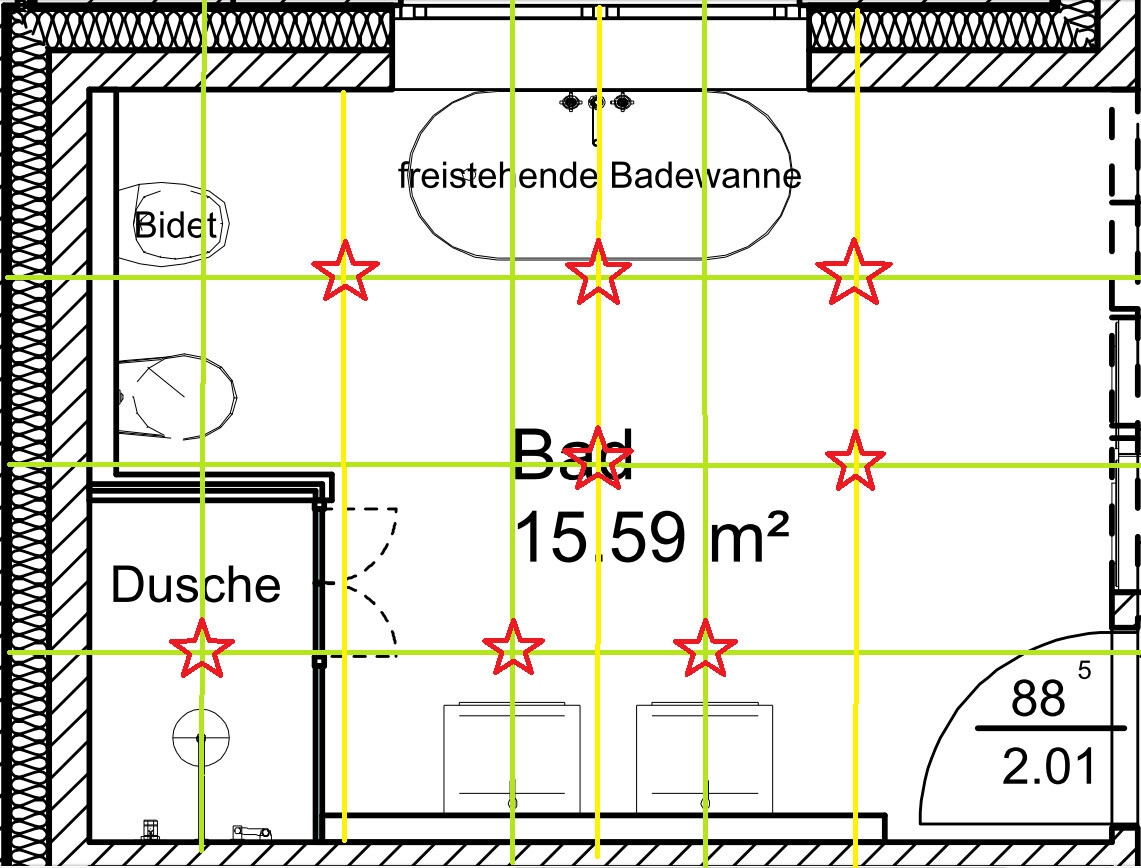
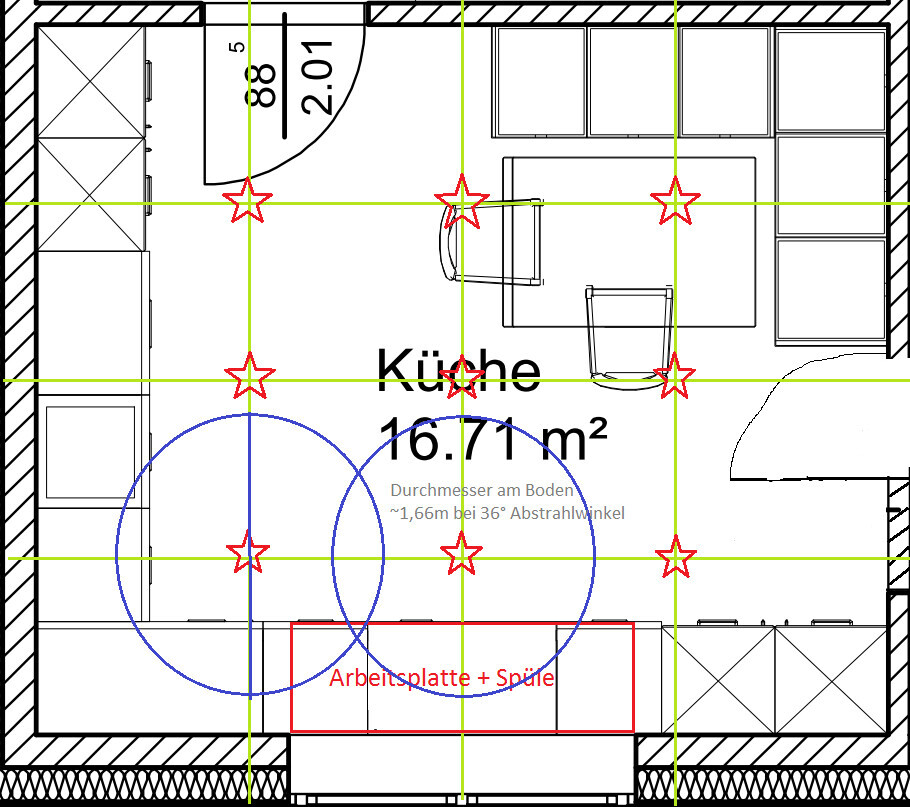
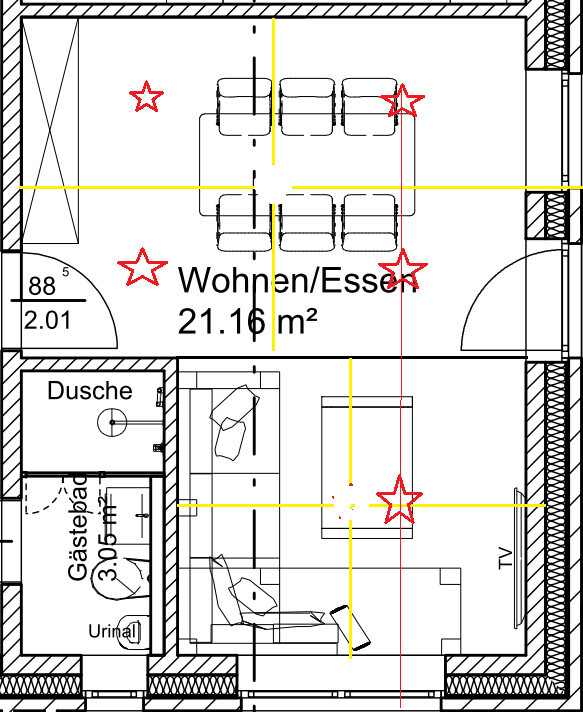
My LED GU10 light sources were:
a) Osram 5.3W 36°
b) Ebay 8W 90°
The 8W 90° was obviously better, but it didn’t fully convince me. Yes, these are more like floodlights.
No, a rain shower is not planned. It will be a standard shower with a built wall enclosure and a glass door.
Here is my plan from yesterday.
T
toxicmolotof17 Nov 2016 21:41Better to avoid those Ebay things altogether.
We used 15W China Ebay LEDs and had to replace almost every fixture twice due to defects within 18 months. The first time, we replaced them with other Ebay products as well. The second time, I was fed up. Since then, I’ve replaced all of them with 5W Philips 110° LEDs with diffusers. Since then, no issues (although they cost 9 instead of 3 euros).
Regarding planning: that just doesn’t work!
Bathroom: Keep away from the bathtub, at least 50 cm (20 inches) distance, or you end up shining light into your face all the time. Place spots directly over the sinks to avoid shadows on your face. Planning additional mirror lights? Definitely makes sense if you have ceiling spots. For the shower, at least a second spot is needed.
Kitchen: Definitely position the spots above the countertop, otherwise you’ll get shadows there as well.
Living room... No experience here. Maybe better to have a dropped ceiling edge with ambient spotlights and a classic central lamp? All with separate switches?
We used 15W China Ebay LEDs and had to replace almost every fixture twice due to defects within 18 months. The first time, we replaced them with other Ebay products as well. The second time, I was fed up. Since then, I’ve replaced all of them with 5W Philips 110° LEDs with diffusers. Since then, no issues (although they cost 9 instead of 3 euros).
Regarding planning: that just doesn’t work!
Bathroom: Keep away from the bathtub, at least 50 cm (20 inches) distance, or you end up shining light into your face all the time. Place spots directly over the sinks to avoid shadows on your face. Planning additional mirror lights? Definitely makes sense if you have ceiling spots. For the shower, at least a second spot is needed.
Kitchen: Definitely position the spots above the countertop, otherwise you’ll get shadows there as well.
Living room... No experience here. Maybe better to have a dropped ceiling edge with ambient spotlights and a classic central lamp? All with separate switches?
G
garfunkel17 Nov 2016 21:52I only have recessed ceiling spotlights in the bedroom and hallway, and I wouldn’t want them throughout the entire apartment.
Nowadays, you can do so much with room lighting, so I find it a shame to limit the light to just top-down.
In my bathroom, living room, kitchen (except for task lighting on the countertop), and bedroom, I use wall lighting and angled ceiling lighting around the bed. I think that works much better, even though I haven’t found the perfect solution everywhere yet.
I was also glad that I only dealt with the lighting details after the floor was installed and after I already had some furniture and pictures in place. That way, you quickly come up with new ideas or realize that what you originally planned is okay but could have been done differently.
Besides, once core drilling is done, it’s very difficult or almost impossible to change the lighting later.
This certainly isn’t a typical new-build approach, but if you have the option — for example, with a suspended ceiling — to maintain some flexibility with lighting, I would hold off a bit.
I also find track lighting systems that don’t require core drilling an interesting alternative.
Nice fixtures can be expensive, but when you add up the cost and effort of core drilling, it might not be much different.
So, if it’s not too late for you, I’d suggest visiting a few stores to check out some lamps and get ideas.
You could also search online to see what others with similar spaces or setups have done.
Otherwise, you’ll need to decide what kind of lighting style you prefer. This sounds a bit odd — “type of lighting” — but some people prefer bright and cool light, others like it softer and warmer.
For example, in your bathroom, I would light the shower area and maybe have a spotlight above the bathtub. But would a spotlight above the tub be comfortable when you’re lying in it looking at the ceiling?
Maybe a second circuit just for bathing and showering that lights only the corners of the bathroom in warm light to create a cozier atmosphere?
And for the morning routine or when using the mirror, you could have a brighter, more practical light.
In your kitchen, I think you should illuminate the dining table with 2 or 3, maybe even 4 spotlights, depending on the table size. It’s better to have one fixture with the switch off than to have the table underlit.
Your countertop will be far too dark that way. I have spotlights every 65cm (25 inches) aimed at my countertop, and that’s sufficient. You shouldn’t have less than that.
The same goes for the table in the living room — it will be too dark otherwise.
In the sofa area, indirect lighting behind you is very good and comfortable for watching TV, at least that’s how I feel.
You could maybe install an LED strip under the sofa or in the corners where the wall meets the ceiling.
Overall, I think your spotlights don’t reach far enough into the corners, and I basically recommend having two circuits in every living space — one for “work” and one for “relaxing.”
In my 20m² (215 sq ft) bedroom, I have 11 LED spotlights with 4.5W each. That’s bright enough for dressing and using the mirror. The spots have a color temperature of 2700K; I guess those with 3000K or warmer would appear brighter and you could probably do with fewer fixtures, but with the 4 you have in your living room, I don’t think it’s enough (at least that’s my opinion).
Nowadays, you can do so much with room lighting, so I find it a shame to limit the light to just top-down.
In my bathroom, living room, kitchen (except for task lighting on the countertop), and bedroom, I use wall lighting and angled ceiling lighting around the bed. I think that works much better, even though I haven’t found the perfect solution everywhere yet.
I was also glad that I only dealt with the lighting details after the floor was installed and after I already had some furniture and pictures in place. That way, you quickly come up with new ideas or realize that what you originally planned is okay but could have been done differently.
Besides, once core drilling is done, it’s very difficult or almost impossible to change the lighting later.
This certainly isn’t a typical new-build approach, but if you have the option — for example, with a suspended ceiling — to maintain some flexibility with lighting, I would hold off a bit.
I also find track lighting systems that don’t require core drilling an interesting alternative.
Nice fixtures can be expensive, but when you add up the cost and effort of core drilling, it might not be much different.
So, if it’s not too late for you, I’d suggest visiting a few stores to check out some lamps and get ideas.
You could also search online to see what others with similar spaces or setups have done.
Otherwise, you’ll need to decide what kind of lighting style you prefer. This sounds a bit odd — “type of lighting” — but some people prefer bright and cool light, others like it softer and warmer.
For example, in your bathroom, I would light the shower area and maybe have a spotlight above the bathtub. But would a spotlight above the tub be comfortable when you’re lying in it looking at the ceiling?
Maybe a second circuit just for bathing and showering that lights only the corners of the bathroom in warm light to create a cozier atmosphere?
And for the morning routine or when using the mirror, you could have a brighter, more practical light.
In your kitchen, I think you should illuminate the dining table with 2 or 3, maybe even 4 spotlights, depending on the table size. It’s better to have one fixture with the switch off than to have the table underlit.
Your countertop will be far too dark that way. I have spotlights every 65cm (25 inches) aimed at my countertop, and that’s sufficient. You shouldn’t have less than that.
The same goes for the table in the living room — it will be too dark otherwise.
In the sofa area, indirect lighting behind you is very good and comfortable for watching TV, at least that’s how I feel.
You could maybe install an LED strip under the sofa or in the corners where the wall meets the ceiling.
Overall, I think your spotlights don’t reach far enough into the corners, and I basically recommend having two circuits in every living space — one for “work” and one for “relaxing.”
In my 20m² (215 sq ft) bedroom, I have 11 LED spotlights with 4.5W each. That’s bright enough for dressing and using the mirror. The spots have a color temperature of 2700K; I guess those with 3000K or warmer would appear brighter and you could probably do with fewer fixtures, but with the 4 you have in your living room, I don’t think it’s enough (at least that’s my opinion).
Similar topics