
Hello!
I'll start.
Heated area 200m2 (2,153 sq ft)
KfW 55 standard
Mechanical ventilation with heat recovery
Current outdoor temperature 6°C (43°F)
Heating energy consumption including hot water 35 kWh
Electricity consumption 9 kWh
COP 3.88
I'll start.
Heated area 200m2 (2,153 sq ft)
KfW 55 standard
Mechanical ventilation with heat recovery
Current outdoor temperature 6°C (43°F)
Heating energy consumption including hot water 35 kWh
Electricity consumption 9 kWh
COP 3.88
guckuck2 schrieb:
You will pay taxes on the fed-in energy and waive the feed-in tariff if you consume it yourself. That’s correct, it amounts to about €200 on saved/earned €1700 over 12 months.
Anyone who speculates with the money or did not include it in the house plan can of course calculate the production costs themselves.
D
Deliverer29 Apr 2021 21:024lpha0ne schrieb:
I agree on the ecological aspect. However, a comprehensive assessment would be useful.
I don't see the factor of 3. Where does that come from? Most of this has already been mentioned, but here it is again briefly: There is no free electricity going into the storage. It is charged with electricity that costs about 10 cents per kWh. Additionally, you don’t currently receive a 7.5 cent per kWh feed-in tariff for that electricity. Then there’s an extra 20% loss, which also requires electricity at the mentioned 17.5 cents per kWh. The storage system itself also consumes electricity—about 500 kWh per year—just to keep it functioning. This electricity usually costs around 30 cents per kWh. On top of that, there is degradation and at least one replacement within the typical 20-year lifespan used for photovoltaic systems. So, it’s a stretch to break even.
Another factor is that the cost of the storage system often prevents photovoltaic systems from being truly large. Photovoltaics should be installed on absolutely every roof (perhaps not yet on north-facing roofs with more than 30° pitch, but otherwise on every roof!). The larger the system, the more economical it is and the better it is for the future of humanity. But if the marketers take 10,000 of my hard-earned euros for the battery, many can no longer afford to cover their roofs fully.
On the other hand—credit where it’s due—I can imagine that many people only decide to install photovoltaics because they are led to believe they can be “self-sufficient” with a battery. As long as it serves as a door opener like that, I have no objection. But those who already understand the situation are better off skipping the battery and covering every bit of roof space they have with solar panels.

Here is an example from the day before yesterday:
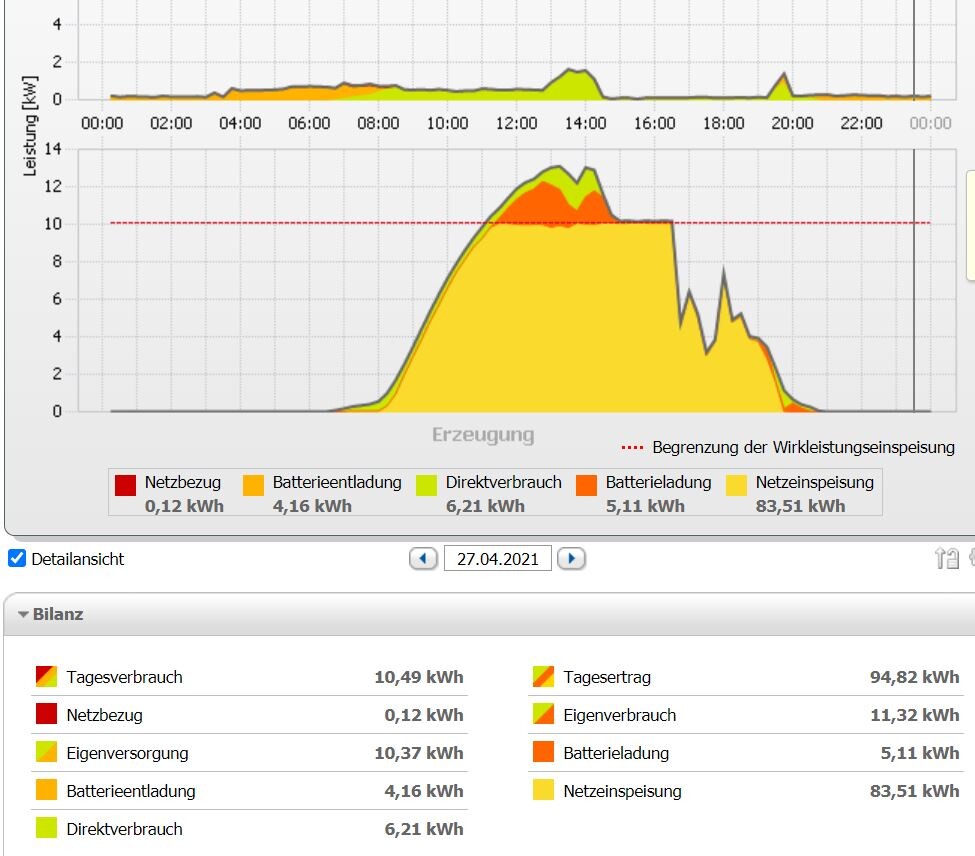
From 11:00 AM, I am above 70%. I schedule all variable consumers I have around midday: hot water, dishwasher, washing machine (see the green hump on the upper curve). But the amount is just not that high. I run at 70% gently—anything above 70% plus self-consumption I have to throttle. The orange part during midday is the battery charging to at least partially ease this throttling. It doesn’t work perfectly either because by 2:30-3:00 PM the battery is full... so throttling starts 🙁 Daily consumption is 10.49 kWh, of which direct consumption (meaning the amount that could have been used without the battery) is 6.21. Grid feed-in was 0.12 kWh. Without the battery, it would have been 10.49 – 6.21 = 4.28, and without storage, I would have had to throttle about 5 kWh more at midday.
Of course, this is not universally applicable. I am actually rather critical about storage, as I find it pointless to store energy at the single-family house level (if at all, then larger storage systems, e.g., at the next transformer station or similar), and these devices are far from environmentally friendly. Overall, however, I am currently satisfied.
The actual deciding factor, however... surprise... was the subsidies: only the battery prevented me from being "+" at KfW40 (= 6,000€ subsidy), plus an additional 2,000€ state subsidy, and by purchasing the photovoltaic system at the same time, you get the VAT refunded. The 10 kWh system including the battery inverter cost 6,500€. That made the decision quite easy.
From 11:00 AM, I am above 70%. I schedule all variable consumers I have around midday: hot water, dishwasher, washing machine (see the green hump on the upper curve). But the amount is just not that high. I run at 70% gently—anything above 70% plus self-consumption I have to throttle. The orange part during midday is the battery charging to at least partially ease this throttling. It doesn’t work perfectly either because by 2:30-3:00 PM the battery is full... so throttling starts 🙁 Daily consumption is 10.49 kWh, of which direct consumption (meaning the amount that could have been used without the battery) is 6.21. Grid feed-in was 0.12 kWh. Without the battery, it would have been 10.49 – 6.21 = 4.28, and without storage, I would have had to throttle about 5 kWh more at midday.
Of course, this is not universally applicable. I am actually rather critical about storage, as I find it pointless to store energy at the single-family house level (if at all, then larger storage systems, e.g., at the next transformer station or similar), and these devices are far from environmentally friendly. Overall, however, I am currently satisfied.
The actual deciding factor, however... surprise... was the subsidies: only the battery prevented me from being "+" at KfW40 (= 6,000€ subsidy), plus an additional 2,000€ state subsidy, and by purchasing the photovoltaic system at the same time, you get the VAT refunded. The 10 kWh system including the battery inverter cost 6,500€. That made the decision quite easy.
Bookstar schrieb:
It’s crazy how our government throws money around. Every piece of nonsense is being subsidized right now. Even though I have personally benefited in this case, you are unfortunately right. For example, I am effectively getting the charging station fully paid for, even though I don’t own an electric car. It’s not really about meaningful initiatives, but rather about political greenwashing (“we subsidized xyz kWh of renewable energy,” “we built xyz charging points,” or, in the case of the KfW double subsidies for granny flats, “we built xyz apartments”).
For photovoltaics, it would make much more sense to eliminate all the bureaucracy (commercial regulations, VAT obligations, depreciation rules, grid connection requests, 70% hard/soft costs, smart meters, etc., etc.). In my opinion, that would achieve far more.
D
Deliverer29 Apr 2021 23:41Hangman schrieb:
[ATTACH alt="PV Hangman.JPG"]60737[/ATTACH]
Quite a lot of effort for that small peak! ;-)So: With a south-facing orientation, the calculated amount is about 3-5% of the total electricity generation that isn’t compensated at a strict 70%. Since very few installations have a perfect south orientation (and if they do, they probably have a north-facing roof as well, so why not just add a few panels there?), this issue—which only occurs in April and June at all—often doesn’t arise. So: fully using all roofs = no problem.
Regarding 40+: In this case, you can of course include the battery storage, although even then it rarely becomes truly economical. Photovoltaic systems generate income; storage costs money. Even the ones given away for free.
Similar topics