
ᐅ Planning to install solar panels – options: 19 kW peak, 25 kW peak, 30 kW peak, battery storage?
Created on: 27 Mar 2022 09:28
O
Obermuh
Good morning everyone,
We are planning to install a photovoltaic system, and I have finally received a first offer. At the moment, everyone seems very busy, as out of three requested providers, only one responded after several weeks. Compared to the many threads here, the price seems a bit high, but this is somewhat offset by the fact that installation could theoretically still take place in April (depending on the module selection, see below).
I am aware of the basic discussion about whether or not to include a battery storage system. The offers I received all include storage systems for now.
Local conditions:
Flat roof with nearly 230 sqm (2,475 sq ft) of usable area, completely unshaded.
Previous year’s consumption: 12,800 kWh – 8,300 kWh measured by heat pump meter, 4,500 kWh household meter.
I recently got an electric car, and I expect an additional annual demand of around 4,000 kWh.
Expected yield: 900 kWh per kWp.
Offered options:
Available modules, same price with identical total output:
Hyundai HiE-S410VG (only available again from May)
Solarwatt Classic H1.1 Pure 375 (in stock with the provider)
Optional storage systems:
E3DC S10X 14 kWh
E3DC S10E Pro 19.5 kWh
Complete system offers (net):
19.68 kWp – €22,828
+ 14 kWh storage €13,250
Optional 19.5 kWh storage €18,630
24.6 kWp – €27,552
+ 14 kWh storage €13,250
Optional 19.5 kWh storage €18,630
According to the provider, 30 kWp could also be installed on the roof, but this would require a ripple control receiver. This option is available on request.
My questions:
- Are these offers still reasonable or overpriced?
- Does it make sense to choose the slightly “weaker” Solarwatt modules that are available now? Considering the current situation, is it better to have “a bird in the hand than two in the bush”?
- Is a battery storage system advisable given our relatively high consumption and low feed-in tariff? Mathematically probably not, but given the recent trends in the energy market, could it be a worthwhile investment for greater independence and peace of mind?
- Is it worth having a controllable wallbox (E3DC Connect)? It seems to be included in the offer but not separately priced. I already have a CEE32 socket in the garage and charge with a Juice Booster at up to 22 kW (missed out on the wallbox subsidy, so I got approval from the grid operator for 22 instead of 11 kW).
My reasoning: If I can achieve around 60% self-sufficiency with the storage, I would save €2,380 per year at the current electricity price of €0.31/kWh (31c/kWh). This means the “smaller” system with 19.68 kWp and 14 kWh of storage would pay for itself in 18 years, excluding feed-in and maintenance costs.
We are planning to install a photovoltaic system, and I have finally received a first offer. At the moment, everyone seems very busy, as out of three requested providers, only one responded after several weeks. Compared to the many threads here, the price seems a bit high, but this is somewhat offset by the fact that installation could theoretically still take place in April (depending on the module selection, see below).
I am aware of the basic discussion about whether or not to include a battery storage system. The offers I received all include storage systems for now.
Local conditions:
Flat roof with nearly 230 sqm (2,475 sq ft) of usable area, completely unshaded.
Previous year’s consumption: 12,800 kWh – 8,300 kWh measured by heat pump meter, 4,500 kWh household meter.
I recently got an electric car, and I expect an additional annual demand of around 4,000 kWh.
Expected yield: 900 kWh per kWp.
Offered options:
Available modules, same price with identical total output:
Hyundai HiE-S410VG (only available again from May)
Solarwatt Classic H1.1 Pure 375 (in stock with the provider)
Optional storage systems:
E3DC S10X 14 kWh
E3DC S10E Pro 19.5 kWh
Complete system offers (net):
19.68 kWp – €22,828
+ 14 kWh storage €13,250
Optional 19.5 kWh storage €18,630
24.6 kWp – €27,552
+ 14 kWh storage €13,250
Optional 19.5 kWh storage €18,630
According to the provider, 30 kWp could also be installed on the roof, but this would require a ripple control receiver. This option is available on request.
My questions:
- Are these offers still reasonable or overpriced?
- Does it make sense to choose the slightly “weaker” Solarwatt modules that are available now? Considering the current situation, is it better to have “a bird in the hand than two in the bush”?
- Is a battery storage system advisable given our relatively high consumption and low feed-in tariff? Mathematically probably not, but given the recent trends in the energy market, could it be a worthwhile investment for greater independence and peace of mind?
- Is it worth having a controllable wallbox (E3DC Connect)? It seems to be included in the offer but not separately priced. I already have a CEE32 socket in the garage and charge with a Juice Booster at up to 22 kW (missed out on the wallbox subsidy, so I got approval from the grid operator for 22 instead of 11 kW).
My reasoning: If I can achieve around 60% self-sufficiency with the storage, I would save €2,380 per year at the current electricity price of €0.31/kWh (31c/kWh). This means the “smaller” system with 19.68 kWp and 14 kWh of storage would pay for itself in 18 years, excluding feed-in and maintenance costs.
Charging during the day is usually not a problem, so having a battery storage for the car is less important. Washing and drying can mostly be done during the day, and the dishwasher would then simply be started in the morning instead of the evening. However, most other energy consumption happens in the evening: cooking, watching TV, lighting, showering/bathing, etc.
D
Deliverer28 Mar 2022 17:25Obermuh schrieb:
Cooking, watching TV, lighting,That is very little overall. Besides, much of this occurs during the summer months when the sun is out.Obermuh schrieb:
Showering/bathing, etc.In this case, you just need to tell the heat pump not to produce hot water after sunset. Then it doesn’t matter if you bathe at night.One last note about storage: The economics for the owner are not the only downside. Storage systems are also bad for the environment. Their production requires energy. Even after that, they are essentially consumers. For some systems, quite significant consumers (several hundred kWh per year). The stored electricity (including losses) could have been used perfectly well by your neighbor who doesn’t have solar panels on their roof.
Current storage solutions are also not grid-friendly—they cause more fossil fuel generation in the morning when electricity demand is high but solar production is low. Around midday, when there is often a surplus of solar energy, the storage is already full, so the inverter reduces output at around 70%, leading to curtailment. At night, when grid demand is low and due to slow-reacting, older power plants there is “too much” electricity, storage systems further reduce demand. Overall, this doesn’t make sense.
Still, I can understand if someone wants one. I want one too... But you should be well informed before you buy. If you don’t believe me, you can find all this information from the environmental protection agency. They published a good report last year on residential photovoltaic systems. It covers everything again. (Full roofs, no storage). And if even they have figured it out... ;-)

I can only share a little from my personal experience. My car (a company vehicle, I don’t have another one) has a small battery (35.5 kWh). I chose this deliberately because I drive short distances 98% of the time, and there are other vehicles available for longer trips. That used to be a Touran (diesel). It has now been replaced by a Model Y. With a larger car battery, I would have more options for charging, for example, I could fully charge the Tesla’s 77 kWh battery over the weekend (at home using my own photovoltaic system, charging the company for the electricity used) and probably get through the week on that alone. Unfortunately, that is not possible with my current vehicle. I just didn’t consider this :-(
So in about 2.5 years, “mine” will be replaced with one that has a larger battery. Also, the Tesla is much more efficient in battery usage (it consumes about 2 kWh less per 100 km on average than the Mazda). Using the house battery to charge the car, as mentioned above, doesn’t really make sense. A 10 kWh house battery, if it can supply three-phase power, would be drained in one hour. However, it’s supposed to cover night-time electricity needs. Your house will likely require about 0.5 kWh per hour with the mentioned annual consumption. For the time when no electricity is generated, a 10 kWh battery probably fits well. Even though most of the points made by @Deliverer are correct, high values for energy self-sufficiency and self-consumption “feel” intuitively right. Additionally, there are studies on the economics of batteries that differ from the above. Sellers always want to push one with a few extra “k” inside anyway 😉 without putting in significantly more effort. In the end, everyone has to do their own calculations because the framework conditions vary enormously.
So in about 2.5 years, “mine” will be replaced with one that has a larger battery. Also, the Tesla is much more efficient in battery usage (it consumes about 2 kWh less per 100 km on average than the Mazda). Using the house battery to charge the car, as mentioned above, doesn’t really make sense. A 10 kWh house battery, if it can supply three-phase power, would be drained in one hour. However, it’s supposed to cover night-time electricity needs. Your house will likely require about 0.5 kWh per hour with the mentioned annual consumption. For the time when no electricity is generated, a 10 kWh battery probably fits well. Even though most of the points made by @Deliverer are correct, high values for energy self-sufficiency and self-consumption “feel” intuitively right. Additionally, there are studies on the economics of batteries that differ from the above. Sellers always want to push one with a few extra “k” inside anyway 😉 without putting in significantly more effort. In the end, everyone has to do their own calculations because the framework conditions vary enormously.
Just as an example of how good it feels to use almost all of your own electricity 😉
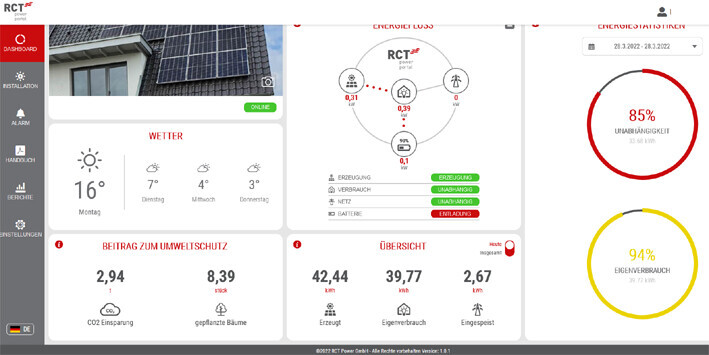
Right now, for about 15 minutes, the roof isn’t producing enough power, and my small 3.8kWh (3.8 kilowatt-hours) battery is discharging. However, it’s not big enough to last until around 8:00 tomorrow morning. So it’s too small. 🙄
Right now, for about 15 minutes, the roof isn’t producing enough power, and my small 3.8kWh (3.8 kilowatt-hours) battery is discharging. However, it’s not big enough to last until around 8:00 tomorrow morning. So it’s too small. 🙄
P
Pitiglianio28 Mar 2022 20:17Question about battery storage.
If I initially skip the currently too expensive battery storage but get a hybrid inverter, can I easily install a potentially more cost-effective battery storage system in a few years, or will I need a certified electrician again who might not be interested in that kind of work?
If I initially skip the currently too expensive battery storage but get a hybrid inverter, can I easily install a potentially more cost-effective battery storage system in a few years, or will I need a certified electrician again who might not be interested in that kind of work?
Similar topics