
ᐅ Underfloor heating with an air-to-water heat pump. House gets too warm when the sun is shining.
Created on: 4 Dec 2019 14:18
C
chewbacca123
Hello everyone,
I have a general question.
We moved into our new build four months ago. The living area on the ground floor has three large floor-to-ceiling windows facing south. We have underfloor heating and an air-to-water heat pump.
It provides a really comfortable temperature inside the house, but we have a problem – whenever the sun is shining in winter, even if it’s -2°C (28°F) outside, the temperature suddenly rises to 24°C (75°F) in the living room. It gets uncomfortably warm in here, and the underfloor heating can’t be turned down quickly.
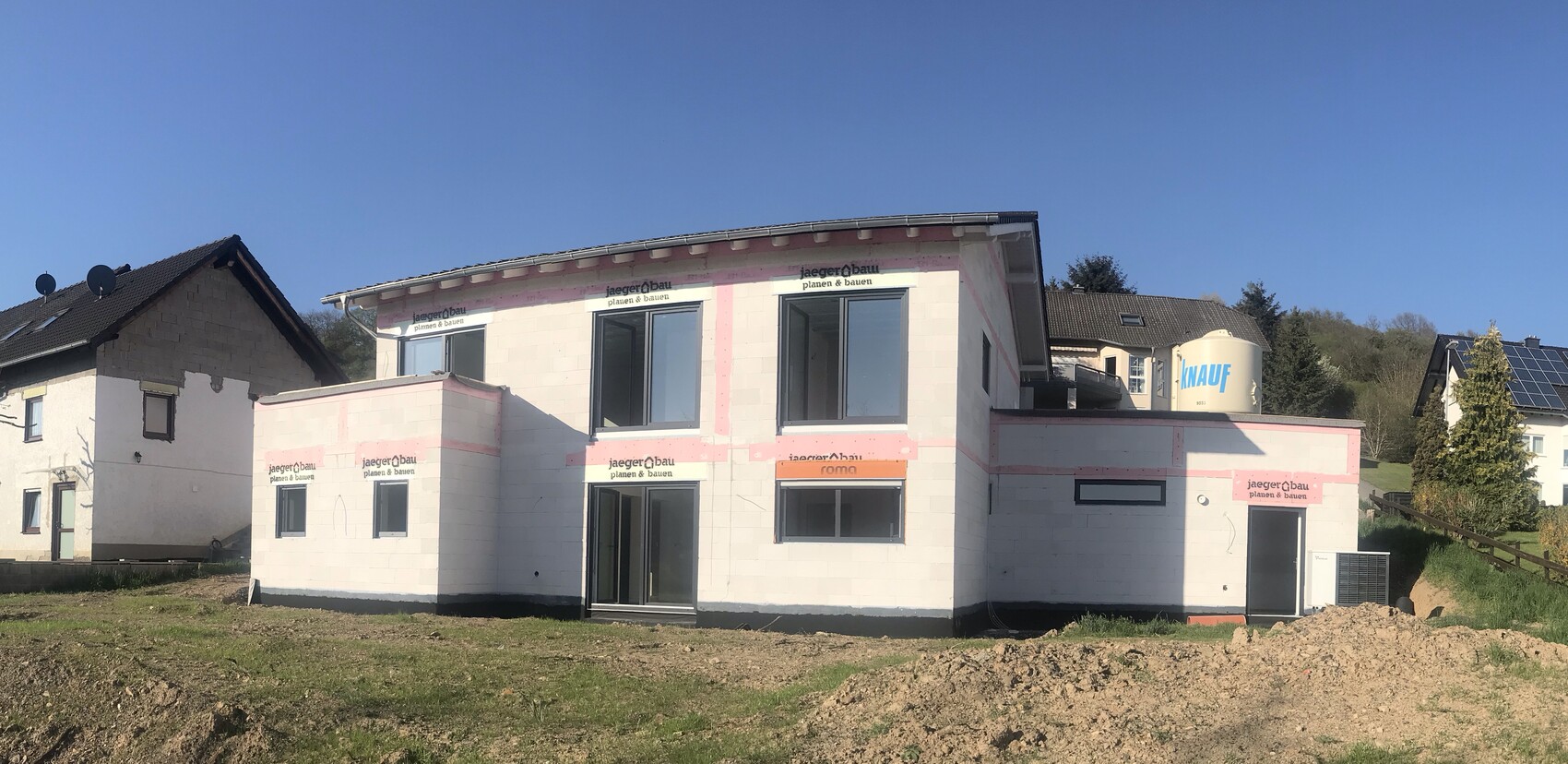
Should we assume that the large floor-to-ceiling windows are responsible for the heat gain? A photo of the south-facing side of the house is attached.
What would you do – always lower all the blinds as soon as sunlight is forecast? That seems quite annoying...
We have motorized blinds controlled by Somfy. Would you consider buying a sensor that automatically lowers the blinds at a certain temperature?
Thanks in advance for your replies.
I have a general question.
We moved into our new build four months ago. The living area on the ground floor has three large floor-to-ceiling windows facing south. We have underfloor heating and an air-to-water heat pump.
It provides a really comfortable temperature inside the house, but we have a problem – whenever the sun is shining in winter, even if it’s -2°C (28°F) outside, the temperature suddenly rises to 24°C (75°F) in the living room. It gets uncomfortably warm in here, and the underfloor heating can’t be turned down quickly.
Should we assume that the large floor-to-ceiling windows are responsible for the heat gain? A photo of the south-facing side of the house is attached.
What would you do – always lower all the blinds as soon as sunlight is forecast? That seems quite annoying...
We have motorized blinds controlled by Somfy. Would you consider buying a sensor that automatically lowers the blinds at a certain temperature?
Thanks in advance for your replies.
D
Daniel-Sp1 Oct 2020 15:18Bookstar schrieb:
I’ve come to believe that the Novelan heat pump is particularly poor quality. You really have to fully close the bypass valve and adjust everything manually. That’s why I would prefer gas instead. The system always works flawlessly without any adjustments, and consumption is reasonable.
My Novelan still cycles twice a day and has an average compressor runtime of 45 minutes. Then it is probably oversized. The problem with very energy-efficient houses is the low heating demand. There are hardly any suitable air-to-water heat pumps for this. Even the smaller units often don’t modulate down enough.
Yes, it is, but that's what the calculation showed. Theory and practice. However, all these problems occur only with heat pumps. For customers, the risk of finding a company that really knows this technology is very high. In our father's case, the ground-source system has already broken down after 5 years. The pump and compressor are failing. It's all just rubbish. I’d rather not say how much the heating system cost him. He could have burned gas for 100 years.
N
nordanney1 Oct 2020 15:36Haha, if my heat pump ever breaks down, it’s not a big deal. Just buy a new unit, set it up, and connect it to the existing pipes. A straight 3,000€ (about 3,300 USD) plus shipping. I really don’t understand why so many people buy such expensive heat pumps.
In some cases, the customer service representatives are just rude and uninformed. For me, a valve on the hot water storage tank had to be replaced because it was leaking slightly. Suddenly, he started messing with the settings and just wanted to increase the hot water temperature, heating curve, and heating limit.

Hehe.
After things went wrong here for a year, I instructed my wife during the second-to-last maintenance to tell the technician not to adjust any of the settings. I think that worked. The last technician came and said, "Oh, this is the house where the ERR units were deactivated and where nothing is supposed to be changed."
After things went wrong here for a year, I instructed my wife during the second-to-last maintenance to tell the technician not to adjust any of the settings. I think that worked. The last technician came and said, "Oh, this is the house where the ERR units were deactivated and where nothing is supposed to be changed."
P
pagoni20201 Oct 2020 16:00I am really impressed by what @Daniel-Sp has accomplished here – WOW!
As an amateur, when I read the thread title mentioning that rooms quickly become very warm or overheated in the sun, I believe this is primarily due to the use of slow-responding underfloor heating systems. These have many advantages and are probably the current standard, but this also seems to me to be a noticeable disadvantage alongside their numerous benefits.
Currently, we have an underfloor heating system that was probably installed rather roughly (it doesn’t belong to us). For example, today the sun is shining a bit, and despite many windows, there is hardly any direct sunlight. Still, it feels noticeably warm, and without open doors or windows, it would be uncomfortably warm for me, even though it is otherwise well regulated here.
In our old house, we had a traditional radiator heating system, and I generally prefer it a bit cooler and then heat up as needed (using central heating or a wood stove) or turn it back down again.
The problem mentioned here would probably also occur with a gas heating system, so I think the reason lies in the underfloor heating system rather than the heat pump or gas heating.
Or am I wrong?
Unfortunately, the heating topic hasn’t been discussed in detail for us yet, but especially due to the slow response of underfloor heating, I’m actually considering installing a classic (often frowned upon) radiator heating system, even if that means losing wall space for the radiators. We’ll see…
As an amateur, when I read the thread title mentioning that rooms quickly become very warm or overheated in the sun, I believe this is primarily due to the use of slow-responding underfloor heating systems. These have many advantages and are probably the current standard, but this also seems to me to be a noticeable disadvantage alongside their numerous benefits.
Currently, we have an underfloor heating system that was probably installed rather roughly (it doesn’t belong to us). For example, today the sun is shining a bit, and despite many windows, there is hardly any direct sunlight. Still, it feels noticeably warm, and without open doors or windows, it would be uncomfortably warm for me, even though it is otherwise well regulated here.
In our old house, we had a traditional radiator heating system, and I generally prefer it a bit cooler and then heat up as needed (using central heating or a wood stove) or turn it back down again.
The problem mentioned here would probably also occur with a gas heating system, so I think the reason lies in the underfloor heating system rather than the heat pump or gas heating.
Or am I wrong?
Unfortunately, the heating topic hasn’t been discussed in detail for us yet, but especially due to the slow response of underfloor heating, I’m actually considering installing a classic (often frowned upon) radiator heating system, even if that means losing wall space for the radiators. We’ll see…
Similar topics