
ᐅ Technical Feasibility and Implementation of a Shower Design Concept
Created on: 6 Jul 2016 13:49
L
leeviHello everyone,
I have a question for all tinkerers and "individualists" and am interested in exchanging experiences.
At the moment, I’m facing the following situation; maybe someone has already completed a similar project and can help me:
For my shower, I plan to cover the three walls with real hardwood flooring up to just below the shower tray. To protect the wood from water splashes, I would like to install a glass panel in front of each wall, with LED strips placed between the wood and the glass panel at both the top and bottom.
Setup: Hardwood flooring → aluminum LED profile about 1–1.5 cm (approximately the gap) → 2 cm (0.8 inch) glass panel.
The panel would then rest on the shower tray (attachment: glass drilled and fixed to the wall with four stainless steel rods/spacers each). The side walls and top would be sealed with silicone (+ aluminum cover strips) to create a closed system.
My main question is whether condensation could form in the gap between the materials? If so, how can this issue be avoided or solved?
So far, I have discussed this with "experts" and craftsmen, but they have been unwilling to give a clear statement. Apparently, this deviates too much from the standard ;-) I hope you have some good ideas or solutions for me (and no, I don’t want wood-effect tiles!!!)
Thanks and best regards,
Stoff
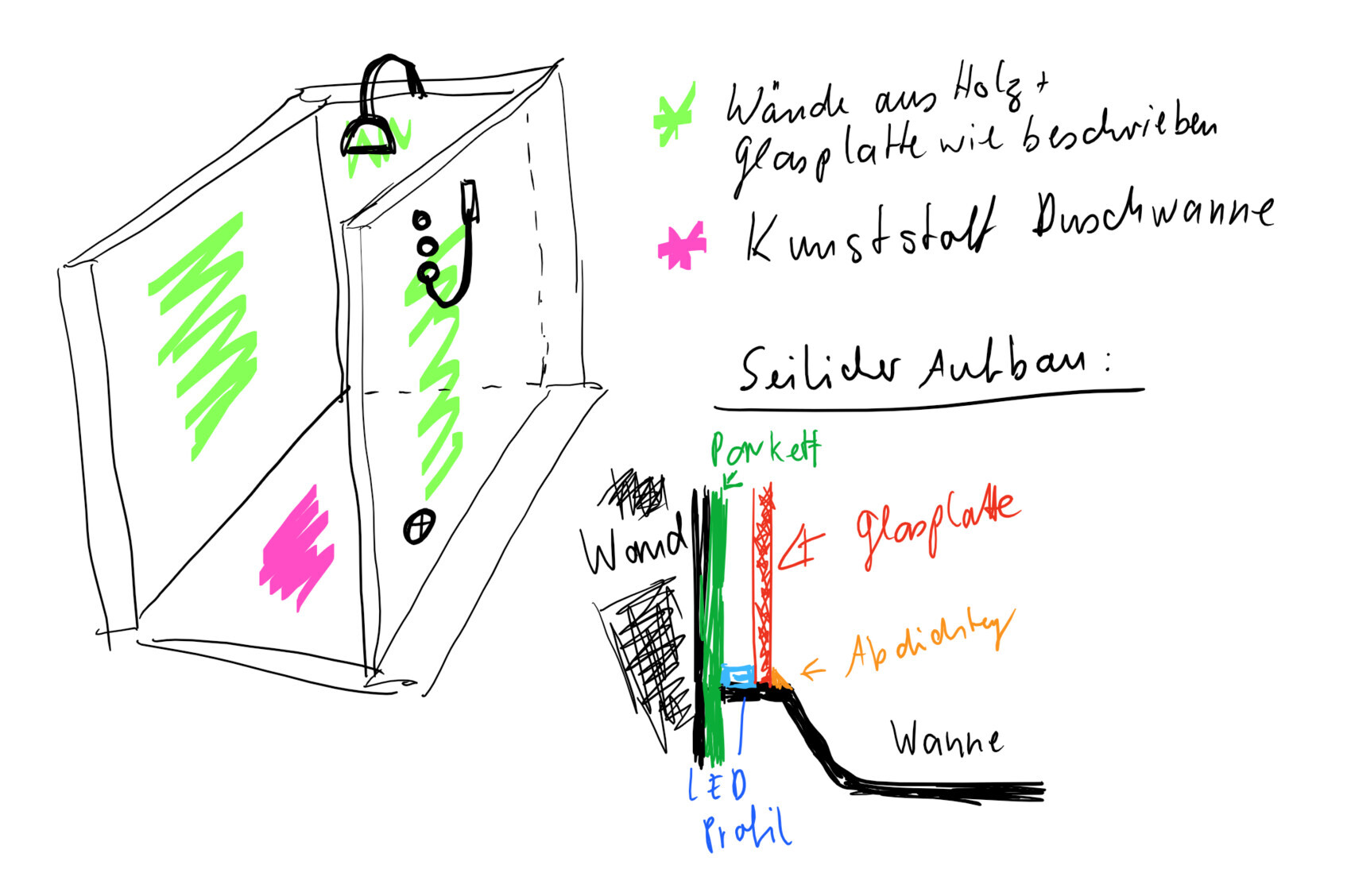
I have a question for all tinkerers and "individualists" and am interested in exchanging experiences.
At the moment, I’m facing the following situation; maybe someone has already completed a similar project and can help me:
For my shower, I plan to cover the three walls with real hardwood flooring up to just below the shower tray. To protect the wood from water splashes, I would like to install a glass panel in front of each wall, with LED strips placed between the wood and the glass panel at both the top and bottom.
Setup: Hardwood flooring → aluminum LED profile about 1–1.5 cm (approximately the gap) → 2 cm (0.8 inch) glass panel.
The panel would then rest on the shower tray (attachment: glass drilled and fixed to the wall with four stainless steel rods/spacers each). The side walls and top would be sealed with silicone (+ aluminum cover strips) to create a closed system.
My main question is whether condensation could form in the gap between the materials? If so, how can this issue be avoided or solved?
So far, I have discussed this with "experts" and craftsmen, but they have been unwilling to give a clear statement. Apparently, this deviates too much from the standard ;-) I hope you have some good ideas or solutions for me (and no, I don’t want wood-effect tiles!!!)
Thanks and best regards,
Stoff
T
toxicmolotof6 Jul 2016 17:00leevi schrieb:
then accordingly sealed with silicone (+ aluminum cover strips) to create a closed system.I have no experience with this.
It will definitely look interesting.
Good luck with it.
But one thing can be said for sure: silicone is not a sealing material.
 Sir_Kermit7 Jul 2016 18:48
Hello,
Looking at your construction, you have chosen different materials with slightly varying coefficients of thermal expansion. This inherently carries the risk of small cracks forming due to temperature changes. I can’t say how much the wood will expand or contract.
This alone doesn’t tell us much at first, but in the context of the rest of the construction, it could become a problem over time—especially if the shower tray and the wall can move independently of each other.
I assume the two parts aren’t rigidly connected; you have also planned a silicone sealant joint for this. However, it seems questionable whether that will hold up consistently in the long run.
Even the smallest cracks are critical because temperature fluctuations can create a pumping effect that draws water from outside toward the interior (or pressure differences push it to areas with lower pressure).
Whether this will actually happen or not depends on one’s current update of their crystal ball. ;-)
I like your idea, but a fully enclosed space like that seems a bit too risky for me. Search Wikipedia for “double-glazed insulating glass,” and you will see how manufacturers do it. They used to fill the gap between the panes with dried air, but today they use the noble gas argon. Ultimately, air and water vapor always diffuse through the edge seal. Any moisture that enters the cavity is absorbed by a desiccant.
It’s quite a complex solution, but it works. Perhaps you can pick up some tricks from that.
Since I come from electronics, I can share how waterproof electronics are protected when installed inside an enclosure:
- Put the electronics inside, close the enclosure, and hope that no condensation forms inside.
- Apply a conformal coating to the electronics (though this has its own challenges), and preferably include a “weep hole” in the enclosure. If water does get inside, which sometimes can’t be prevented, it should at least be able to drain back out.
Regarding your LED strip, opinions vary on lifespan and durability.
leevi schrieb:
My big question here is whether condensation will form in the intermediate space?
Looking at your construction, you have chosen different materials with slightly varying coefficients of thermal expansion. This inherently carries the risk of small cracks forming due to temperature changes. I can’t say how much the wood will expand or contract.
This alone doesn’t tell us much at first, but in the context of the rest of the construction, it could become a problem over time—especially if the shower tray and the wall can move independently of each other.
I assume the two parts aren’t rigidly connected; you have also planned a silicone sealant joint for this. However, it seems questionable whether that will hold up consistently in the long run.
Even the smallest cracks are critical because temperature fluctuations can create a pumping effect that draws water from outside toward the interior (or pressure differences push it to areas with lower pressure).
Whether this will actually happen or not depends on one’s current update of their crystal ball. ;-)
I like your idea, but a fully enclosed space like that seems a bit too risky for me. Search Wikipedia for “double-glazed insulating glass,” and you will see how manufacturers do it. They used to fill the gap between the panes with dried air, but today they use the noble gas argon. Ultimately, air and water vapor always diffuse through the edge seal. Any moisture that enters the cavity is absorbed by a desiccant.
It’s quite a complex solution, but it works. Perhaps you can pick up some tricks from that.
leevi schrieb:
If so, how can this problem be avoided or solved in another way?
Since I come from electronics, I can share how waterproof electronics are protected when installed inside an enclosure:
- Put the electronics inside, close the enclosure, and hope that no condensation forms inside.
- Apply a conformal coating to the electronics (though this has its own challenges), and preferably include a “weep hole” in the enclosure. If water does get inside, which sometimes can’t be prevented, it should at least be able to drain back out.
Regarding your LED strip, opinions vary on lifespan and durability.
Thank you, Sir Kermit, for the detailed explanation.
I almost completely agree with your points, and they match what I have researched so far. Your point about the desiccant used in double or triple-glazed units is particularly interesting. However, I am not sure (I have only done some preliminary research) if there are compounds that actively regulate moisture—meaning they absorb water vapor regularly and then release it again. For example, silica gel only absorbs moisture until it becomes saturated and then requires heating to release the water. This option is less ideal for my application.
- Could it be an option to deliberately leave the top and sides open for ventilation and install only some kind of “membrane”? There must be materials—like a type of Gore-Tex—that allow moisture to escape in one direction but prevent water, dust, etc., from entering the cavity from above or the sides...
I am thinking of visiting a window specialist in the next few weeks; maybe they will have some ideas.
Thanks again!
I almost completely agree with your points, and they match what I have researched so far. Your point about the desiccant used in double or triple-glazed units is particularly interesting. However, I am not sure (I have only done some preliminary research) if there are compounds that actively regulate moisture—meaning they absorb water vapor regularly and then release it again. For example, silica gel only absorbs moisture until it becomes saturated and then requires heating to release the water. This option is less ideal for my application.
- Could it be an option to deliberately leave the top and sides open for ventilation and install only some kind of “membrane”? There must be materials—like a type of Gore-Tex—that allow moisture to escape in one direction but prevent water, dust, etc., from entering the cavity from above or the sides...
I am thinking of visiting a window specialist in the next few weeks; maybe they will have some ideas.
Thanks again!
Sir_Kermit13 Jul 2016 06:57Hello,
Manufacturers have it easier. They use dry air (of course not too dry to avoid other issues), and the amount of silica gel can be adjusted according to the expected moisture level.
Exactly.
I’m not sure about that. The idea of only using double glazing that size (essentially a frame-less window) isn’t really feasible, as it wouldn’t allow the lighting effect you want. It would probably also be much too expensive.
Although I’m not a materials expert, that sounds like a promising concept to explore further.
Kermit
leevi schrieb:
Your point about the desiccant used in double or triple glazed units is interesting.
Manufacturers have it easier. They use dry air (of course not too dry to avoid other issues), and the amount of silica gel can be adjusted according to the expected moisture level.
leevi schrieb:
This option is less ideal for my use ;-) )
Exactly.
leevi schrieb:
- Maybe an option ?? (I’m not sure myself yet) to leave the top and sides intentionally open for ventilation and just apply a kind of "membrane".
I’m not sure about that. The idea of only using double glazing that size (essentially a frame-less window) isn’t really feasible, as it wouldn’t allow the lighting effect you want. It would probably also be much too expensive.
leevi schrieb:
There must be materials like Gore-Tex that let moisture escape one way but don’t allow water, dust ... to enter the gap from above/side...
Although I’m not a materials expert, that sounds like a promising concept to explore further.
Kermit
Similar topics