
Hello everyone,
I’m hoping to get some ideas on where you would place water access points in the garden. Or rather, where it would be best to lay water pipes now if you might want to have at least partial automatic irrigation in the future. It’s clear that automatic garden irrigation requires more planning. However, I don’t have the time or motivation for that at the moment. It also doesn’t seem likely that this could be done anytime soon. But at least we could plan and lay the water pipes now, so that the option is available later. Attached is a sketch of the current garden plans. The following facts apply:
Maybe you have some inspiration or ideas. I would appreciate it. Thank you very much.
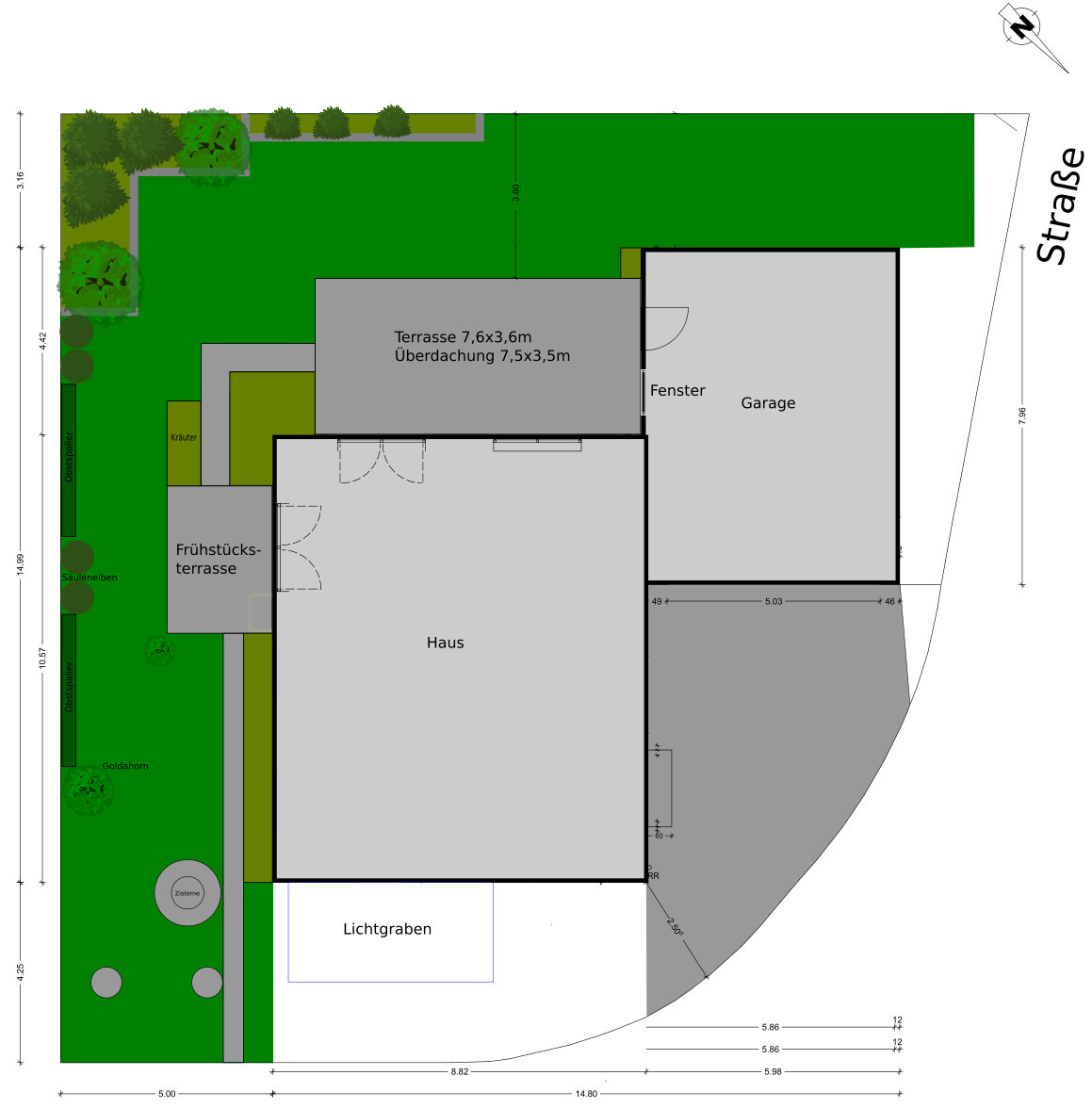
I’m hoping to get some ideas on where you would place water access points in the garden. Or rather, where it would be best to lay water pipes now if you might want to have at least partial automatic irrigation in the future. It’s clear that automatic garden irrigation requires more planning. However, I don’t have the time or motivation for that at the moment. It also doesn’t seem likely that this could be done anytime soon. But at least we could plan and lay the water pipes now, so that the option is available later. Attached is a sketch of the current garden plans. The following facts apply:
- The terrace including the roof is already built
- Breakfast terrace and paths are only planned so far, but these should not be the topic here
- The garden is not yet established, and topsoil has not been spread
- Raised planting beds are planned for the upper left area. I definitely want to include a water point there
- To the right of the garage, the ground slopes gently up to the street. Something low-maintenance will be placed there
- Below the house is a light well, and to the right of the light well is a heat pump
- A pump will later be installed in the cistern, so water pipes can be routed from there
- From the cistern there is a conduit leading to the garage for a water pipe
- In the garage, at the upper left, there is already a tap with mains water and a utility sink
Maybe you have some inspiration or ideas. I would appreciate it. Thank you very much.

Now is the perfect time to plan and install the irrigation system. You don’t need to dig trenches and can lay the pipes “freestyle,” then simply cover them up afterward. It will never be this easy again. If you do it later, you’ll have to dig everything up again.
Install a pump, for example, a Tipp 30082 AJ 4 plus 100/57 AUT, inside the cistern.
Is there power supply available in the cistern? If you have an empty conduit running to the garage, you could install the controller there.
Also, connect a water supply line to the cistern for refilling.
Whether you only lay the pipes now or also connect sprinklers every few meters doesn’t add much extra work.
Your situation is relatively simple with no large open areas.
You will need only 1-2 different sprinkler heads (MP1000 and MP2000).
Run a PE-HD pipe (DN32) from the cistern pump, branch off once into a distribution box, and from there run another line to the pop-up sprinklers, placed next to the flowerbeds, terrace, and wherever else you think you need them.
Use drip irrigation or root watering for raised beds, hedges, and trees.
Sprinkler housings: PRO Spray PRS40-CV. Connectors from Unidelta. Valves must also be DN32.
Controller: Hunter Hydrawise, if you want a functional, stable, and standalone system.
From the distribution box, run the control cable to the controller and the water lines to the individual zones.
Place the sprinklers along the edges (inside and outside) of the area to be irrigated. The spacing between sprinklers should always match their radius so they cover each other.
For the flowerbeds, only lay the water line (separate zones). Then continue with drip tubing (I recommend Hunter XFS). With the pump mentioned, you will need a pressure reducer.
The specified sprinkler heads have a short range and very low water consumption, allowing many sprinklers per zone.
For your lawn area, 2-3 zones will suffice. Then add 2-3 additional zones for drip or root irrigation.
With two people, the whole system can be installed in one day since no trenching is required.
Install a pump, for example, a Tipp 30082 AJ 4 plus 100/57 AUT, inside the cistern.
Is there power supply available in the cistern? If you have an empty conduit running to the garage, you could install the controller there.
Also, connect a water supply line to the cistern for refilling.
Whether you only lay the pipes now or also connect sprinklers every few meters doesn’t add much extra work.
Your situation is relatively simple with no large open areas.
You will need only 1-2 different sprinkler heads (MP1000 and MP2000).
Run a PE-HD pipe (DN32) from the cistern pump, branch off once into a distribution box, and from there run another line to the pop-up sprinklers, placed next to the flowerbeds, terrace, and wherever else you think you need them.
Use drip irrigation or root watering for raised beds, hedges, and trees.
Sprinkler housings: PRO Spray PRS40-CV. Connectors from Unidelta. Valves must also be DN32.
Controller: Hunter Hydrawise, if you want a functional, stable, and standalone system.
From the distribution box, run the control cable to the controller and the water lines to the individual zones.
Place the sprinklers along the edges (inside and outside) of the area to be irrigated. The spacing between sprinklers should always match their radius so they cover each other.
For the flowerbeds, only lay the water line (separate zones). Then continue with drip tubing (I recommend Hunter XFS). With the pump mentioned, you will need a pressure reducer.
The specified sprinkler heads have a short range and very low water consumption, allowing many sprinklers per zone.
For your lawn area, 2-3 zones will suffice. Then add 2-3 additional zones for drip or root irrigation.
With two people, the whole system can be installed in one day since no trenching is required.
rick2018 schrieb:
Now is exactly the right time to plan and install the irrigation system. You don’t have to dig and can lay pipes “freely” before covering them up.
It won’t be this easy again later. If you do it afterward, you’ll have to dig up everything again.
Install a pump, such as the Tipp 30082 AJ 4 plus 100/57 AUT, inside the cistern.
Is there electricity in the cistern? If you have an empty conduit (KG pipe) from the garage to the cistern, you could install the control unit there.
Also, run a water line to the cistern for refilling.
Whether you just lay pipes now or also connect a sprinkler every few meters is not much extra effort.
Your situation is relatively simple with no large open spaces.
You only need 1-2 different types of sprinkler heads (MP1000 and MP2000).
In other words, run a PE-HD pipe (DN32) from the cistern pump, branch off once into a distribution box, then continue with another line to the valve boxes (bodendosen). These serve the areas near the flower beds, terrace, and wherever else you need sprinklers.
For raised beds, hedges, and trees, use drip irrigation or root irrigation.
Sprinkler housings: PRO Spray PRS40-CV. Connectors from Unidelta. Be sure the valves are DN32 as well.
Use a Hunter Hydrawise controller if you want something functional, stable, and standalone.
From the distribution box, run the control cable to the controller and the water pipes to the individual zones.
Place the sprinklers always at the edges (inside and outside) of the area to be watered. The spacing between sprinklers should always be the throw range so that their water patterns overlap.
In the flower beds, lay only the water pipes (separate zones). Then continue with drip tubing (I recommend Hunter XFS). With the mentioned pump, you will need a pressure regulator.
The sprinkler heads mentioned, with their short throw distance, have very low water consumption. This allows you to connect many sprinklers in a single zone.
For your lawn area, you will need 2-3 zones. Then add another 2-3 zones for the drip or root irrigation.
With two people, the entire installation can be done in one day since no digging is required. Thanks for the feedback.
I have looked through the information but I’m still not quite clear. There is currently no electricity in the cistern, but there is an empty KG conduit running from the garage to the cistern. It would be possible to install cables and a water line there. At the moment, there is a lot of information that I need to process first. A diagram showing the basic setup is also missing for me.
- A PE-HD water pipe to the distribution box? And what pipes then go from the distribution box to the sprinklers? One pipe per sprinkler? Or are the sprinklers tapped off from a single pipe?
- Would everything be controlled by the Hydrawise system or only the sprinklers?
- Do you mean a distribution box with integrated valves? Or which valves do you recommend?
- By valve box (bodendose) do you mean a box where you can connect a standard garden hose?
- Is there software available to plan all this?
- Should the sprinklers be planned at their maximum throw distance or is there another reference point?
- Does the controller activate irrigation based on a timer? Is there no moisture sensor included, or could one be added optionally? I have a PLC installed in the house that could also control the valves, but so far I haven’t researched enough about what the Hunter system can do.
I have sketched out the sprinklers. It is still far from a finalized plan. I am also not yet sure how to account for the water volume and which sprinklers can be connected on the same line. I’m still missing ideas for the top left area as well. You don’t want the paths to be watered all the time. Also, I’m unsure how much the individual sprinklers need to overlap and what to do with the small open spaces.
Two different types of sprinklers probably won’t be enough, especially in the corners.
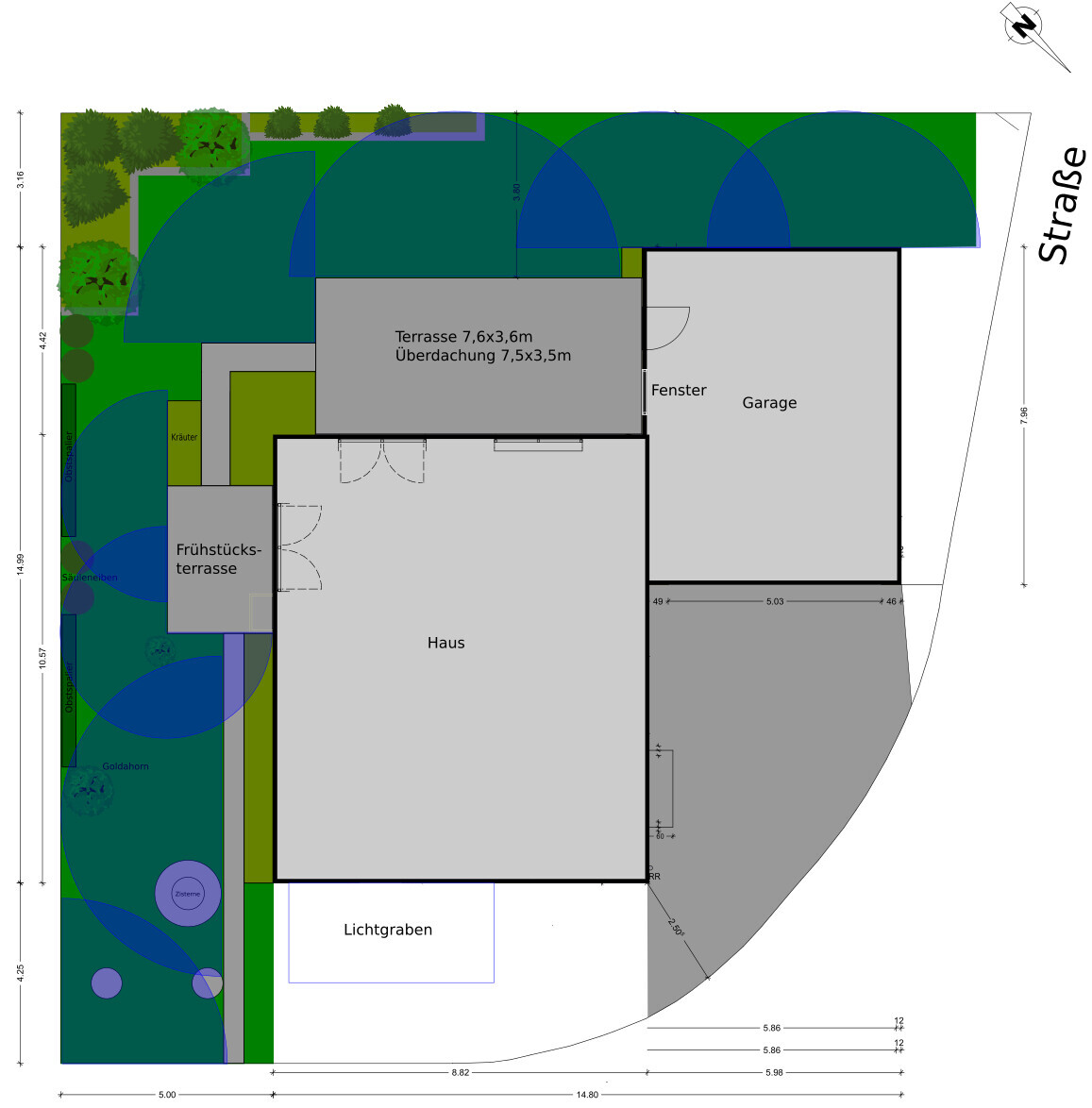
Two different types of sprinklers probably won’t be enough, especially in the corners.
We can definitely manage that 😉
First, the direct points:
You should also be able to refill the rainwater tank. Along with the PVC sewer pipe, you lay an additional PE-HD pipe. Connect this to a water source in the garage. You also run the control cable for the valves through the PVC sewer pipe. The number of wires needed equals the number of valves plus one. And, of course, power for the pump. Refilling could be controlled via an additional valve but is not strictly necessary.
There are quite a few threads here in the forum about irrigation already.
First, the direct points:
- A PE-HD water pipe to the distribution box? And which pipes run from the distribution box to the sprinklers? One pipe per sprinkler? Or are they tapped off a single pipe? -> A PE-HD pipe (DN32) runs from the pump to the distribution box. The distribution box contains the water sub-distribution with valves. So, one PE-HD pipe leads from each valve per sprinkler zone or drip irrigation zone. Each zone is controlled by one valve. All sprinklers for that zone are connected to this line. The sprinkler housings I mentioned regulate pressure to 2.8 bar (41 psi), so it doesn’t matter how you arrange the sprinklers in a zone (as long as more than 2.8 bar (41 psi) is available). Everything from the pump onward is done with PE-HD pipes (DN32).
- Would everything run through the Hydrawise controller or only the sprinklers? -> All valves are controlled via Hydrawise, regardless of whether the zone has sprinklers or drip irrigation.
- Do you mean a distribution box with integrated valves? Or which valves do you mean? -> Yes, the easiest option is a ready-made box with an additional connection for compressed air, so you can easily blow out the system in autumn.
- By ground box, do you mean a box where you can connect a normal garden hose? -> Yes, these are tapped off the pipe between the pump and valves. They are not controlled by valves, so you don’t need extra valves. The pump I mentioned has an integrated control with a pressure switch. You just have to plug it in. Once the pressure is built, it shuts off. If water is drawn (either by valves opening or ground boxes), the pump starts again.
- Is there software where you can plan all this? Kind of. It’s not really necessary. You can do it in any simple drawing program or quickly with a compass. You place one sprinkler in a corner, the next at the end of its throw distance, and so on.
- Do you plan sprinklers with their maximum throw distance or is there another guideline? On the Hunter website, you can download a list showing how far each sprinkler throws at different pressures. This can be adjusted by about 25%. You always have 2.8 bar (41 psi) pressure.
- Does the controller activate irrigation based on a timer? Is there no soil moisture measurement or could that be an option? I have a programmable logic controller (PLC) in the house that could also control the valves but haven’t researched what the Hunter controller can do yet. -> Using a PLC gets quite complicated. Hydrawise accesses local weather stations, so temperature, wind, precipitation, and rain probability are taken into account. This works very well without local sensors. Irrigation can also be automatically adjusted (e.g., longer watering times at higher temperatures, shorter at lower temperatures, no watering below a minimum temperature, none during strong wind, etc.). Zones are activated one after another (otherwise water pressure and flow aren’t sufficient). You can create groups or individual “programs.” This is done through the web portal or app.
You should also be able to refill the rainwater tank. Along with the PVC sewer pipe, you lay an additional PE-HD pipe. Connect this to a water source in the garage. You also run the control cable for the valves through the PVC sewer pipe. The number of wires needed equals the number of valves plus one. And, of course, power for the pump. Refilling could be controlled via an additional valve but is not strictly necessary.
There are quite a few threads here in the forum about irrigation already.
Quickly showing the rear area. Different colors are used just for better clarity.
This is how the overlap should look.

The other areas are just as simple. The great thing about MP rotors is that you can easily combine the sprinkler heads. The casing always stays the same. Download the chart from Hunter (links are not allowed here). Calculate with a maximum of 2,000 liters per hour per zone.
The sprinklers I marked only require 1.44 m³/h (1,440 liters per hour). Nevertheless, it makes sense to create a separate zone for the corner area and the left area due to different water requirements caused by sun exposure.
This is how the overlap should look.
The other areas are just as simple. The great thing about MP rotors is that you can easily combine the sprinkler heads. The casing always stays the same. Download the chart from Hunter (links are not allowed here). Calculate with a maximum of 2,000 liters per hour per zone.
The sprinklers I marked only require 1.44 m³/h (1,440 liters per hour). Nevertheless, it makes sense to create a separate zone for the corner area and the left area due to different water requirements caused by sun exposure.
Similar topics