
Hello everyone,
I’m hoping to get some ideas on where you would place water access points in the garden. Or rather, where it would be best to lay water pipes now if you might want to have at least partial automatic irrigation in the future. It’s clear that automatic garden irrigation requires more planning. However, I don’t have the time or motivation for that at the moment. It also doesn’t seem likely that this could be done anytime soon. But at least we could plan and lay the water pipes now, so that the option is available later. Attached is a sketch of the current garden plans. The following facts apply:
Maybe you have some inspiration or ideas. I would appreciate it. Thank you very much.
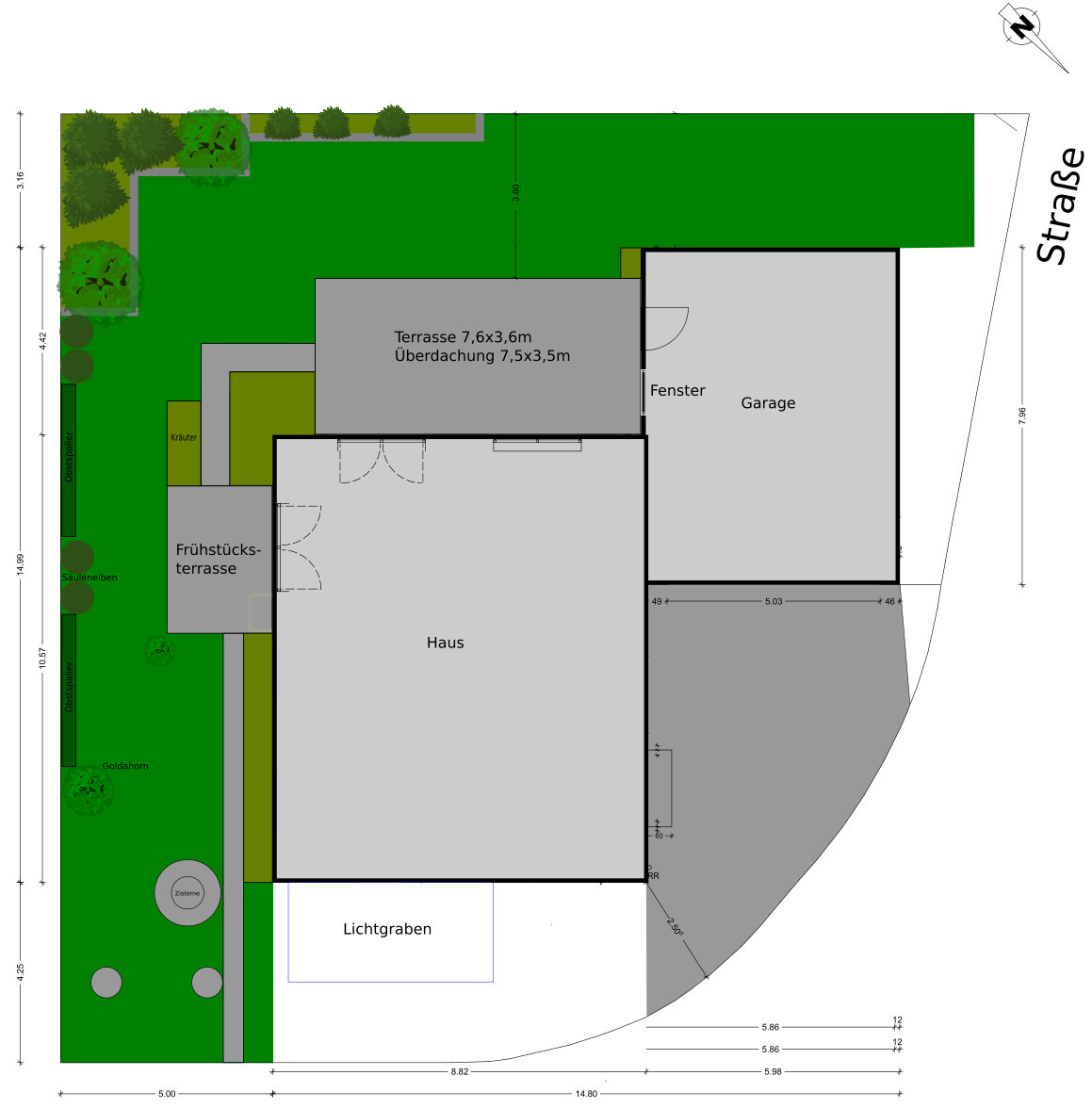
I’m hoping to get some ideas on where you would place water access points in the garden. Or rather, where it would be best to lay water pipes now if you might want to have at least partial automatic irrigation in the future. It’s clear that automatic garden irrigation requires more planning. However, I don’t have the time or motivation for that at the moment. It also doesn’t seem likely that this could be done anytime soon. But at least we could plan and lay the water pipes now, so that the option is available later. Attached is a sketch of the current garden plans. The following facts apply:
- The terrace including the roof is already built
- Breakfast terrace and paths are only planned so far, but these should not be the topic here
- The garden is not yet established, and topsoil has not been spread
- Raised planting beds are planned for the upper left area. I definitely want to include a water point there
- To the right of the garage, the ground slopes gently up to the street. Something low-maintenance will be placed there
- Below the house is a light well, and to the right of the light well is a heat pump
- A pump will later be installed in the cistern, so water pipes can be routed from there
- From the cistern there is a conduit leading to the garage for a water pipe
- In the garage, at the upper left, there is already a tap with mains water and a utility sink
Maybe you have some inspiration or ideas. I would appreciate it. Thank you very much.

@rick2018
Sorry to bother you again. You once mentioned that for drip irrigation, the XFS from Rechtsanwältin Bird is recommended.
Thank you very much
Sorry to bother you again. You once mentioned that for drip irrigation, the XFS from Rechtsanwältin Bird is recommended.
- So, do you use some components from Hunter and others from Rechtsanwältin Bird? Or would a drip line from Hunter not be as good?
- Does the XFS require additional accessories to connect to the DN32 pipe? Like pressure regulation and filtration?
- The XFS can be installed both below the ground and on the surface, right? Is there a big difference between these methods, and what are the pros and cons?
Thank you very much

I always test the layout I’ve drawn on paper above ground first and only bury the sprinklers afterwards. This way, you can immediately see where problems occur and fix them right away.
Mixing sprinklers and nozzles from different manufacturers is generally not an issue. For example, I use Hunter bodies (PROS-S and PRS30) with Rainbird R-VAN nozzles. Of course, I wouldn’t mix PGPs and PRO-S on the same zone.
However, I’m just an interested amateur when it comes to irrigation systems.
Mixing sprinklers and nozzles from different manufacturers is generally not an issue. For example, I use Hunter bodies (PROS-S and PRS30) with Rainbird R-VAN nozzles. Of course, I wouldn’t mix PGPs and PRO-S on the same zone.
However, I’m just an interested amateur when it comes to irrigation systems.
You can mix manufacturers.
You need a reducer for the drip line since it only has a 17mm (0.67 inch) diameter.
The XFS can handle pressure well. Therefore, a pressure regulator is not necessary if your pump does not exceed 6 bar significantly. At the outlet point, the pressure is usually below 4 bar.
We only use the XFS now. I have not tested Hunter for drip line use. Pressure resistance is an important factor. Many can only withstand 2.5 bar.
Whether the installation is above ground or not depends on several factors.
For ground covers or hedges, I would install it above ground. It grows through, but you can easily check the function and also make changes or replacements more easily. In public areas (which is not relevant here), burying is preferred due to vandalism.
You need a reducer for the drip line since it only has a 17mm (0.67 inch) diameter.
The XFS can handle pressure well. Therefore, a pressure regulator is not necessary if your pump does not exceed 6 bar significantly. At the outlet point, the pressure is usually below 4 bar.
We only use the XFS now. I have not tested Hunter for drip line use. Pressure resistance is an important factor. Many can only withstand 2.5 bar.
Whether the installation is above ground or not depends on several factors.
For ground covers or hedges, I would install it above ground. It grows through, but you can easily check the function and also make changes or replacements more easily. In public areas (which is not relevant here), burying is preferred due to vandalism.
I have now also made a cost estimate for a 6-way distribution box. It costs nearly 600€ when bought from DVS. If you build it yourself, the cost is around 250-300€:
Is it recommended to install a filter in between? For example, a Bird filter?
| Hunter solenoid valves PGV-101G | 6 pieces | €17.00 | €102.00 |
| Rectangular valve box | 1 piece | €60.00 | €60.00 |
| Dura cross fitting 1" 3x female thread x 1x male thread | 3 pieces | €9.00 | €27.00 |
| Dura connector 1" male x female thread | 7 pieces | €4.50 | €31.50 |
| Dura T-piece 1" | 1 piece | €6.60 | €6.60 |
| Dura elbow 1" | 1 piece | €6.00 | €6.00 |
| Unidelta coupling DN32 x internal thread 1" | 7 pieces | €1.80 | €12.60 |
| Ball valve | 1 piece | €10.00 | €10.00 |
| Total | €255.70 |
Is it recommended to install a filter in between? For example, a Bird filter?
Similar topics