
ᐅ Underfloor heating with an air-to-water heat pump. House gets too warm when the sun is shining.
Created on: 4 Dec 2019 14:18
C
chewbacca123
Hello everyone,
I have a general question.
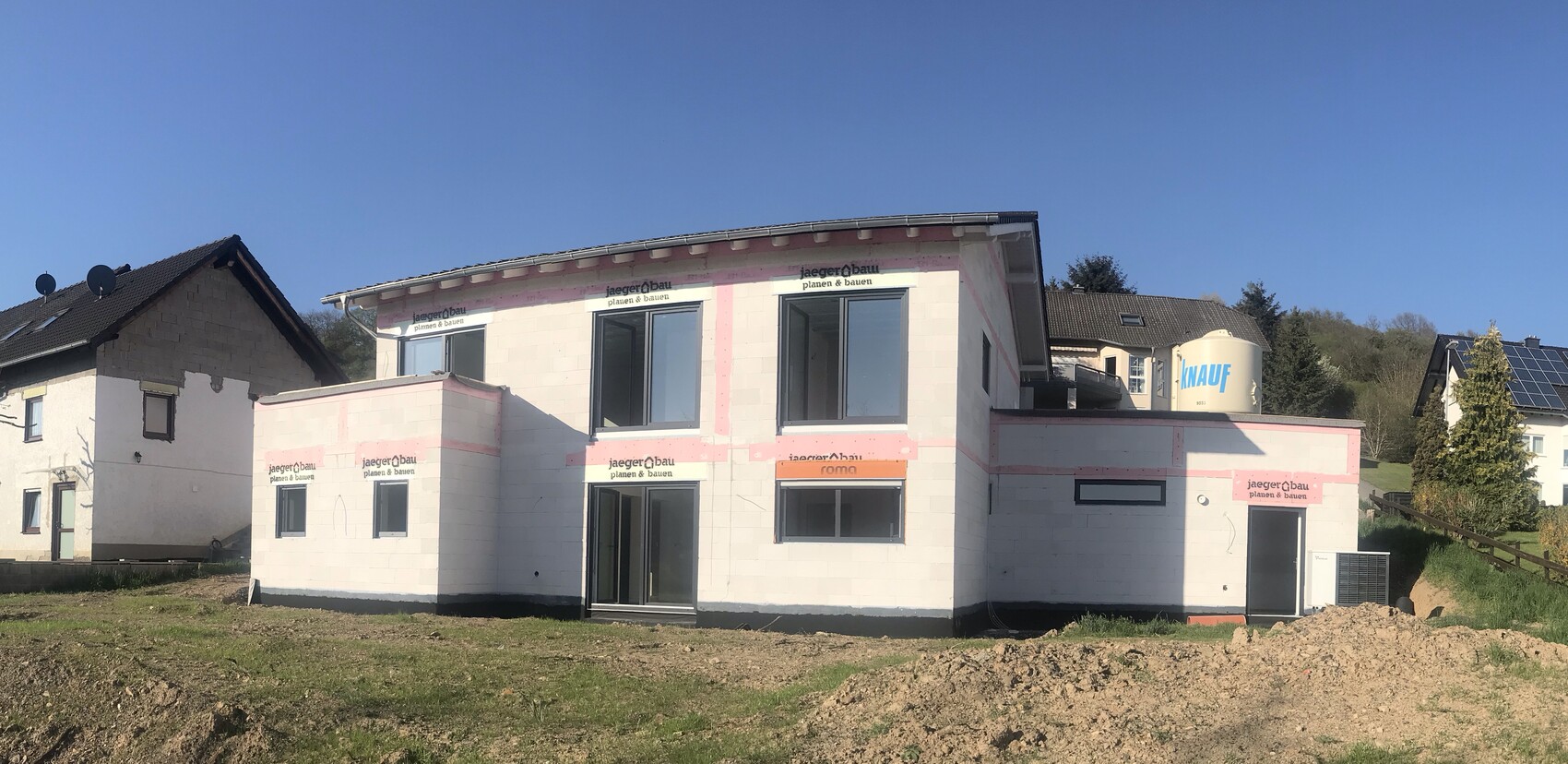
We moved into our new build four months ago. The living area on the ground floor has three large floor-to-ceiling windows facing south. We have underfloor heating and an air-to-water heat pump.
It provides a really comfortable temperature inside the house, but we have a problem – whenever the sun is shining in winter, even if it’s -2°C (28°F) outside, the temperature suddenly rises to 24°C (75°F) in the living room. It gets uncomfortably warm in here, and the underfloor heating can’t be turned down quickly.
Should we assume that the large floor-to-ceiling windows are responsible for the heat gain? A photo of the south-facing side of the house is attached.
What would you do – always lower all the blinds as soon as sunlight is forecast? That seems quite annoying...
We have motorized blinds controlled by Somfy. Would you consider buying a sensor that automatically lowers the blinds at a certain temperature?
Thanks in advance for your replies.
I have a general question.
We moved into our new build four months ago. The living area on the ground floor has three large floor-to-ceiling windows facing south. We have underfloor heating and an air-to-water heat pump.
It provides a really comfortable temperature inside the house, but we have a problem – whenever the sun is shining in winter, even if it’s -2°C (28°F) outside, the temperature suddenly rises to 24°C (75°F) in the living room. It gets uncomfortably warm in here, and the underfloor heating can’t be turned down quickly.
Should we assume that the large floor-to-ceiling windows are responsible for the heat gain? A photo of the south-facing side of the house is attached.
What would you do – always lower all the blinds as soon as sunlight is forecast? That seems quite annoying...
We have motorized blinds controlled by Somfy. Would you consider buying a sensor that automatically lowers the blinds at a certain temperature?
Thanks in advance for your replies.
D
Daniel-Sp21 Dec 2019 11:13Could you please open and post only the file from the last DTA? That way it’s easier to keep track. Thanks.
D
Daniel-Sp21 Dec 2019 11:26Are there any updates on the heating circuit lengths and pipe spacing? The hallway is still too warm; are the thermostatic radiator valves (TRVs) installed there? What flow rate does the heat pump controller indicate, and what are you simultaneously reading on the flow meters? According to the statistics, you’ve already had heating cycles lasting several hours, which is significantly better than before!

 chewbacca12321 Dec 2019 12:38
Daniel-Sp schrieb:
Could you please open and post only the file from the latest DTA? That would make it clearer, thanks Sure, I’ll include it here.
Unfortunately, the company still hasn’t provided me with the documentation—I’ve already asked three times. They said they’ll do it when they have time… well, I’ll keep following up.
There is one heating circuit valve (HKV) on the ground floor, and the second one is in the utility room in the basement.
The tubes showed a flow of about 1059 liters per hour (l/h) yesterday morning. The flow reading at the system shows: ----- l/h, so no value?!
December 21, 8:30 a.m., what do you think of this value? Much better, right?
D
Daniel-Sp21 Dec 2019 13:48Yes, better, but.
It appears that at the start of the heating cycle, the return temperature rises quickly. In my case, you only see an increase after more than 10 minutes. You have a kind of "short circuit" somewhere. The bathroom radiator is running without heating water from the heat pump, right? If so, the graph shows that a significant amount of heating water is still flowing past the underfloor heating through the bypass valve. This unnecessarily shortens the heating cycles and causes frequent switching. You could zoom in on the graph from the start of a heating cycle again.
It appears that at the start of the heating cycle, the return temperature rises quickly. In my case, you only see an increase after more than 10 minutes. You have a kind of "short circuit" somewhere. The bathroom radiator is running without heating water from the heat pump, right? If so, the graph shows that a significant amount of heating water is still flowing past the underfloor heating through the bypass valve. This unnecessarily shortens the heating cycles and causes frequent switching. You could zoom in on the graph from the start of a heating cycle again.
chewbacca12321 Dec 2019 14:01Daniel-Sp schrieb:
Yes, better, but.
It seems that at the start of the heating cycle the return temperature rises quickly. With me, you only see an increase after more than 10 minutes. You have a kind of "short circuit" somewhere. The bathroom radiator is running without hot water from the heat pump, right? If so, the curve shows that a significant amount of heating water is still bypassing the underfloor heating via the bypass valve. This shortens the heating cycles unnecessarily and causes frequent cycling. You could zoom in on the curve at the start of a heating cycle again. Could it also be because I only have a flow rate of 1059 l/h (about 28 gallons per minute) instead of the 1600 l/h (about 42 gallons per minute) required by the LAD 9?
Exactly, the bathroom radiator runs on electricity, independently from the air-to-water heat pump.
Similar topics