
Hello everyone,
We are currently planning the arrangement of our recessed lights—mainly in the shower area of our bathroom.
At the moment, our contract includes 4 recessed lights at our request, but this number can of course be increased or decreased anytime (1 recessed light for concrete ceiling = €70.00).
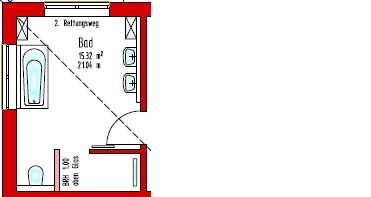
I have attached our bathroom on the upper floor.
Shower: the full depth to the "toilet wall" is 2.10 m (7 feet), with a width of 1.00 m (3 feet 3 inches). The wall towards the door will be built up three-quarters high, meaning the shower is not fully enclosed and may still get some light since the wall does not reach the ceiling. The toilet wall is half height and has glass above it, so light also comes in here. How many recessed lights would you install in the shower, and how would you arrange them? Are 4 recessed lights really necessary here?
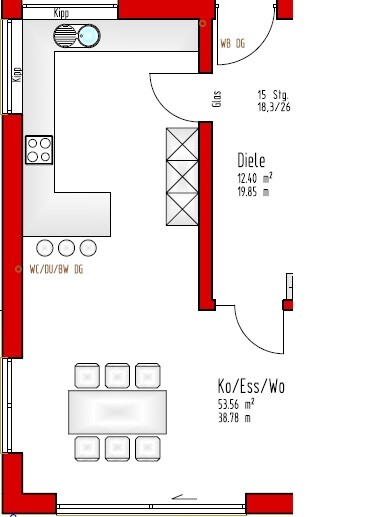
I have also attached our kitchen on the ground floor.
We are planning to add 2 recessed lights above the breakfast bar, plus a normal ceiling light centered in the kitchen. Does this make sense or not? The kitchen is quite long, so we assume that 2 recessed lights above the bar area would improve the lighting.
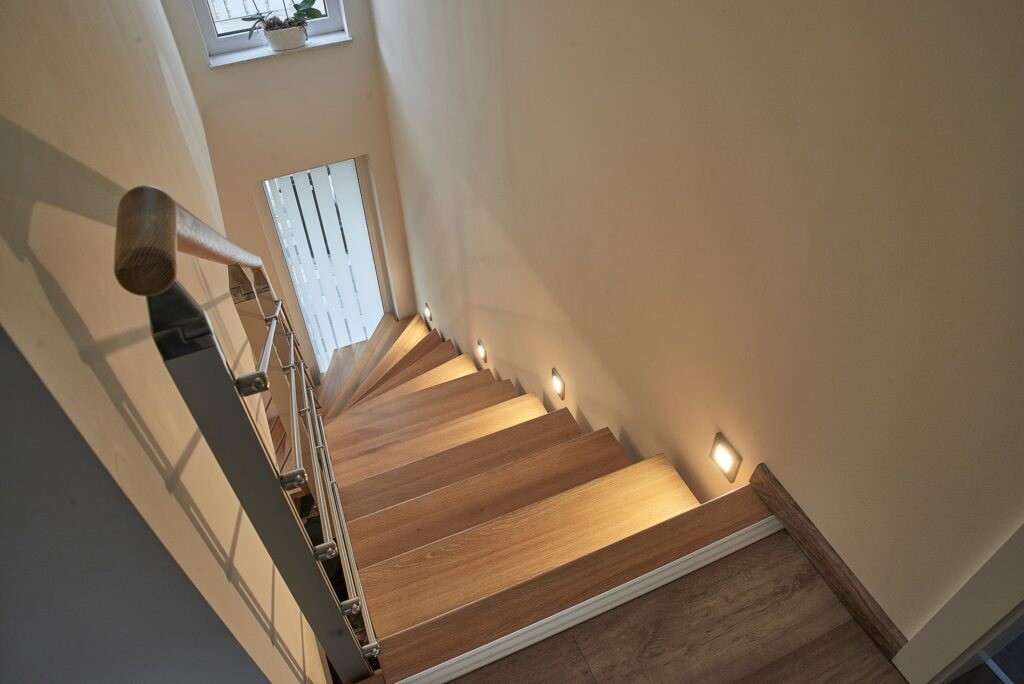
We are also considering typical recessed lighting along the stairs—see the example image attached.
What do you think about that? Is the main contractor allowed to charge the €70.00 per recessed light here as well, or is it somehow cheaper to install wall-mounted lights? Does this make sense at all, or does anyone have experience with it? Or is it ultimately just a visual highlight that ends up costing a lot?
Otherwise, we are not planning any other recessed lights in the house.
We would appreciate brief feedback on our thoughts 🙂
We are currently planning the arrangement of our recessed lights—mainly in the shower area of our bathroom.
At the moment, our contract includes 4 recessed lights at our request, but this number can of course be increased or decreased anytime (1 recessed light for concrete ceiling = €70.00).
I have attached our bathroom on the upper floor.
Shower: the full depth to the "toilet wall" is 2.10 m (7 feet), with a width of 1.00 m (3 feet 3 inches). The wall towards the door will be built up three-quarters high, meaning the shower is not fully enclosed and may still get some light since the wall does not reach the ceiling. The toilet wall is half height and has glass above it, so light also comes in here. How many recessed lights would you install in the shower, and how would you arrange them? Are 4 recessed lights really necessary here?
I have also attached our kitchen on the ground floor.
We are planning to add 2 recessed lights above the breakfast bar, plus a normal ceiling light centered in the kitchen. Does this make sense or not? The kitchen is quite long, so we assume that 2 recessed lights above the bar area would improve the lighting.
We are also considering typical recessed lighting along the stairs—see the example image attached.
What do you think about that? Is the main contractor allowed to charge the €70.00 per recessed light here as well, or is it somehow cheaper to install wall-mounted lights? Does this make sense at all, or does anyone have experience with it? Or is it ultimately just a visual highlight that ends up costing a lot?
Otherwise, we are not planning any other recessed lights in the house.
We would appreciate brief feedback on our thoughts 🙂

Tarnari schrieb:
Doesn’t matter. Think about the plug. There’s no absolute standard. USB-A, USB-C. Use both? Only one? What comes next?
Better to install a regular power outlet and a power adapter. Then you don’t have to worry about where to put it. It’s annoying if you have USB-A or C at the bedside and the device wants something else in the near future. I agree. We are also just regular people who built with normal power outlets. Then I discovered the convenience of charging pads and since then I just prefer to put my phone on the pad without plugging in any cables.

kati1337 schrieb:
I think so too. We're just ordinary people who simply installed standard power outlets. Then I discovered the convenience of charging pads, and since then, I prefer to just place my phone on the pad without plugging in any cable.I hadn’t considered that at all. Great point. No more cables. Just set the device down and charge. That’s where it’s headed.rdwlnts schrieb:
Please keep your nonsense to yourself and don’t bother the forum with it. Sorry, I’m just sharing some data about current high-end smartphones.
rdwlnts schrieb:
Several smartphone manufacturers have already announced 100W and 120W power adapters. rdwlnts schrieb:
The phone isn’t fully charged even early in the morning. You argue ("bother") with announced technologies to charge phones in 15 minutes, then deny that these wouldn’t fully charge devices overnight. Alright then.
rdwlnts schrieb:
Apple does not accept less than 1A, which was often the standard until recently. Why would they? Apple has been charging with more than 2A for 7 years. If you consider that a short period (“until recently”), I’m honestly relieved. I’m fine charging my phone overnight for the next few years.
Seriously, what use do I have for devices that don’t last 24 hours?
Tarnari schrieb:
Think about the connector. No absolute standard. USB-A, USB-C. Sure, a simple cable with USB-A on one end and USB-C on the other. Fits perfectly. It really couldn’t be any easier.
kati1337 schrieb:
Charging pads Aren’t they all connected via USB cable now? Edit: Yes, apparently they all are. So I can’t accept that argument 😀
Tassimat schrieb:
Sorry, but I’m only sharing a few specs from current high-end smartphones.
You talk (“harass”) about promised technologies to charge phones in 15 minutes, and then you deny that you can’t fully charge your devices overnight with those. Alright then.
Why bother, Apple has been charging with over 2A for 7 years. If that’s a short period ("until recently") to you, then I’m really relieved. For me, charging the phone overnight for the next few years is enough.
Honestly, what use do I have for devices that don’t last 24 hours?
Sure, simple cable with USB-A connector on one end and USB-C on the other. Fits in. It really doesn’t get any easier than that.
Aren’t those now all USB cables? Edit: Yes, apparently they all are. So I can’t accept that argument 😀No, the “next” cable will be USB-C to USB-C. Simply because no one can agree on a standard. Just look at the evolution of USB-C. Pure chaos.Tassimat schrieb:
Aren't they all now USB-connected? Edit: Yes, apparently they all are. So I can’t use that argument anymore 😀I think so, but I bought a special power adapter for my USB cable that plugs into the wall outlet to charge my phone on the pad as quickly as possible. But I see we’re going in circles with this argument. For us, USB wall sockets were simply too expensive. To pay such a high extra cost for just one USB port on an outlet seemed unreasonable. Nowadays, I can buy USB plugs that have several high-powered USB ports, so I find it more efficient to install a standard double wall outlet and dedicate one socket to a good USB adapter rather than use a built-in outlet with a mediocre USB port.
Similar topics