
Hello everyone,
We are currently planning the arrangement of our recessed lights—mainly in the shower area of our bathroom.
At the moment, our contract includes 4 recessed lights at our request, but this number can of course be increased or decreased anytime (1 recessed light for concrete ceiling = €70.00).
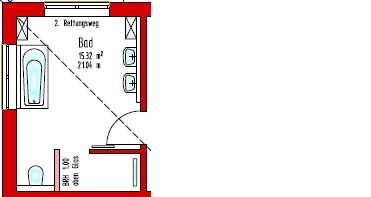
I have attached our bathroom on the upper floor.
Shower: the full depth to the "toilet wall" is 2.10 m (7 feet), with a width of 1.00 m (3 feet 3 inches). The wall towards the door will be built up three-quarters high, meaning the shower is not fully enclosed and may still get some light since the wall does not reach the ceiling. The toilet wall is half height and has glass above it, so light also comes in here. How many recessed lights would you install in the shower, and how would you arrange them? Are 4 recessed lights really necessary here?
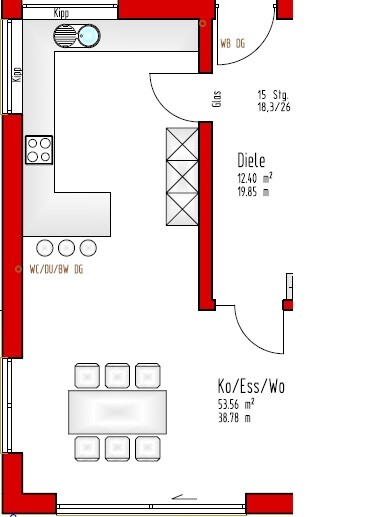
I have also attached our kitchen on the ground floor.
We are planning to add 2 recessed lights above the breakfast bar, plus a normal ceiling light centered in the kitchen. Does this make sense or not? The kitchen is quite long, so we assume that 2 recessed lights above the bar area would improve the lighting.
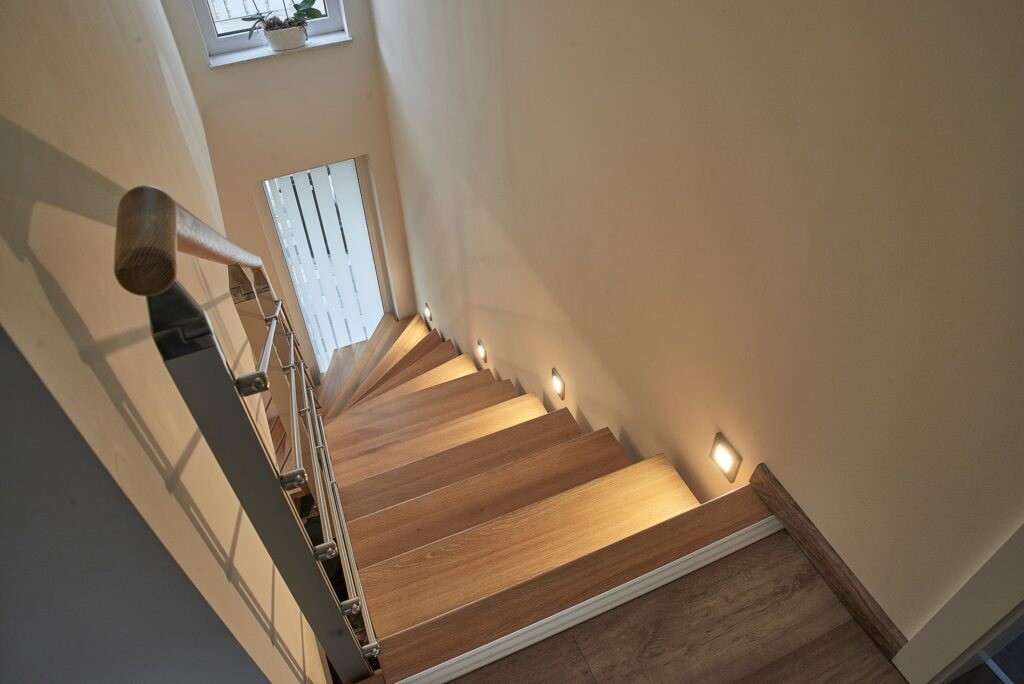
We are also considering typical recessed lighting along the stairs—see the example image attached.
What do you think about that? Is the main contractor allowed to charge the €70.00 per recessed light here as well, or is it somehow cheaper to install wall-mounted lights? Does this make sense at all, or does anyone have experience with it? Or is it ultimately just a visual highlight that ends up costing a lot?
Otherwise, we are not planning any other recessed lights in the house.
We would appreciate brief feedback on our thoughts 🙂
We are currently planning the arrangement of our recessed lights—mainly in the shower area of our bathroom.
At the moment, our contract includes 4 recessed lights at our request, but this number can of course be increased or decreased anytime (1 recessed light for concrete ceiling = €70.00).
I have attached our bathroom on the upper floor.
Shower: the full depth to the "toilet wall" is 2.10 m (7 feet), with a width of 1.00 m (3 feet 3 inches). The wall towards the door will be built up three-quarters high, meaning the shower is not fully enclosed and may still get some light since the wall does not reach the ceiling. The toilet wall is half height and has glass above it, so light also comes in here. How many recessed lights would you install in the shower, and how would you arrange them? Are 4 recessed lights really necessary here?
I have also attached our kitchen on the ground floor.
We are planning to add 2 recessed lights above the breakfast bar, plus a normal ceiling light centered in the kitchen. Does this make sense or not? The kitchen is quite long, so we assume that 2 recessed lights above the bar area would improve the lighting.
We are also considering typical recessed lighting along the stairs—see the example image attached.
What do you think about that? Is the main contractor allowed to charge the €70.00 per recessed light here as well, or is it somehow cheaper to install wall-mounted lights? Does this make sense at all, or does anyone have experience with it? Or is it ultimately just a visual highlight that ends up costing a lot?
Otherwise, we are not planning any other recessed lights in the house.
We would appreciate brief feedback on our thoughts 🙂
Schimi1791 schrieb:
About 14 months ago, I bought some for 17 euros. Since these outlets with two USB ports are not immediately visible, they didn’t have to exactly match the rest of the series.So, I can easily remove the "regular" outlet afterwards and look for a USB outlet myself to install it later? It’s not rocket science, and if the general contractor charges a lot for a USB outlet, that definitely makes sense.
Mycraft schrieb:
Presence detectors really do detect the presence of people, because with many models the movement of the respiratory system and shoulders is enough to trigger them.
Motion detectors, on the other hand, require larger and stronger movements to activate.Okay. I assume presence detectors are significantly more expensive, right? Has anyone installed these here before and can say something about the costs as well as the installation?
 Schimi17916 Apr 2021 15:04
exto1791 schrieb:
So I can easily remove the "regular" outlet afterwards and look for a USB outlet myself to install it later?
... At least in our case, "regular" outlets were replaced with the mentioned outlets without any changes to the wiring.

Of course, you can buy an outlet somewhere and install it yourself later. But I don’t think the electricians of the general contractor would use any “no-name” switchgear. If they do, I would be concerned. USB outlets from Gira, Jung, Busch & Jäger, and similar brands cost a bit more, but the labor is the same.
AMNE3IA schrieb:
@exto1791 I can't imagine a USB socket costing only 10 euros.Sure, discount grocery stores sometimes offer these sockets every few months. From my experience, online shopping for hardware store items is often significantly more expensive, especially from the one named after a big river.Anyway, replacing a standard outlet with a USB socket is quite easy and straightforward. You just have to be okay with some limitations regarding the appearance, and so on. If the existing outlet has a single frame, you can use the new frame that comes with the USB socket. Otherwise, you need to make sure that at least the basic shape fits within the frame system. A square USB socket won’t fit properly into a rounded frame (e.g., BJ reflex SI). But even “square” into “square” doesn’t fit perfectly; for example, the balance SI series flattens at the top and bottom, causing the corners of the USB socket to protrude. It’s not perfect, but personally, it didn’t bother me.

exto1791 schrieb:
Okay. So presence detectors are significantly more expensive too, right? Yes, definitely, because presence detectors are simply more functional and accurate. They also tend to be more durable and often more attractive in terms of design.
exto1791 schrieb:
Has anyone here already installed these and can share some information regarding the costs as well as the installation? Of course, this technology is nothing new and was available long before the rise of typical smart homes; it has been commonly installed in single-family houses for decades. For example, I have 5 of them installed in my house.
Price-wise, they start around 60–80 per detector (just the detector). The most advanced models can easily cost 300 or more. However, those usually don’t just detect presence but also measure additional parameters like CO2 or humidity, so they can combine 5, 6, or 7 sensors in one device.
AMNE3IA schrieb:
USB outlets from Gira, Jung, Busch & Jäger, and others tend to be a bit more expensive. The installation work remains the same. The price is often not just about the brand name or compatibility with your existing switch systems but also what’s inside. There are plenty of unboxing videos where electricians thoroughly test these devices, and no-name products rarely perform well.
Similar topics