
Hello everyone,
We are currently planning the arrangement of our recessed lights—mainly in the shower area of our bathroom.
At the moment, our contract includes 4 recessed lights at our request, but this number can of course be increased or decreased anytime (1 recessed light for concrete ceiling = €70.00).
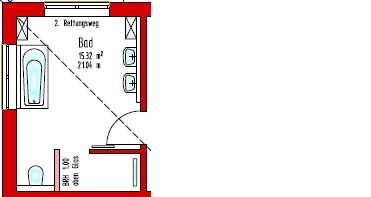
I have attached our bathroom on the upper floor.
Shower: the full depth to the "toilet wall" is 2.10 m (7 feet), with a width of 1.00 m (3 feet 3 inches). The wall towards the door will be built up three-quarters high, meaning the shower is not fully enclosed and may still get some light since the wall does not reach the ceiling. The toilet wall is half height and has glass above it, so light also comes in here. How many recessed lights would you install in the shower, and how would you arrange them? Are 4 recessed lights really necessary here?
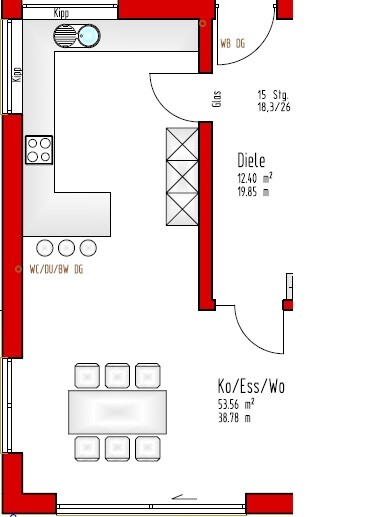
I have also attached our kitchen on the ground floor.
We are planning to add 2 recessed lights above the breakfast bar, plus a normal ceiling light centered in the kitchen. Does this make sense or not? The kitchen is quite long, so we assume that 2 recessed lights above the bar area would improve the lighting.
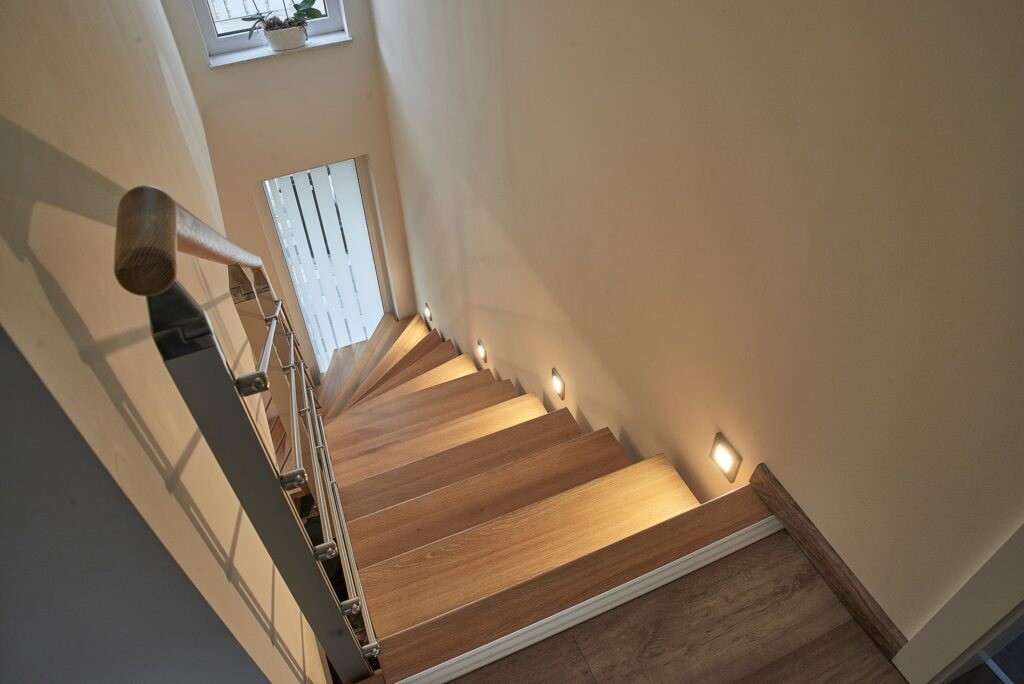
We are also considering typical recessed lighting along the stairs—see the example image attached.
What do you think about that? Is the main contractor allowed to charge the €70.00 per recessed light here as well, or is it somehow cheaper to install wall-mounted lights? Does this make sense at all, or does anyone have experience with it? Or is it ultimately just a visual highlight that ends up costing a lot?
Otherwise, we are not planning any other recessed lights in the house.
We would appreciate brief feedback on our thoughts 🙂
We are currently planning the arrangement of our recessed lights—mainly in the shower area of our bathroom.
At the moment, our contract includes 4 recessed lights at our request, but this number can of course be increased or decreased anytime (1 recessed light for concrete ceiling = €70.00).
I have attached our bathroom on the upper floor.
Shower: the full depth to the "toilet wall" is 2.10 m (7 feet), with a width of 1.00 m (3 feet 3 inches). The wall towards the door will be built up three-quarters high, meaning the shower is not fully enclosed and may still get some light since the wall does not reach the ceiling. The toilet wall is half height and has glass above it, so light also comes in here. How many recessed lights would you install in the shower, and how would you arrange them? Are 4 recessed lights really necessary here?
I have also attached our kitchen on the ground floor.
We are planning to add 2 recessed lights above the breakfast bar, plus a normal ceiling light centered in the kitchen. Does this make sense or not? The kitchen is quite long, so we assume that 2 recessed lights above the bar area would improve the lighting.
We are also considering typical recessed lighting along the stairs—see the example image attached.
What do you think about that? Is the main contractor allowed to charge the €70.00 per recessed light here as well, or is it somehow cheaper to install wall-mounted lights? Does this make sense at all, or does anyone have experience with it? Or is it ultimately just a visual highlight that ends up costing a lot?
Otherwise, we are not planning any other recessed lights in the house.
We would appreciate brief feedback on our thoughts 🙂


Once again for the original poster (I haven’t read the remaining 9 pages):
We have 4 recessed lights throughout the bathroom, one of them directly above the shower. Our shower is walk-in and measures 100cm x 120cm (40 inches x 47 inches) with a fairly narrow door opening.
The single light directly in the shower feels more than sufficient. For your shower, I would consider 2 recessed lights, especially if additional light can enter from outside over a half-height partition wall.
For us, one recessed light plus the natural light coming through the opening is plenty, as our shower walls are fully built up to ceiling height.
We have 4 recessed lights throughout the bathroom, one of them directly above the shower. Our shower is walk-in and measures 100cm x 120cm (40 inches x 47 inches) with a fairly narrow door opening.
The single light directly in the shower feels more than sufficient. For your shower, I would consider 2 recessed lights, especially if additional light can enter from outside over a half-height partition wall.
For us, one recessed light plus the natural light coming through the opening is plenty, as our shower walls are fully built up to ceiling height.
rdwlnts schrieb:
Some built-in Busch Jäger outlets only provide 3W, meaning the phone isn’t fully charged even early in the morning.I’m not sure what Busch Jäger does, it might be that their products have lower output than the generic brands. The rest is just polemical nonsense.Any standard USB outlet provides at least 2A (which equals 10W). This allows an iPhone 12 to be fully charged in 2.5 hours.
rdwlnts schrieb:
Phone chargers nowadays charge at 30 - 50W.That’s incorrect... just because it’s printed on the charger doesn’t mean the phone actually charges at 30 to 50W. An iPhone 12 never draws more than 18W, even when connected to a 65A power supply. By the way, it only draws 18W briefly at the start if the battery is completely empty. Afterwards, the power is significantly throttled:From 0% to 100% charge:
18W: 1 hour 40 minutes
10W (2A): 2 hours 35 minutes
5W (1A): 3 hours 19 minutes
Tassimat schrieb:
I don't know what Busch-Jaeger does, maybe they have less powerful equipment than the no-name brands. The rest is just polemical nonsense.Please keep your nonsense to yourself and don’t bother the forum with it. How could I even mention the insignificant Busch-Jaeger with 700mA (0.7A) while you have the reference no-name brands on your side?
Apple doesn’t accept anything under 1A, and that is often found and was the standard until recently.
And yes, Apple is known for small batteries, which is why the low power only gives about 2.5 hours.
My phone, however, draws over 6A and doesn’t need 2.5 hours despite having a 5000mAh battery. The trend is moving towards higher power, as can be seen from the increasingly stronger power adapters. The outlet in the wall, however, is fixed and you don’t want to change it every few years.

No matter. Think about the plug. There is no absolute standard. USB-A, USB-C. Use both? Just one? What comes next?
Better to install a power outlet and a power adapter instead. That way, you don’t have to worry about where to connect it. It’s inconvenient if your bedside table has USB-A or USB-C and the device needs something different again in the near future.
Better to install a power outlet and a power adapter instead. That way, you don’t have to worry about where to connect it. It’s inconvenient if your bedside table has USB-A or USB-C and the device needs something different again in the near future.
Similar topics