
ᐅ Creating a Plan for Insulating an Old Building – How to Proceed?
Created on: 30 Aug 2022 10:30
T
Tobibi
Hello,
I’m currently trying to make a plan for how to best improve the insulation of our house. I hope I can write everything down clearly so that some of you might be able to give me tips or suggest different approaches.
We bought a large house from 1982, about 200 sqm (2,150 sq ft) of living space. There is an approximately 6-year-old heat pump for heating and hot water, and a small wood stove in the living room. The ground floor and first floor have underfloor heating, while three basement rooms and a converted room above the garage have radiators. These radiators have a separate heating circuit with their own flow temperature and are rarely used, actually not at all in the basement.
In the main bedroom on the first floor, the previous owner opened the ceiling a few years ago, creating a high space that goes up to the roof ridge. The roof was insulated at that time, but I don’t have any documentation on how well. The rest of the house remains in its original condition, so basically uninsulated.
The walls are solid brick. The wooden windows have double glazing. Many windows and the front door do not seal well, allowing noticeable drafts at some windows. The top floor ceiling is not concrete but made of joists, covered underneath on the first floor with drywall and boards on top. Between the joists, there appears to be rock wool insulation packed in.
We have a 9 kWp photovoltaic system with battery storage, which the previous owner also installed. As it currently stands, the electricity from the photovoltaic system cannot be used for the heat pump, only for other household electricity. There is a separate meter with a heating electricity contract. Surplus electricity is fed back into the grid.
I recently received the heating electricity bill, showing that from March 2021 to March 2022—one full year—we used about 12,500 kWh for heating and hot water, which I find quite high. I definitely want to take action, especially since electricity prices are rising sharply. I’m not an experienced DIYer, but I can assist and have very helpful father and father-in-law who have a lot of skills. So, some things could be done ourselves, although time is always a factor.
A no-brainer seems to be replacing the window seals and adjusting them so they close tightly again. I am already in contact with a company for this.
Next, I’m thinking about insulating the roller shutter boxes. I would probably get a company to do this as well.
I’m considering insulating the basement ceiling with insulation boards that can be glued or fixed with plugs. If there are instructions available, we would rather do that ourselves. Or should I focus on insulating the top floor ceiling or installing insulation between the rafters? Or both? Probably not at the same time—maybe one this year and the other in a year or two. What would be the better order?
Would it make sense to modify the photovoltaic system so that the electricity can be used for the heat pump? I would have to hire an electrician for that, which costs money. But then the electricity would be usable for heating, and there would be only one basic fee. On the other hand, the yield in winter is not very good, and I would lose the cheaper heating electricity tariff. I once tracked generated, fed-in, self-used, and purchased electricity over a longer period and basically concluded that the conversion might not be worthwhile. But now electricity prices are rising dramatically.
Insulating the facade and/or installing new windows is honestly too expensive for me right now. On the other hand, we will need to have the entire exterior repainted next year or the year after. That costs several thousand when done professionally, which would almost offset the cost of external wall insulation. But presumably, these two should go together—insulation and new windows—because doing only one is not sensible and could cause problems with condensation.
So, that turned out to be quite a long message. I hope it’s understandable. How would you proceed? If I forgot anything, just ask. I might also add a follow-up later.
Best regards,
Tobi
I’m currently trying to make a plan for how to best improve the insulation of our house. I hope I can write everything down clearly so that some of you might be able to give me tips or suggest different approaches.
We bought a large house from 1982, about 200 sqm (2,150 sq ft) of living space. There is an approximately 6-year-old heat pump for heating and hot water, and a small wood stove in the living room. The ground floor and first floor have underfloor heating, while three basement rooms and a converted room above the garage have radiators. These radiators have a separate heating circuit with their own flow temperature and are rarely used, actually not at all in the basement.
In the main bedroom on the first floor, the previous owner opened the ceiling a few years ago, creating a high space that goes up to the roof ridge. The roof was insulated at that time, but I don’t have any documentation on how well. The rest of the house remains in its original condition, so basically uninsulated.
The walls are solid brick. The wooden windows have double glazing. Many windows and the front door do not seal well, allowing noticeable drafts at some windows. The top floor ceiling is not concrete but made of joists, covered underneath on the first floor with drywall and boards on top. Between the joists, there appears to be rock wool insulation packed in.
We have a 9 kWp photovoltaic system with battery storage, which the previous owner also installed. As it currently stands, the electricity from the photovoltaic system cannot be used for the heat pump, only for other household electricity. There is a separate meter with a heating electricity contract. Surplus electricity is fed back into the grid.
I recently received the heating electricity bill, showing that from March 2021 to March 2022—one full year—we used about 12,500 kWh for heating and hot water, which I find quite high. I definitely want to take action, especially since electricity prices are rising sharply. I’m not an experienced DIYer, but I can assist and have very helpful father and father-in-law who have a lot of skills. So, some things could be done ourselves, although time is always a factor.
A no-brainer seems to be replacing the window seals and adjusting them so they close tightly again. I am already in contact with a company for this.
Next, I’m thinking about insulating the roller shutter boxes. I would probably get a company to do this as well.
I’m considering insulating the basement ceiling with insulation boards that can be glued or fixed with plugs. If there are instructions available, we would rather do that ourselves. Or should I focus on insulating the top floor ceiling or installing insulation between the rafters? Or both? Probably not at the same time—maybe one this year and the other in a year or two. What would be the better order?
Would it make sense to modify the photovoltaic system so that the electricity can be used for the heat pump? I would have to hire an electrician for that, which costs money. But then the electricity would be usable for heating, and there would be only one basic fee. On the other hand, the yield in winter is not very good, and I would lose the cheaper heating electricity tariff. I once tracked generated, fed-in, self-used, and purchased electricity over a longer period and basically concluded that the conversion might not be worthwhile. But now electricity prices are rising dramatically.
Insulating the facade and/or installing new windows is honestly too expensive for me right now. On the other hand, we will need to have the entire exterior repainted next year or the year after. That costs several thousand when done professionally, which would almost offset the cost of external wall insulation. But presumably, these two should go together—insulation and new windows—because doing only one is not sensible and could cause problems with condensation.
So, that turned out to be quite a long message. I hope it’s understandable. How would you proceed? If I forgot anything, just ask. I might also add a follow-up later.
Best regards,
Tobi
Oh, by the way... a insulation panel made of a 1–3cm (0.4–1.2 inch) vacuum glass microsphere mixture is currently in development, I was told. Maybe then nordanney’s comment will no longer be relevant once this product is released and is just as light or even lighter than vacuum insulation panels.

@nordanney:
Well, the water in the paint will probably evaporate, right?
Let’s say it starts with 40% water content (normal paints have 25%), which then drops to 5% (my assumption, I have no idea how much water remains in the paint on the wall, maybe less than 5%).
= 24 kg/m³ (1.5 lb/ft³).
@MartinR.
Calculation goes like this:
U-value concrete wall (25cm (10 inches)): 3.3 W/m²K
U-value KSK (24cm (9.5 inches)): 1.61 W/m²K
U-value 16cm (6.3 inches) Styrofoam with WLG 035: 0.2 W/m²K
The savings compared to concrete are therefore 1550%, compared to KSK: 705%, and compared to a wall material with exactly 1.0 W/m²K transmission heat loss: 400%.
Well, the water in the paint will probably evaporate, right?
Let’s say it starts with 40% water content (normal paints have 25%), which then drops to 5% (my assumption, I have no idea how much water remains in the paint on the wall, maybe less than 5%).
= 24 kg/m³ (1.5 lb/ft³).
@MartinR.
Calculation goes like this:
U-value concrete wall (25cm (10 inches)): 3.3 W/m²K
U-value KSK (24cm (9.5 inches)): 1.61 W/m²K
U-value 16cm (6.3 inches) Styrofoam with WLG 035: 0.2 W/m²K
The savings compared to concrete are therefore 1550%, compared to KSK: 705%, and compared to a wall material with exactly 1.0 W/m²K transmission heat loss: 400%.
Okay nordanney, I asked you not to get too carried away, but you completely went overboard with your statements. According to you, our European neighboring countries are corrupt, clueless about what they are doing, and only specialize in deception.
I know some German companies that have had a problematic past in that regard, but I would never generalize like that.
Thanks for your opinion, but with that statement, my side considers the constructive discussion with you over.
By the way...
The Polish address is the office, and the place of manufacture is in the Czech Republic, but well researched.
Please Google my company address if you’re at it and ask yourself if I have my loft doors made at my garage. LOL
I know some German companies that have had a problematic past in that regard, but I would never generalize like that.
Thanks for your opinion, but with that statement, my side considers the constructive discussion with you over.
By the way...
The Polish address is the office, and the place of manufacture is in the Czech Republic, but well researched.
Please Google my company address if you’re at it and ask yourself if I have my loft doors made at my garage. LOL
N
nordanney22 May 2024 12:31MartinR. schrieb:
Thanks for your opinion, but for me, the constructive discussion ends here following your statement. But it’s interesting that you haven’t addressed a single argument I’ve made so far. Not one. Respect – that’s one way to ignore uncomfortable truths.
MartinR. schrieb:
According to you, our European neighboring countries are corrupt, clueless about what they are doing, and only specialize in deceit. Where did I write that? However, a back-office operation—whatever the physical address might actually be—physical impossibilities, inconsistent descriptions, missing approvals, etc., do not suggest a highly professional and pioneering product development. The pattern repeats everywhere.
If it looks like a duck, waddles like a duck, and quacks like a duck, it probably is one.
Unfortunately, this is evident with all these so-called miracle coatings from various Polish and Czech companies mentioned in this thread so far.
P.S. I’m happy to have windows made in Poland or buy doors in the Czech Republic (Sapeli), but they all just do regular work and don’t sell miracles. Good technical training, often better than ours.
P.S. 2: Talk to an energy consultant about the coating. You won’t be the first to have to revive one who literally laughed themselves out of business. Others here in this thread have already done that regarding possible KfW funding. Failed miserably.
What arguments? I’m not here to prove that this stuff works; I’m here to receive constructive feedback and then form my own opinion based on that.
Backyard offices? Well, the office didn’t seem like a backyard one to me, but hey, you were there.
No, it wasn’t a Trump Tower, but maybe it doesn’t have to be.
Apple, Microsoft, etc. were all developed in garages, but they are just quacking ducks.
I never said it’s a miracle product—you are the one calling it that. I see it more as a not-yet-fully-developed but useful and possibly complementary product.
It works in casting technology and will eventually work in house construction.
At least I hope so, since styrofoam and mineral wool insulation are already being used.
P.S. Arguments only work if you are open to them, but you tear everything apart immediately.
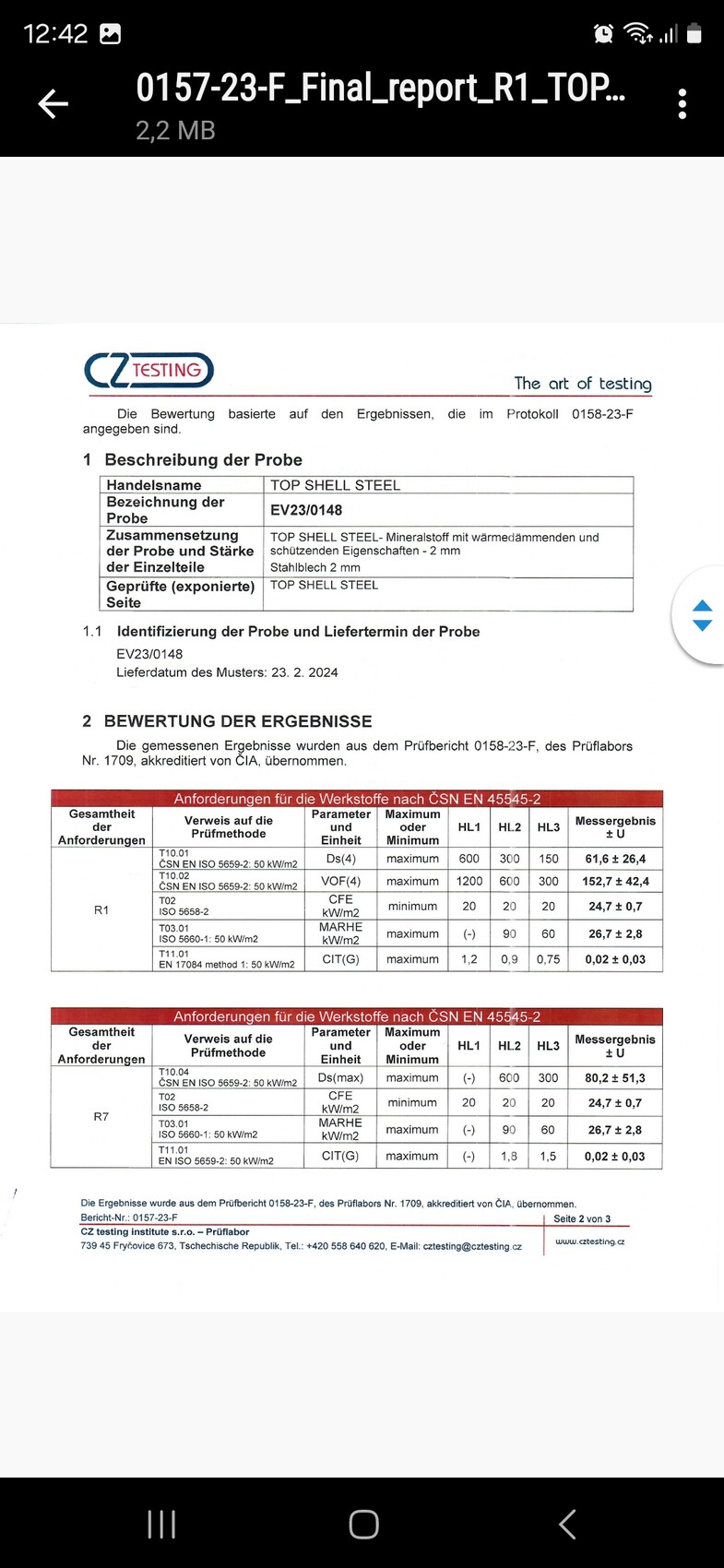
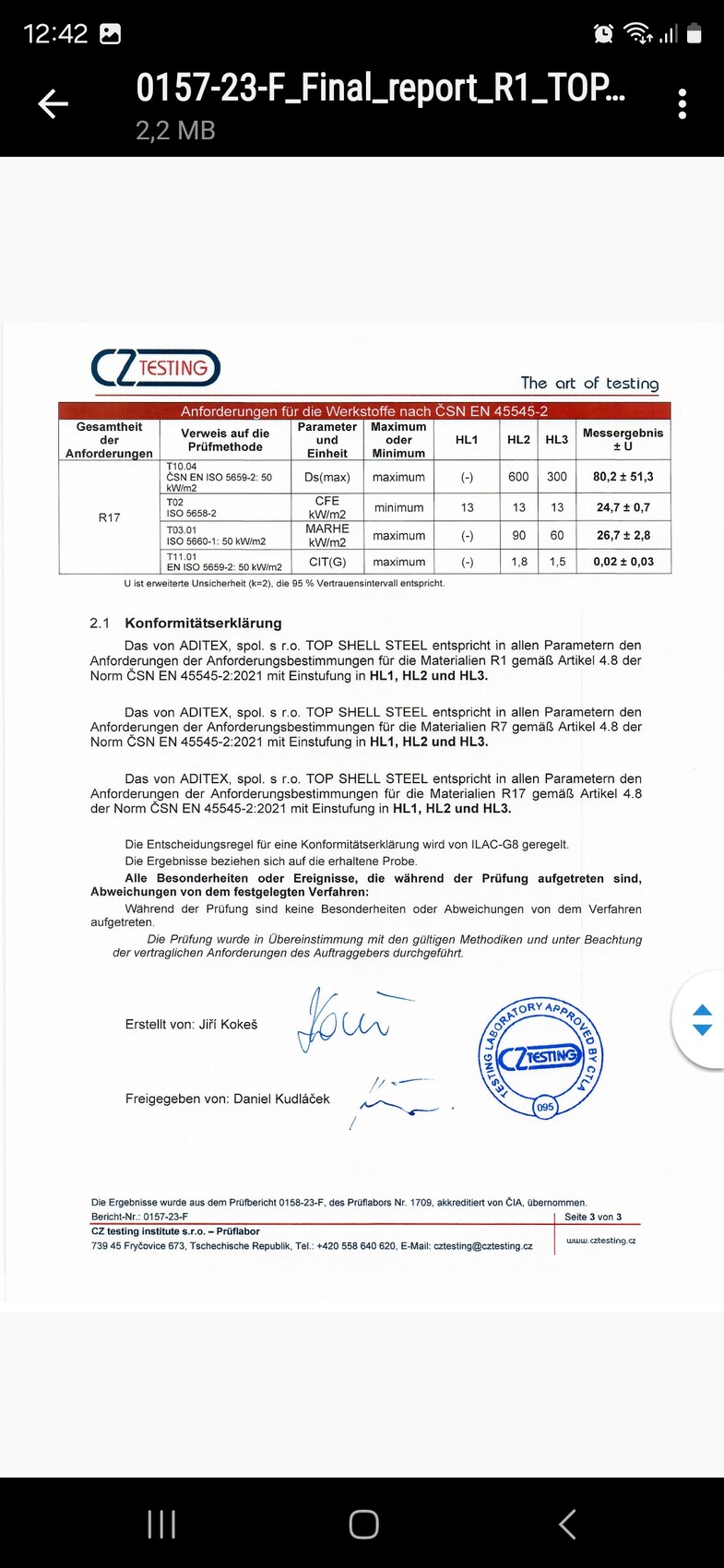
The EN ISO 3795 standard was shown and it was stated that only the required tests were performed and the values were met.
The EN 13501 certification will be added later this month. Of course, only if the price is right.
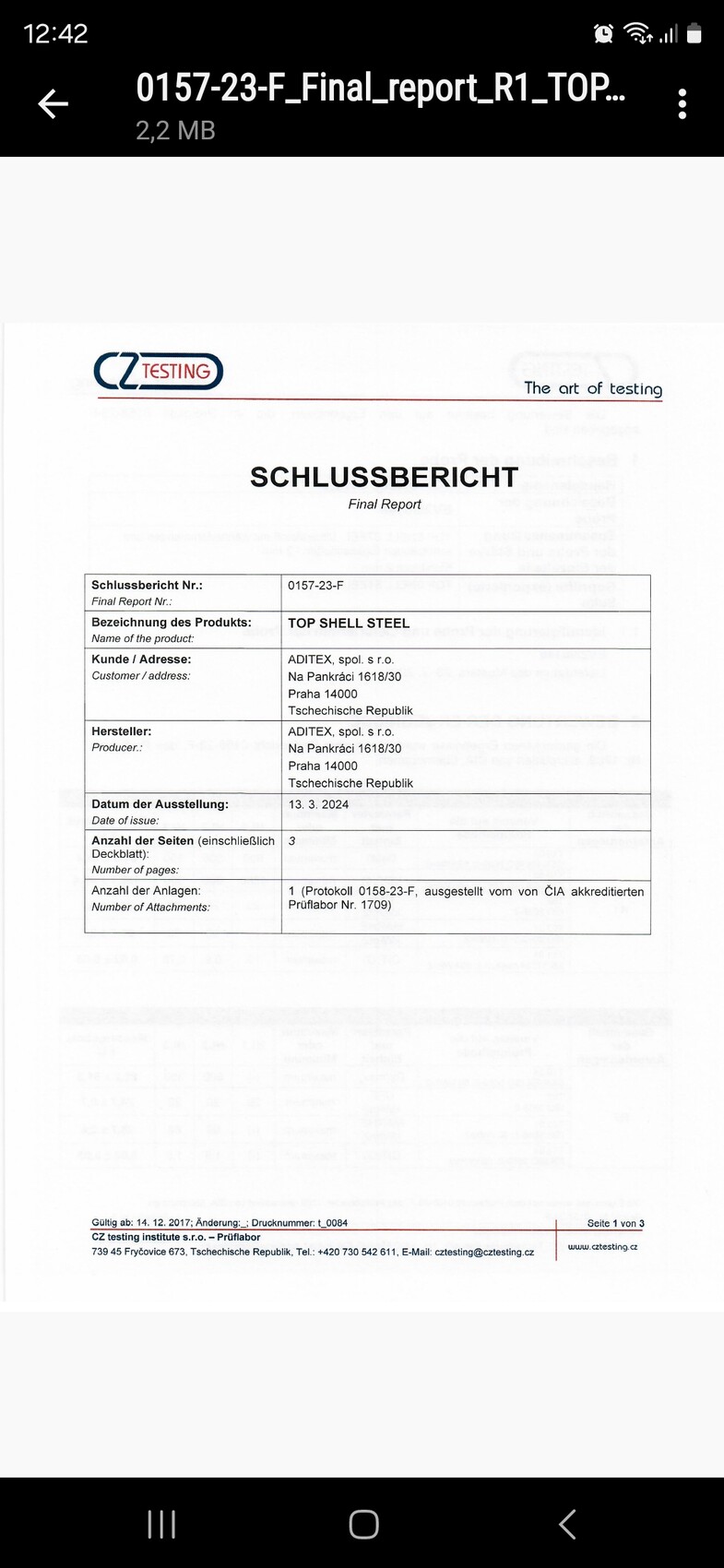
I also found a certificate that was requested by a major German insulation manufacturer for processing with TopShell in your factory.
Please feel free to tear it apart and tell me what is wrong with it.
Backyard offices? Well, the office didn’t seem like a backyard one to me, but hey, you were there.
No, it wasn’t a Trump Tower, but maybe it doesn’t have to be.
Apple, Microsoft, etc. were all developed in garages, but they are just quacking ducks.
I never said it’s a miracle product—you are the one calling it that. I see it more as a not-yet-fully-developed but useful and possibly complementary product.
It works in casting technology and will eventually work in house construction.
At least I hope so, since styrofoam and mineral wool insulation are already being used.
P.S. Arguments only work if you are open to them, but you tear everything apart immediately.
The EN ISO 3795 standard was shown and it was stated that only the required tests were performed and the values were met.
The EN 13501 certification will be added later this month. Of course, only if the price is right.
I also found a certificate that was requested by a major German insulation manufacturer for processing with TopShell in your factory.
Please feel free to tear it apart and tell me what is wrong with it.
Similar topics