
Hello
I have a newly built, 5-year-old passive house equipped with a ventilation system.
Lately, I have been thinking a lot about cleaning the ducts installed inside the building structure, since these are not accessible for removing construction dust and accumulated dirt.
I have now taken some photos with an inspection camera, showing about a 1 cm (0.4 inch) layer of dust inside the exhaust duct, which is not ideal.
After much consideration, I have found a partner with whom I have solved this problem.
We offer efficient cleaning using a cleaning pig. However, before we enter the market (planned for 1.1.2019), I wanted to hear some feedback regarding new buildings with ventilation systems.
This concerns systems installed with distributors and plastic ducts.
We would like to limit our service initially to the NRW area, but here I am interested in a realistic assessment from owners of such systems.
I have one myself and want to continue breathing clean air, not dirty, dusty air...
The method we offer is truly effective and efficient.
So, let’s hear your thoughts.
I have a newly built, 5-year-old passive house equipped with a ventilation system.
Lately, I have been thinking a lot about cleaning the ducts installed inside the building structure, since these are not accessible for removing construction dust and accumulated dirt.
I have now taken some photos with an inspection camera, showing about a 1 cm (0.4 inch) layer of dust inside the exhaust duct, which is not ideal.
After much consideration, I have found a partner with whom I have solved this problem.
We offer efficient cleaning using a cleaning pig. However, before we enter the market (planned for 1.1.2019), I wanted to hear some feedback regarding new buildings with ventilation systems.
This concerns systems installed with distributors and plastic ducts.
We would like to limit our service initially to the NRW area, but here I am interested in a realistic assessment from owners of such systems.
I have one myself and want to continue breathing clean air, not dirty, dusty air...
The method we offer is truly effective and efficient.
So, let’s hear your thoughts.
B
bau_2015_27 Oct 2018 15:58The operating manual states the following:
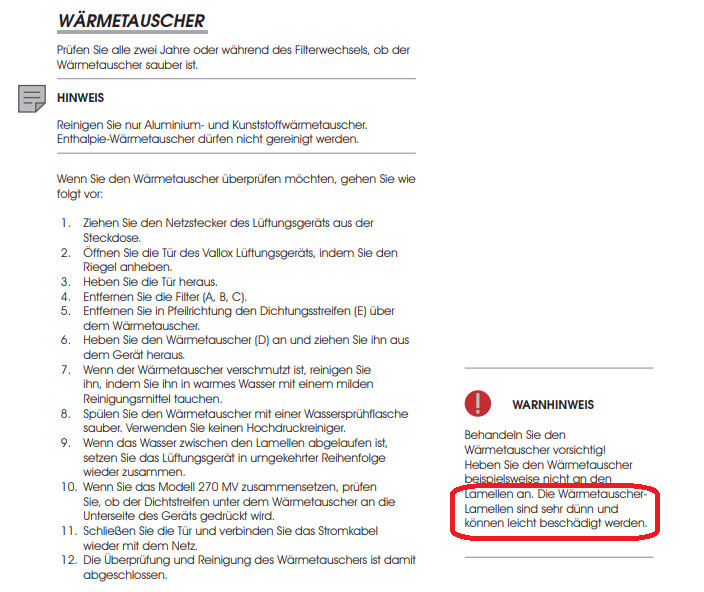
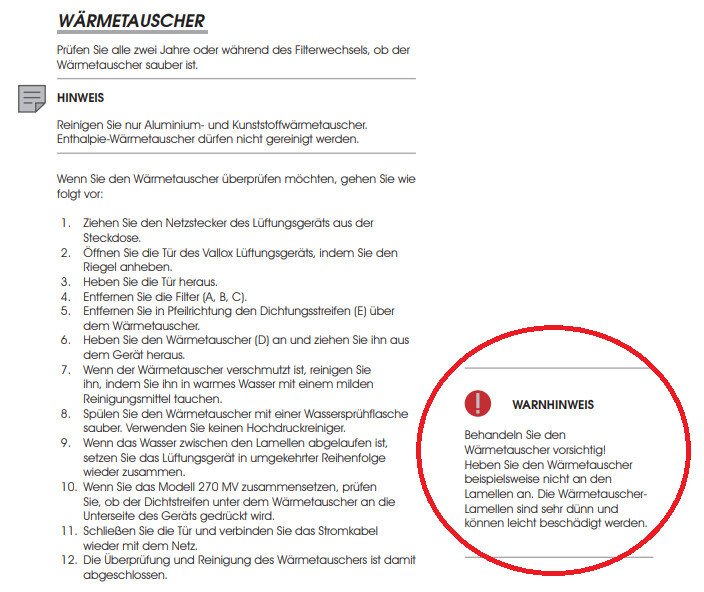

If you don’t damage them, there won’t be any leaks. The plastic fins are ultrasonic welded, so nothing can pass through them, and actually, a heat exchanger like the one shown in the picture should be fully sealed with sealant all around. That’s where you can separate the good from the bad.

Regarding your issue with drawing in chimney air, etc., that is normal. Air is also drawn from neighboring chimneys. However, it’s still only a fraction of the polluted air that an open window brings into the house.
Regarding your issue with drawing in chimney air, etc., that is normal. Air is also drawn from neighboring chimneys. However, it’s still only a fraction of the polluted air that an open window brings into the house.
B
bau_2015_27 Oct 2018 18:31Mycraft schrieb:
The plastic fins are ultrasonic welded, so nothing can get through, and essentially a heat exchanger like the one shown in the picture should be fully sealed with sealant. This is how it looks in my case
B
bau_2015_27 Oct 2018 19:08Mycraft schrieb:
Yes, I already noticed it in the first pictures. The system looks rather oddly pieced together. The bent filter also looks quite questionable.
In my case, there isn’t even a sheet of paper that can fit in there, so nothing can leak or overflow, etc.Well, I trusted my builder. Actually, the system is from Vallox.
B
bau_2015_27 Oct 2018 19:28I would like to summarize some points from our discussion.
Issue:
How important is the hygienic condition of the exhaust duct for the supply air quality? It is usually assumed that a negative pressure is created in the exhaust duct and no air flows from the duct into the house. However, the discussion considers other aspects that are not so obvious.
The following reasons for influencing the supply air quality were discussed:
- Leakage in the system construction.
- Leakage in the heat exchanger.
- Intake of exhaust air into the supply air duct.
Leakage in the system construction:
This must be checked during maintenance. It can be caused by poorly fitting sealing elements (at least in my system).
Leakage in the heat exchanger
Modern manufacturing processes make it possible to avoid leaks in the heat exchanger. During maintenance, special care must be taken not to damage the sensitive fin structure.
Intake of exhaust air into the supply air duct:
We agreed that exhaust air can be drawn into the supply air duct.
Conclusion.
To ensure the hygienic condition of the supply air, the exhaust duct must also be kept clean.
Issue:
How important is the hygienic condition of the exhaust duct for the supply air quality? It is usually assumed that a negative pressure is created in the exhaust duct and no air flows from the duct into the house. However, the discussion considers other aspects that are not so obvious.
The following reasons for influencing the supply air quality were discussed:
- Leakage in the system construction.
- Leakage in the heat exchanger.
- Intake of exhaust air into the supply air duct.
Leakage in the system construction:
This must be checked during maintenance. It can be caused by poorly fitting sealing elements (at least in my system).
Leakage in the heat exchanger
Modern manufacturing processes make it possible to avoid leaks in the heat exchanger. During maintenance, special care must be taken not to damage the sensitive fin structure.
Intake of exhaust air into the supply air duct:
We agreed that exhaust air can be drawn into the supply air duct.
Mycraft schrieb:
Regarding your problem with intake of chimney air, etc. This is normal.
Conclusion.
To ensure the hygienic condition of the supply air, the exhaust duct must also be kept clean.
Similar topics