
Hello
I have a newly built, 5-year-old passive house equipped with a ventilation system.
Lately, I have been thinking a lot about cleaning the ducts installed inside the building structure, since these are not accessible for removing construction dust and accumulated dirt.
I have now taken some photos with an inspection camera, showing about a 1 cm (0.4 inch) layer of dust inside the exhaust duct, which is not ideal.
After much consideration, I have found a partner with whom I have solved this problem.
We offer efficient cleaning using a cleaning pig. However, before we enter the market (planned for 1.1.2019), I wanted to hear some feedback regarding new buildings with ventilation systems.
This concerns systems installed with distributors and plastic ducts.
We would like to limit our service initially to the NRW area, but here I am interested in a realistic assessment from owners of such systems.
I have one myself and want to continue breathing clean air, not dirty, dusty air...
The method we offer is truly effective and efficient.
So, let’s hear your thoughts.
I have a newly built, 5-year-old passive house equipped with a ventilation system.
Lately, I have been thinking a lot about cleaning the ducts installed inside the building structure, since these are not accessible for removing construction dust and accumulated dirt.
I have now taken some photos with an inspection camera, showing about a 1 cm (0.4 inch) layer of dust inside the exhaust duct, which is not ideal.
After much consideration, I have found a partner with whom I have solved this problem.
We offer efficient cleaning using a cleaning pig. However, before we enter the market (planned for 1.1.2019), I wanted to hear some feedback regarding new buildings with ventilation systems.
This concerns systems installed with distributors and plastic ducts.
We would like to limit our service initially to the NRW area, but here I am interested in a realistic assessment from owners of such systems.
I have one myself and want to continue breathing clean air, not dirty, dusty air...
The method we offer is truly effective and efficient.
So, let’s hear your thoughts.
B
bau_2015_10 Feb 2019 11:11Hooray!!! It’s finally approved. It took a bit of time, though. It seems that skilled workers in the construction industry are currently quite busy. The screw is now removed. The craftsman surprisingly found and unscrewed it quite quickly.
My heating installer was quite impressed by my story and even tried three different systems to be able to offer cleaning as a service in the future. The systems were as follows:
- Rotating brush (by Bösch)
- Cleaning balls (MAICO MF-R63)
- Cleaning set (by fd-ds)
We started with the exhaust duct in the kitchen. The pictures show what it looked like.

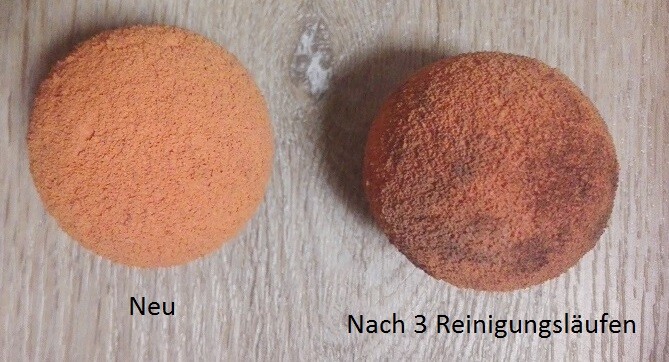
At first, we tried the balls (MF-R75). You insert a ball into the duct and suck it in from the other end using a vacuum cleaner. The ball stirs up the dust, which is then supposed to be vacuumed out at the duct’s end. After three runs, the ball was quite dirty. Since the balls are made of foam, we couldn’t clean them properly anymore.
Despite the three cleaning runs, the deposits inside the duct were still clearly visible with the camera.
Perhaps this is because the ball almost completely blocks the duct’s diameter. For this reason, the airflow cannot build up sufficiently to carry the contamination through the duct.
Next, we tried the rotating brush (by Bösch). The brush is turned using a cordless drill and pushed through the duct with a flexible shaft. Again, a vacuum cleaner is supposed to suction up the stirred-up dust at the other end of the duct. After cleaning, the deposits were barely visible with the camera (at least within the first 2 meters (6.5 feet) from the valve). But the cleaning with the cleaning set showed that it was not thoroughly cleaned.
It’s possible that the rotating brush blocks the airflow too much. As a result, the active brush also does not allow enough airflow to transport the dust through the several meters (yards) of duct. Thus, the stirred-up contamination might settle again inside the duct.
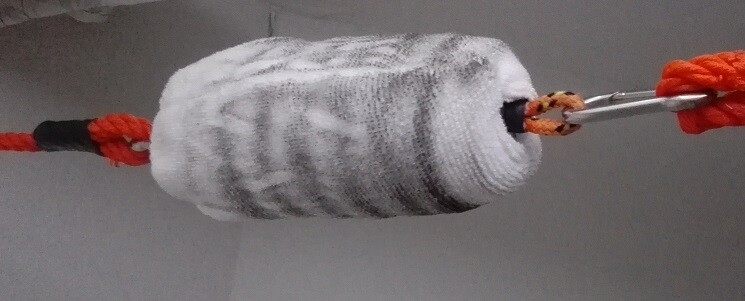
We cleaned the same duct again with the cleaning set (by fd-ds). It works as follows: a pulling rope is installed by means of a pulling unit, which is suctioned by a vacuum cleaner. The duct is cleaned with a cloth attached to a foam body. This is pulled through by the installed pulling rope. The cloths on the foam body are changed after each duct or each run.
Despite several cleaning runs with the balls and the rotating brush, the cloths from the cleaning set came out quite dirty from the first duct we used for testing.
We cleaned all other ducts with the cleaning set. Without testing the systems on the first duct, the entire cleaning took about 2 hours. Cleaning with the cleaning set looked quite simple. Because of that, I am considering whether to take out a maintenance contract or clean my ducts myself in the future.
My heating installer was quite impressed by my story and even tried three different systems to be able to offer cleaning as a service in the future. The systems were as follows:
- Rotating brush (by Bösch)
- Cleaning balls (MAICO MF-R63)
- Cleaning set (by fd-ds)
We started with the exhaust duct in the kitchen. The pictures show what it looked like.
At first, we tried the balls (MF-R75). You insert a ball into the duct and suck it in from the other end using a vacuum cleaner. The ball stirs up the dust, which is then supposed to be vacuumed out at the duct’s end. After three runs, the ball was quite dirty. Since the balls are made of foam, we couldn’t clean them properly anymore.
Despite the three cleaning runs, the deposits inside the duct were still clearly visible with the camera.
Perhaps this is because the ball almost completely blocks the duct’s diameter. For this reason, the airflow cannot build up sufficiently to carry the contamination through the duct.
Next, we tried the rotating brush (by Bösch). The brush is turned using a cordless drill and pushed through the duct with a flexible shaft. Again, a vacuum cleaner is supposed to suction up the stirred-up dust at the other end of the duct. After cleaning, the deposits were barely visible with the camera (at least within the first 2 meters (6.5 feet) from the valve). But the cleaning with the cleaning set showed that it was not thoroughly cleaned.
It’s possible that the rotating brush blocks the airflow too much. As a result, the active brush also does not allow enough airflow to transport the dust through the several meters (yards) of duct. Thus, the stirred-up contamination might settle again inside the duct.
We cleaned the same duct again with the cleaning set (by fd-ds). It works as follows: a pulling rope is installed by means of a pulling unit, which is suctioned by a vacuum cleaner. The duct is cleaned with a cloth attached to a foam body. This is pulled through by the installed pulling rope. The cloths on the foam body are changed after each duct or each run.
Despite several cleaning runs with the balls and the rotating brush, the cloths from the cleaning set came out quite dirty from the first duct we used for testing.
We cleaned all other ducts with the cleaning set. Without testing the systems on the first duct, the entire cleaning took about 2 hours. Cleaning with the cleaning set looked quite simple. Because of that, I am considering whether to take out a maintenance contract or clean my ducts myself in the future.
B
bau_2015_10 Feb 2019 18:22What if....?
Is it bad....?
I don’t know. I don’t care anymore, I can clean my pipes. If they get dirty, I clean them; if not, that’s fine too.
Is it bad....?
I don’t know. I don’t care anymore, I can clean my pipes. If they get dirty, I clean them; if not, that’s fine too.

readytorumble schrieb:
that the company founder-to-be didn’t do their homework.... at first, I thought this was a harsh remark, until ...Luftikuss schrieb:
because for me it is purely a part-time activity.... convinced me of its truthfulness :-(The pages that followed were quite amusing – but even I missed having some popcorn...
https://www.instagram.com/11antgmxde/
https://www.linkedin.com/company/bauen-jetzt/
This thread has piqued my curiosity.
In a few weeks, my Zehnder system will have logged 27,000 operating hours. On that occasion, I will open the unit to inspect and clean the heat exchanger. I plan to document the process with photos and share them here. This will include an inspection of the ventilation ducts with an endoscope camera, as far as possible.
The filters in the system have been vacuumed every six months and replaced annually. The exhaust air valve filters are also changed about every six months (kitchen, bathroom) or vacuumed (hallway, dressing room). I have not touched the supply air valves yet.
I’m really looking forward to it and will report back.
In a few weeks, my Zehnder system will have logged 27,000 operating hours. On that occasion, I will open the unit to inspect and clean the heat exchanger. I plan to document the process with photos and share them here. This will include an inspection of the ventilation ducts with an endoscope camera, as far as possible.
The filters in the system have been vacuumed every six months and replaced annually. The exhaust air valve filters are also changed about every six months (kitchen, bathroom) or vacuumed (hallway, dressing room). I have not touched the supply air valves yet.
I’m really looking forward to it and will report back.
Similar topics