
Hello
I have a newly built, 5-year-old passive house equipped with a ventilation system.
Lately, I have been thinking a lot about cleaning the ducts installed inside the building structure, since these are not accessible for removing construction dust and accumulated dirt.
I have now taken some photos with an inspection camera, showing about a 1 cm (0.4 inch) layer of dust inside the exhaust duct, which is not ideal.
After much consideration, I have found a partner with whom I have solved this problem.
We offer efficient cleaning using a cleaning pig. However, before we enter the market (planned for 1.1.2019), I wanted to hear some feedback regarding new buildings with ventilation systems.
This concerns systems installed with distributors and plastic ducts.
We would like to limit our service initially to the NRW area, but here I am interested in a realistic assessment from owners of such systems.
I have one myself and want to continue breathing clean air, not dirty, dusty air...
The method we offer is truly effective and efficient.
So, let’s hear your thoughts.
I have a newly built, 5-year-old passive house equipped with a ventilation system.
Lately, I have been thinking a lot about cleaning the ducts installed inside the building structure, since these are not accessible for removing construction dust and accumulated dirt.
I have now taken some photos with an inspection camera, showing about a 1 cm (0.4 inch) layer of dust inside the exhaust duct, which is not ideal.
After much consideration, I have found a partner with whom I have solved this problem.
We offer efficient cleaning using a cleaning pig. However, before we enter the market (planned for 1.1.2019), I wanted to hear some feedback regarding new buildings with ventilation systems.
This concerns systems installed with distributors and plastic ducts.
We would like to limit our service initially to the NRW area, but here I am interested in a realistic assessment from owners of such systems.
I have one myself and want to continue breathing clean air, not dirty, dusty air...
The method we offer is truly effective and efficient.
So, let’s hear your thoughts.
Zuluft schrieb:
I don’t think much of air purifiers either, as they clog up quickly and thus change the airflow. That really takes the cake...
One should also avoid windows because they get dirty and then no light comes into the house. Traps are also terrible—they get badly clogged and then no water drains. None of that is acceptable.
B
bau_2015_27 Oct 2018 15:05Hello,
I wanted to explain my post about the possible impact of supply air quality due to contamination of the exhaust air ducts in more detail. The picture shows my ValloPlus 350 MV system.
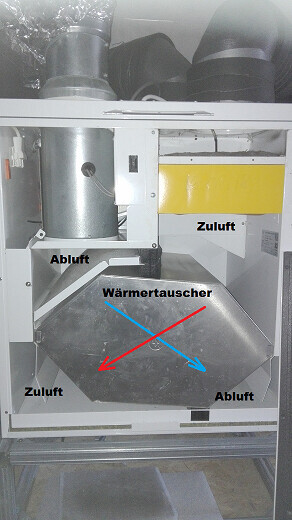
As you can see, the exhaust and supply airflows are very likely not airtight and separated from each other. In the next picture, you can see the internal structure of the heat exchanger.
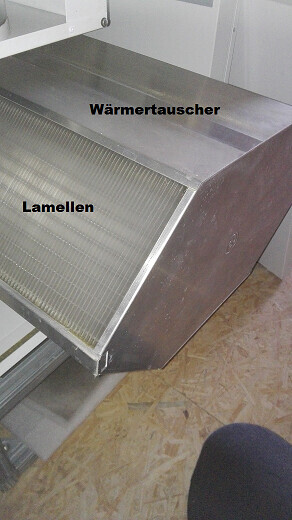
As you can see, the exhaust and supply airflows are only separated by thin fins. Of course, the question is whether this design will remain airtight over the years.
Another reason to assume that air from the exhaust ducts can enter the supply air ducts is the black ring around the ceiling valve.
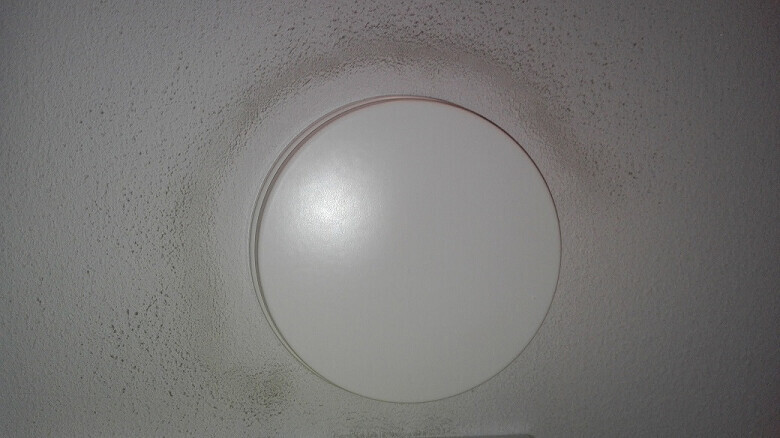
The system has two filters (G4 and F7), which we replace every 4 months, yet after about 1.5 years, the black ring formed around the ceiling valve. Our heating installer said this happened because of the chimney outlets. He also said he often observed this in houses with fireplaces. If this statement is correct, it means that air from the chimney duct is being sucked into the supply air duct. This concerns hot air, which theoretically should rise during the colder seasons. The pipes on the roof can be seen in the picture.
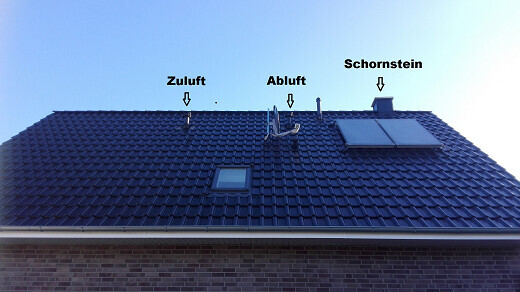
The distance between the chimney and the supply air ducts is about 6 m (20 feet). The fireplace is used by us no more than twice a month in the cold season. From this, I conclude that air from the exhaust duct (which is always running) occasionally enters the supply duct.
Conclusion.
An airtight separation of the supply and exhaust airflows cannot be guaranteed with high probability, meaning that the supply air quality may also depend on the condition of the exhaust duct. Of course, everything strongly depends on the system design.
With this post, I do not want to question the use of ventilation systems at all. We are very satisfied with the ventilation, and I think it is a great way to ensure healthy indoor air, provided that the system is properly installed and maintained.
Best regards.
I wanted to explain my post about the possible impact of supply air quality due to contamination of the exhaust air ducts in more detail. The picture shows my ValloPlus 350 MV system.
As you can see, the exhaust and supply airflows are very likely not airtight and separated from each other. In the next picture, you can see the internal structure of the heat exchanger.
As you can see, the exhaust and supply airflows are only separated by thin fins. Of course, the question is whether this design will remain airtight over the years.
Another reason to assume that air from the exhaust ducts can enter the supply air ducts is the black ring around the ceiling valve.
The system has two filters (G4 and F7), which we replace every 4 months, yet after about 1.5 years, the black ring formed around the ceiling valve. Our heating installer said this happened because of the chimney outlets. He also said he often observed this in houses with fireplaces. If this statement is correct, it means that air from the chimney duct is being sucked into the supply air duct. This concerns hot air, which theoretically should rise during the colder seasons. The pipes on the roof can be seen in the picture.
The distance between the chimney and the supply air ducts is about 6 m (20 feet). The fireplace is used by us no more than twice a month in the cold season. From this, I conclude that air from the exhaust duct (which is always running) occasionally enters the supply duct.
Conclusion.
An airtight separation of the supply and exhaust airflows cannot be guaranteed with high probability, meaning that the supply air quality may also depend on the condition of the exhaust duct. Of course, everything strongly depends on the system design.
With this post, I do not want to question the use of ventilation systems at all. We are very satisfied with the ventilation, and I think it is a great way to ensure healthy indoor air, provided that the system is properly installed and maintained.
Best regards.
N
nixus_maximus27 Oct 2018 15:23Why shouldn’t the heat exchanger remain sealed? If it is not, you should replace it, as they are not excessively expensive (around 1000 euros for us).
B
bau_2015_27 Oct 2018 15:281000 euros does not sound very cheap to me. Unfortunately, I couldn’t find anywhere how often it needs to be replaced.
B
bau_2015_27 Oct 2018 15:35Never, there are zero reasons why it should become leakyUnfortunately, I can neither confirm nor deny that. Is there any way to test it?
Similar topics