
Hello,
I need some advice regarding the bathroom. The layout is attached.
What would you do with the gap between the shower and the bathtub?
Should the shower be enlarged to extend all the way to the tub? If so, would a partition be necessary, or could it be left out? Any splash water would land in the bathtub anyway.
Alternatively, should the shower be partially walled off and hooks for towels placed in the gap?
Maybe some of you have other ideas?
The next question is about the shower wall/door. Glass is often used, which I find nice, but I’m quite sure that apart from me, no one will use a squeegee after every shower. The glass will likely look bad after a short time... What alternatives are there?
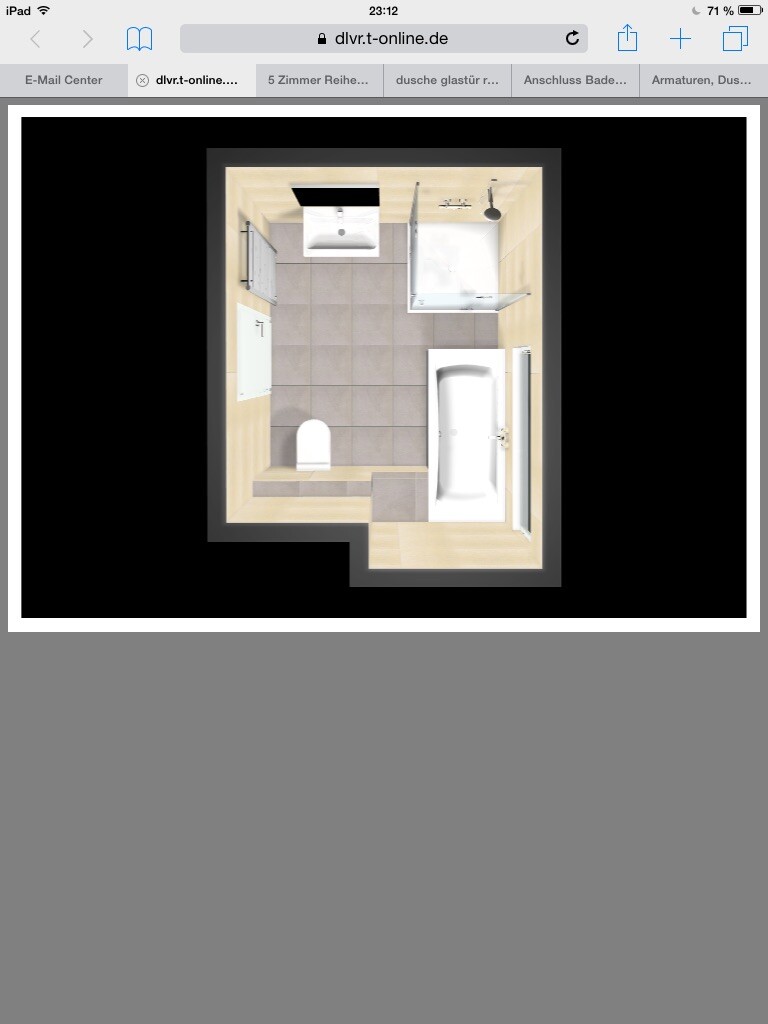
I need some advice regarding the bathroom. The layout is attached.
What would you do with the gap between the shower and the bathtub?
Should the shower be enlarged to extend all the way to the tub? If so, would a partition be necessary, or could it be left out? Any splash water would land in the bathtub anyway.
Alternatively, should the shower be partially walled off and hooks for towels placed in the gap?
Maybe some of you have other ideas?
The next question is about the shower wall/door. Glass is often used, which I find nice, but I’m quite sure that apart from me, no one will use a squeegee after every shower. The glass will likely look bad after a short time... What alternatives are there?

Lile08 schrieb:
The next question is about the shower wall/door. Glass is often used, which I find nice, but I’m pretty sure nobody except me will use a squeegee after every shower. After a short time, the glass will likely not look good anymore... What alternatives are there?Well – we also have two showers with two glass walls each.
What you’re saying is correct. You should squeegee them after showering. We do this regularly, so our shower walls still look like new even after 2 years.
We also squeegee the other two walls (tiles, floor-to-ceiling in the shower) and quickly dry the fixtures with a towel. It takes less than a minute. Otherwise, eventually, there would be limescale spots and deposits there too – but these would probably be easier to clean than from “grimy” glass.
Okay – I understand it’s not everyone’s thing. Personally, I believe that people who shower at home can leave the shower clean and dry. All guests we’ve had have done this voluntarily and unprompted, with great results. It’s apparently quite common that people don’t leave a wet mess in the bathroom – after all, it’s not a public swimming pool.
About 1.5 years ago, I saw an interesting solution in a show home in W´tal. I’m not in the mood to make a drawing right now.
So:
Shower about 2 to 2.5 m long and approximately 1 to 1.5 m wide. These dimensions can vary; I’m estimating from memory. The fixtures were mounted on the outer wall in this case. Opposite that was an internal wall (around the 2–2.5 m width mentioned). Of course, the outer wall was wider still: the shower was accessible from both sides (though one side would be enough).
I found it quite charming since no glass walls or anything like that were needed. Just a wall and an opposite wall. All tiled. Done. But if you always leave this kind of shower soaking wet, eventually the tiles, grout, and fixtures will get dirty and yellowed over time.
Whether this would fit your space, maybe as a smaller version... I don’t know, as I didn’t check the measurements. It was just a suggestion in response to your question: What else is out there?
Additionally: Plastic shower walls are not better than glass. However, you could have the glass treated either after purchase or when installing it with a product that creates a “lotus effect,” causing water to bead off the glass. Or you could train your household members to treat the house and its fixtures with care going forward, starting right after moving in. Alternatively, you would need to clean regularly and aggressively with limescale removers or hire a professional cleaner to keep things tidy... which can be expensive.
Best regards,
Thorsten
Similar topics