
Hello everyone!
I just realized, to my horror, that our two-month-old oak furniture piece is infested with pests.
There is very fine-looking sawdust on our glass shelves.
I noticed this when unpacking it back in October and wiped it off, assuming it came from transport or manufacturing.
What should I do now? I have, of course, contacted the seller directly, but I’m also worried about my other wooden furniture in the room and our roof beams. 🤨
What do I need to do or what can I do to prevent further damage?
I just realized, to my horror, that our two-month-old oak furniture piece is infested with pests.
There is very fine-looking sawdust on our glass shelves.
I noticed this when unpacking it back in October and wiped it off, assuming it came from transport or manufacturing.
What should I do now? I have, of course, contacted the seller directly, but I’m also worried about my other wooden furniture in the room and our roof beams. 🤨
What do I need to do or what can I do to prevent further damage?
 Schimi179115 Jan 2021 07:40
In dry wood, the pest starves, and temperatures of around 60°C (140°F) are not well tolerated by the larvae. However, using hot water and wood is probably not the best idea, as the wood can lose its shape. The same can happen with dry heat. Dry heat can also cause cracks to form.
Oak is often infested by the brown powderpost beetle (Lyctus brunneus).
I see two options:
1. The chemical approach. This is only recommended for minor infestations and for surfaces that are not in constant physical contact. The product is drawn into a syringe and injected into the holes. After some time, a follow-up treatment with wood wax can be applied.
2. Call a professional. The expert will pick up the piece of furniture, package it in a special device, and fumigate it. More information about this can be found online. 🙂
Oak is often infested by the brown powderpost beetle (Lyctus brunneus).
I see two options:
1. The chemical approach. This is only recommended for minor infestations and for surfaces that are not in constant physical contact. The product is drawn into a syringe and injected into the holes. After some time, a follow-up treatment with wood wax can be applied.
2. Call a professional. The expert will pick up the piece of furniture, package it in a special device, and fumigate it. More information about this can be found online. 🙂
C
chand198615 Jan 2021 07:58Schimi1791 schrieb:
Wood and hot water is probably not the best idea, as the wood can lose its shape. Place a large, closed pot with as much boiled water as possible on the affected area as a heat reservoir. This is neither wet nor dry; it just raises the local temperature in the wood to about 60°C (140°F).Schimi179115 Jan 2021 08:04It would be helpful to first determine the extent of the infestation. If the entire (large) piece of furniture is affected, it might be difficult to deal with it using the pot method 🙂

I’m not sure how extensive the infestation is. I only see the wood dust on the shelves, but on both sides of the display cabinet. In the middle, between the two sides, I see a small hole. I don’t think any of this would fit in our small freezer.
I also don’t really see why I should take care of getting rid of the pests. The cabinet is only 3 months old, so the seller should handle it.
I’m more worried that the problem might spread to nearby furniture. Is that likely? The piece is about 5cm (2 inches) away from my door frame and about 5cm (2 inches) from another solid oak piece from the same series, where I haven’t found any dust so far.
Edit: This is the piece of furniture I’m talking about.
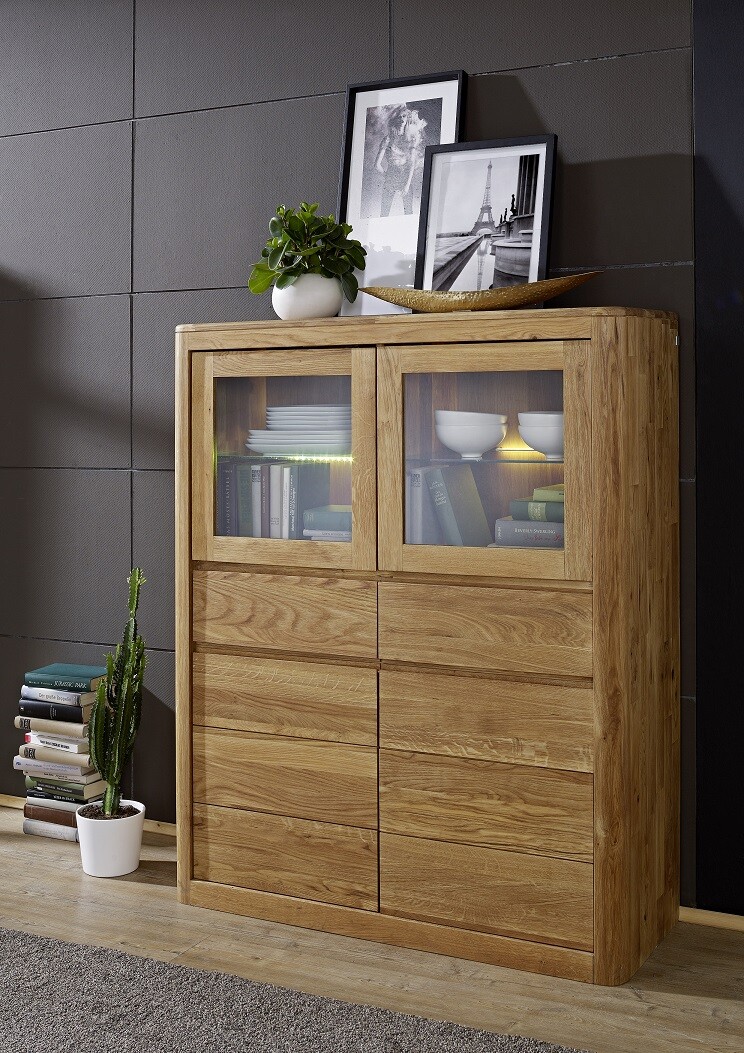
I also don’t really see why I should take care of getting rid of the pests. The cabinet is only 3 months old, so the seller should handle it.
I’m more worried that the problem might spread to nearby furniture. Is that likely? The piece is about 5cm (2 inches) away from my door frame and about 5cm (2 inches) from another solid oak piece from the same series, where I haven’t found any dust so far.
Edit: This is the piece of furniture I’m talking about.

kati1337 schrieb:
I am more concerned that the problem might spread to nearby furniture. Is that likely?Wikipedia provides information under "Common furniture beetle." The risk of spreading to other wooden parts mainly exists with the next generation of these small pests, with the idea, "Let's find a nice new home with enough food for our offspring.”H
hampshire15 Jan 2021 11:10kati1337 schrieb:
I’m more worried that the problem might spread to the surrounding furniture? That would be my concern as well. For that reason, I would remove the piece of furniture from the house and return it to the seller / exchange it / have it treated—whatever you agree on together.
Similar topics