
ᐅ Photovoltaic System: Costs and Savings Potential – Experiences?
Created on: 16 Jan 2020 10:50
H
Hans-Maulwurf
Hello everyone,
Since I have no prior experience, I would like to get some general information.
Our new building will be heated using an air-to-water heat pump.
What would generally and overall be the advantages, potential savings, and costs of installing a photovoltaic system on the roof? Is it worthwhile or not?
Since I have no prior experience, I would like to get some general information.
Our new building will be heated using an air-to-water heat pump.
What would generally and overall be the advantages, potential savings, and costs of installing a photovoltaic system on the roof? Is it worthwhile or not?

Fuchur schrieb:
He is "planning" construction start in 2021, so no installer is working on it todayI hadn’t considered that. My apologies. Our target is 08/2020

I’m sharing our calculations for the photovoltaic system we are getting. Here is the version we settled on.
Assumptions we based this on (which of course we cannot know for sure):
- Consumption values for our electricity demand, air-to-water heat pump combined with ventilation, and air conditioning.
- Assumption that electricity prices will continue to rise by about 2.7% per year (based on statistics from recent years).
- Self-consumption rate of 45%, determined using an online calculator.
- 2% annual operating costs as a flat rate, which is quite optimistic.
As you can see, we reach break-even somewhere around year 16. The calculation does not yet take potential tax liabilities into account.
If those are included (I wasn’t quite sure how), it could make the return less favorable.
Why we are still doing it:
- We expect electricity prices to increase more sharply in the coming years than they have so far (this is our personal opinion).
- We hope that, due to the continuous operation of the air-to-water heat pump also acting as a ventilation system, and the synergy of photovoltaic plus air conditioning, our self-consumption will be higher than 45%.
- We hope the system can operate for longer than 16 years with the assumed operating costs and then generate pure profit.
From a purely numerical standpoint, as you can see, photovoltaics is no longer the great deal it might seem at first glance. But we are doing it anyway, with conviction.
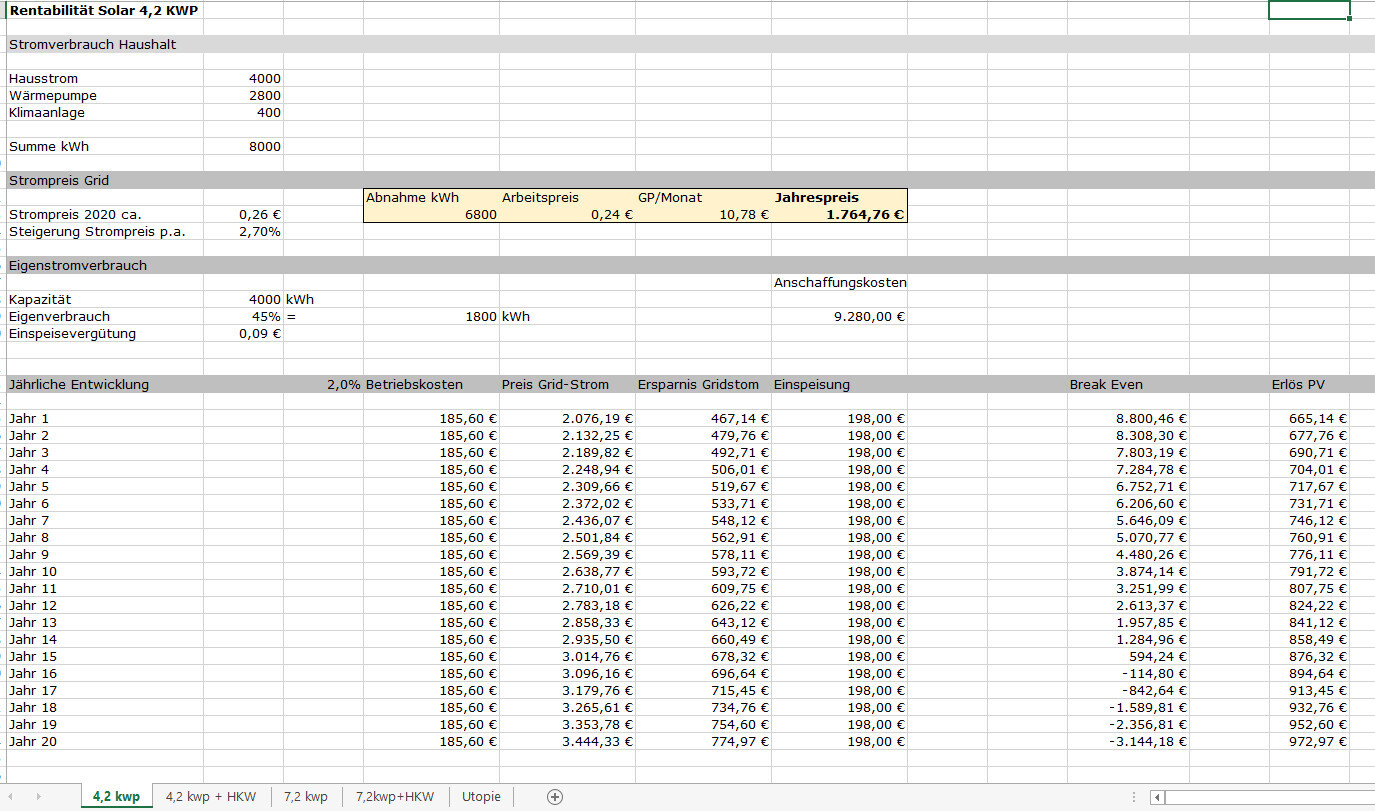
Assumptions we based this on (which of course we cannot know for sure):
- Consumption values for our electricity demand, air-to-water heat pump combined with ventilation, and air conditioning.
- Assumption that electricity prices will continue to rise by about 2.7% per year (based on statistics from recent years).
- Self-consumption rate of 45%, determined using an online calculator.
- 2% annual operating costs as a flat rate, which is quite optimistic.
As you can see, we reach break-even somewhere around year 16. The calculation does not yet take potential tax liabilities into account.
If those are included (I wasn’t quite sure how), it could make the return less favorable.
Why we are still doing it:
- We expect electricity prices to increase more sharply in the coming years than they have so far (this is our personal opinion).
- We hope that, due to the continuous operation of the air-to-water heat pump also acting as a ventilation system, and the synergy of photovoltaic plus air conditioning, our self-consumption will be higher than 45%.
- We hope the system can operate for longer than 16 years with the assumed operating costs and then generate pure profit.
From a purely numerical standpoint, as you can see, photovoltaics is no longer the great deal it might seem at first glance. But we are doing it anyway, with conviction.
N
nordanney5 Jun 2020 13:53kati1337 schrieb:
As you can see, we break even somewhere around year 16.Well, with the price of the system, the solar installer is really the one making a big profit. The price is unacceptable and completely inflated. I’m currently planning a system of just under 10 kWp and have quotes between €1,150 and €1,350, so for a system 2.5 times larger, between €11,500 and €13,500.nordanney schrieb:
Well, at that price for the system, the solar installer is the one really making a big profit. The price is a no-go and completely inflated. I am currently planning a system just under 10 kWp and have prices between €1,150 and €1,350 (between $1,250 and $1,460), so for a system 2.5 times larger, between €11,500 and €13,500 (between $12,500 and $14,600). This is probably our fault because we had it included directly by the general contractor. If we had ordered it separately, it surely would have been cheaper. But hindsight is always 20/20.
Thoughts on the table
- First mistake already in the household electricity consumption. Where do 4000+2800+400 = 8000 come from?
- Electricity price for 2020 stated as 0.26 cents, four columns to the right it shows 0.24 working price. Huh?
- Purchase cost of €9280 for 4.2 kWp is absolutely overpriced (in my opinion the biggest miscalculation). The system should cost around €4600-4800 net. Or is a battery included that spoils the calculation?
- The photovoltaic system is simply too small for household consumption. The self-consumption ratio is therefore likely quite high. On the other hand, a battery would be particularly uneconomical if planned.
- All taxes were forgotten. In the case of self-consumption, VAT is missing, which negatively affects profitability. On the other hand, this applies only for 5 years (afterwards reduced VAT rate). In the other direction, depreciation affects results, which is also ignored (especially with the high system price).
So, back to square one.
EDIT:
Oh, this has already been commissioned?! Then the biggest mistake is already done (moon price). Now you have to make the best of it.
To other home builders, do not commission this through the general contractor! With bad luck, they won’t issue a separate invoice (= no VAT refund on the purchase). Photovoltaics can also be easily prepared with 1-2 empty conduits and then contracted separately.
- First mistake already in the household electricity consumption. Where do 4000+2800+400 = 8000 come from?
- Electricity price for 2020 stated as 0.26 cents, four columns to the right it shows 0.24 working price. Huh?
- Purchase cost of €9280 for 4.2 kWp is absolutely overpriced (in my opinion the biggest miscalculation). The system should cost around €4600-4800 net. Or is a battery included that spoils the calculation?
- The photovoltaic system is simply too small for household consumption. The self-consumption ratio is therefore likely quite high. On the other hand, a battery would be particularly uneconomical if planned.
- All taxes were forgotten. In the case of self-consumption, VAT is missing, which negatively affects profitability. On the other hand, this applies only for 5 years (afterwards reduced VAT rate). In the other direction, depreciation affects results, which is also ignored (especially with the high system price).
So, back to square one.
EDIT:
Oh, this has already been commissioned?! Then the biggest mistake is already done (moon price). Now you have to make the best of it.
To other home builders, do not commission this through the general contractor! With bad luck, they won’t issue a separate invoice (= no VAT refund on the purchase). Photovoltaics can also be easily prepared with 1-2 empty conduits and then contracted separately.
Oh yes, we had a second offer for 7.2 kWp and 14,400, also through the general contractor. However, we did not accept that one.
It makes even less financial sense because although there would be more panels on the roof, our self-consumption ratio would decrease. It only becomes truly profitable if you use as much of the electricity yourself as possible and feed very little back into the grid.
But that’s not that easy unless you consider adding a combined heat and power unit (CHP) or battery, which makes it disproportionately more expensive and frankly not worth it.
It makes even less financial sense because although there would be more panels on the roof, our self-consumption ratio would decrease. It only becomes truly profitable if you use as much of the electricity yourself as possible and feed very little back into the grid.
But that’s not that easy unless you consider adding a combined heat and power unit (CHP) or battery, which makes it disproportionately more expensive and frankly not worth it.
Similar topics