
ᐅ Photovoltaic System: Costs and Savings Potential – Experiences?
Created on: 16 Jan 2020 10:50
H
Hans-Maulwurf
Hello everyone,
Since I have no prior experience, I would like to get some general information.
Our new building will be heated using an air-to-water heat pump.
What would generally and overall be the advantages, potential savings, and costs of installing a photovoltaic system on the roof? Is it worthwhile or not?
Since I have no prior experience, I would like to get some general information.
Our new building will be heated using an air-to-water heat pump.
What would generally and overall be the advantages, potential savings, and costs of installing a photovoltaic system on the roof? Is it worthwhile or not?
H
hampshire19 May 2021 12:23One of the most important details is missing here: What is the charging and discharging power of your system? The charging power determines how quickly you can recharge the battery when the sun is shining, while the discharging power determines how much energy you can draw from the battery at any given moment. For example, if you are cooking on an induction hob and have several other appliances running, you might need 7 kW of power at that moment. If the battery is full but the photovoltaic system is providing little or no power (due to darkness or cloud cover), a typical discharging power of 3.5 kW means you are effectively buying electricity even though there is enough energy stored in the battery. This is something to pay attention to.
A hybrid inverter with two MPPT inputs should be sufficient unless you have significant shading issues.
I would choose a compact and tidy all-in-one device. I personally use this one with 8 kWh battery capacity and 8 kW charging/discharging power; with more storage capacity, the unit becomes about 50 cm (20 inches) taller. I can buy additional batteries anytime and plug them in like drawers. Software updates are delivered over the air, so I’m well prepared for a long service life and future applications. I still have a heating element lying around that I should connect at some point. Preparation for a charging station with surplus power regulation is included, although I currently still drive a combustion engine. I’m undecided about whether I want to control household appliances. (Image needs to be rotated)
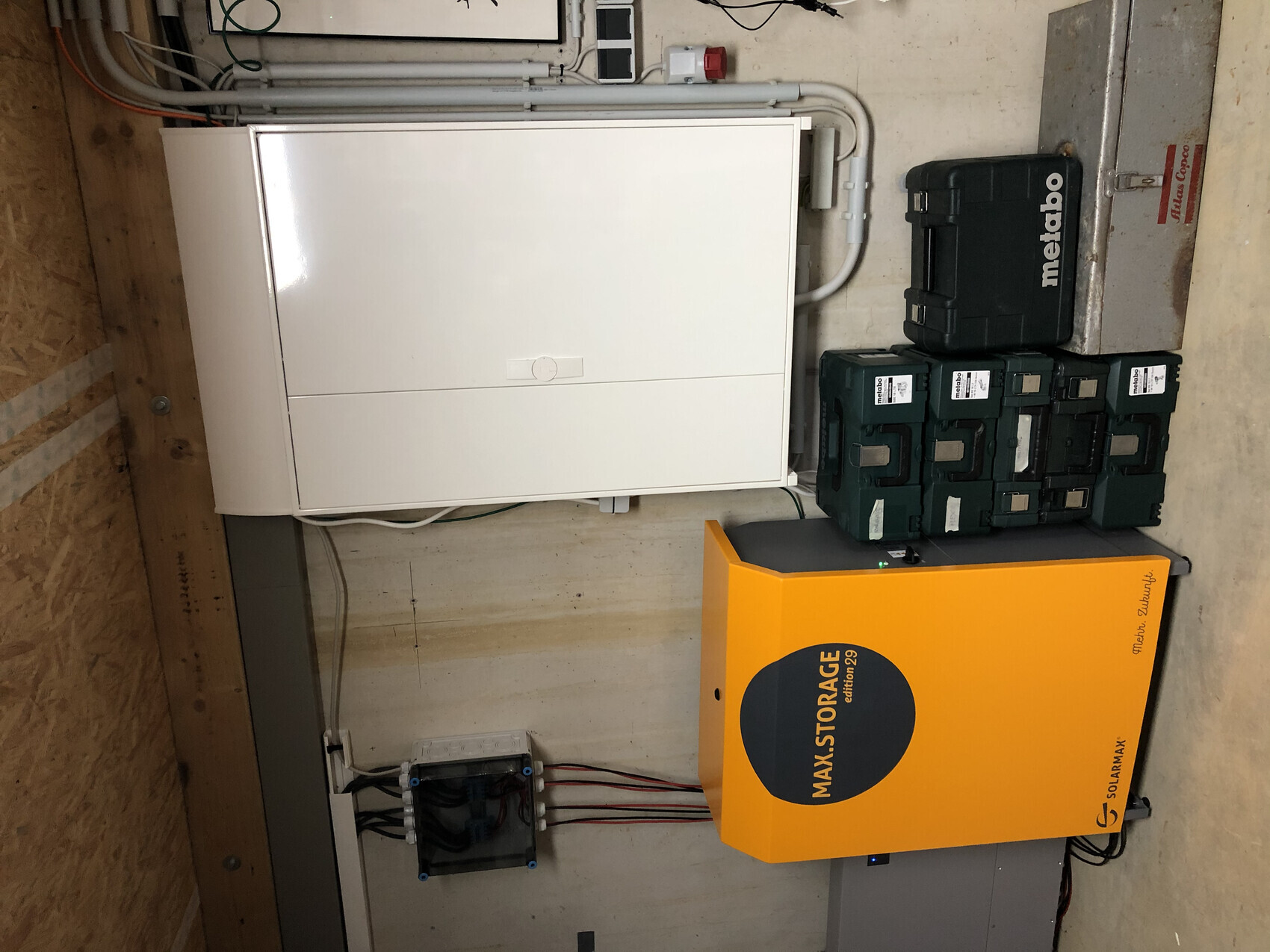
A hybrid inverter with two MPPT inputs should be sufficient unless you have significant shading issues.
I would choose a compact and tidy all-in-one device. I personally use this one with 8 kWh battery capacity and 8 kW charging/discharging power; with more storage capacity, the unit becomes about 50 cm (20 inches) taller. I can buy additional batteries anytime and plug them in like drawers. Software updates are delivered over the air, so I’m well prepared for a long service life and future applications. I still have a heating element lying around that I should connect at some point. Preparation for a charging station with surplus power regulation is included, although I currently still drive a combustion engine. I’m undecided about whether I want to control household appliances. (Image needs to be rotated)

Thanks for the quick responses!
The offer is for 11.25 kWp. We have a total roof area of 160 m² (22-degree hip roof). Excluding the north side, about 116 m² can be covered with modules. That corresponds to approximately 60 modules or 22.5 kWp.
Oh, the mounting frames say "30 pieces" as well. Makes sense….
Yes. Production is in China and Romania. But isn’t the vast majority coming from China nowadays anyway? In my opinion, given the warranties, that’s not as critical as some think.
No idea. I’ve never heard of that system before. The brochure promises a lot (higher safety, more output, less installation effort). But based on your comments, the cost probably won’t pay off under normal conditions, right?
That’s a good point. I couldn’t find any information about the battery in the datasheet either.
Which device are you using? Do you know the manufacturer and model?
Tobbster77 schrieb:
That should be a bit more than 10 kWp, right?
At first glance, the offer seems well-priced in terms of value for money.
Never heard of the module manufacturer before.
BYD is well known. They are supposed to be quite reliable.
I’ve learned: fill the roof as much as possible (sensibly). Keep the battery as small as possible.
The offer is for 11.25 kWp. We have a total roof area of 160 m² (22-degree hip roof). Excluding the north side, about 116 m² can be covered with modules. That corresponds to approximately 60 modules or 22.5 kWp.
nordanney schrieb:
The mounting frame refers to the aluminum rails on which the modules are attached. You can’t proceed without those.
The ladder scaffold is probably unnecessary since you already have scaffolding.
Modules are assembled in Austria, but the material comes from China—so Chinese modules with a European label. I have no experience with this; it is probably rarely encountered here.
BYD is almost standard now. You were offered the cheaper variant.
In my opinion, the price-performance ratio is absolutely fine.
Oh, the mounting frames say "30 pieces" as well. Makes sense….
Yes. Production is in China and Romania. But isn’t the vast majority coming from China nowadays anyway? In my opinion, given the warranties, that’s not as critical as some think.
Tobbster77 schrieb:
Whether SolarEdge is really necessary, in my view, depends on the roof conditions and orientations.
nordanney schrieb:
SolarEdge necessary?
No idea. I’ve never heard of that system before. The brochure promises a lot (higher safety, more output, less installation effort). But based on your comments, the cost probably won’t pay off under normal conditions, right?
hampshire schrieb:
One of the most important details is missing here: What is the battery’s charge and discharge power? The charge power determines how fast you can recharge the battery when the sun is shining; the discharge power determines how much energy you can draw from the battery at any moment. For example, if you’re cooking on induction and have some other appliances running, you might need 7 kW at once. The battery is full, but the solar system is providing no or insufficient power (e.g. at night or when cloudy). With a typical discharge power of 3.5 kW, you effectively have to buy extra power even though there is enough energy stored in the battery. I would pay attention to this.
A hybrid inverter with two MPPT (maximum power point tracking) inputs should suffice if you don’t have significant shading issues.
I would go for a compact, tidy all-in-one device. I use one myself with 8 kWh battery capacity and 8 kW charge-discharge power. With more storage capacity, the unit is about 50 cm (20 inches) taller. I can buy additional batteries anytime and slide them in like a drawer. Software updates come over the air, so I am prepared for long-term use and future applications. I have a heating element ready to connect, and preparations for a charging station with surplus power control are in place, although I’m still driving a combustion engine. I’m not sure yet if I want to control household appliances. (Image should be rotated)
[ATTACH alt="tempImageYiPkL6.png"]61533[/ATTACH]
That’s a good point. I couldn’t find any information about the battery in the datasheet either.
Which device are you using? Do you know the manufacturer and model?
hampshire schrieb:
One of the most important details is missing here: What charging or discharging power does your system have? According to the datasheet
| max. 195 A | |
At 50 volts, this corresponds to almost 10 kW output power.
H
hampshire19 May 2021 13:01DaSch17 schrieb:
What device do you have? Do you know the manufacturer and model?It’s printed on it 🙂 Scout schrieb:
At 50 volts, that’s just under 10 kW output power.That’s what’s stated on the battery. What can the system actually do?H
hampshire19 May 2021 13:15The inverter can handle 9 kW from the photovoltaic array. It is unclear what it can deliver from the battery.
Similar topics