
ᐅ Water from the shower is not draining properly – is it a ventilation issue?
Created on: 2 Dec 2017 23:59
W
WayneDayneW
WayneDayne2 Dec 2017 23:59Hello everyone,
we recently renovated a house, and as a DIY enthusiast, I’m a bit stuck.
Here is the situation:
We renovated the guest bathroom (shower / toilet / sink) and installed new tiles and bathroom fixtures. The plumbing lines remained mostly the same.
Before the renovation, there were no issues with the shower drainage.
Now, we installed a shower drain channel (Camargue 80cm (31.5 inches)) from the hardware store. Previously, there was a raised shower tray with a standard trap underneath.
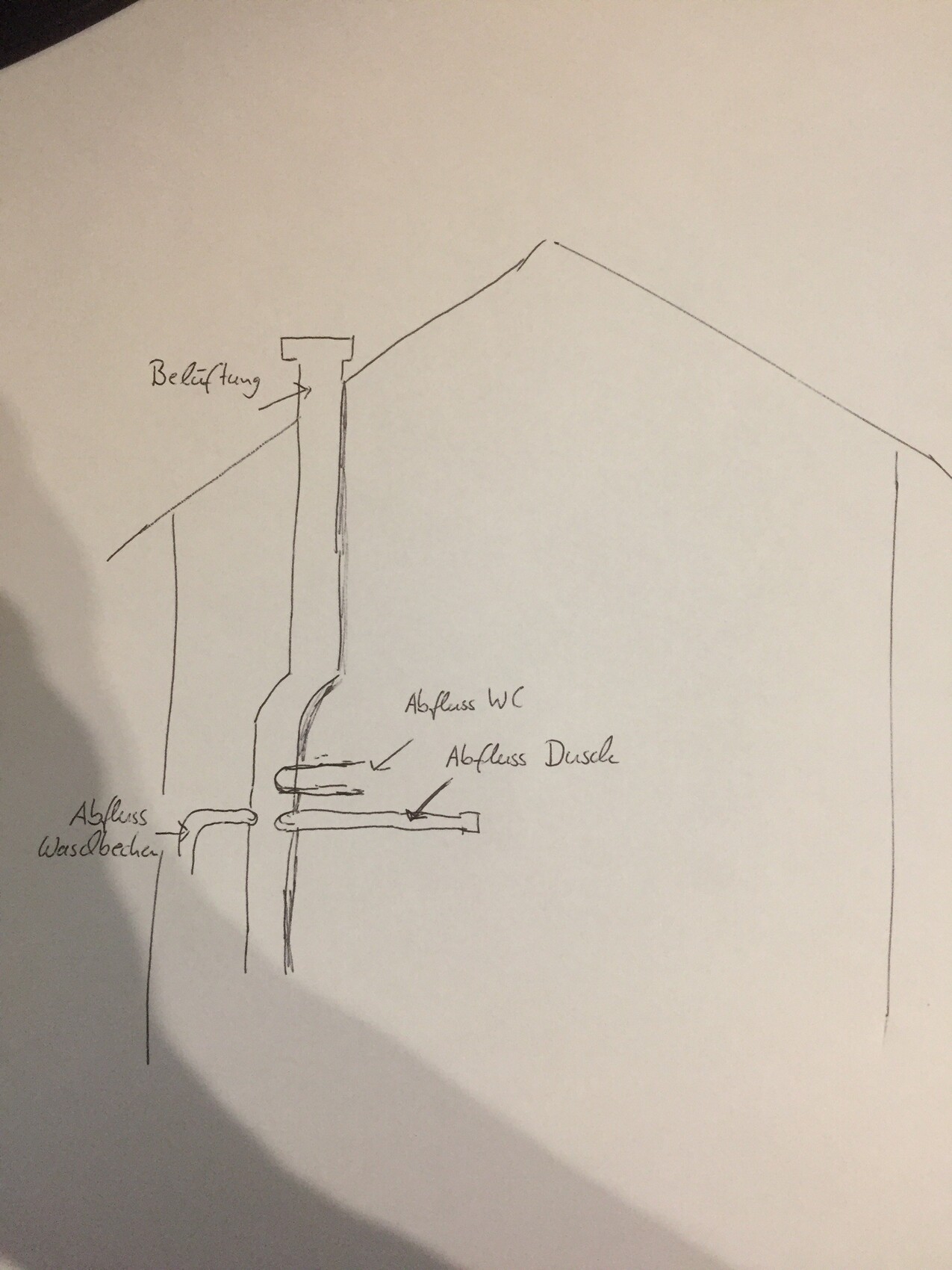
Attached is a rough sketch of the drainage system.
When the shower is turned on, the water does not drain properly with the integrated trap in place. If I remove the trap, air rises up and the water drains. Then I wait until no more air rises while the water is running, put the trap back in, and the water continues to drain without problems. When I turn off the water, it still drains, but suddenly there is bubbling... somehow air gets back into the system.
When I turn the water on again, it doesn’t drain until I remove the trap again and wait for the air to escape from the drain.
I also noticed that when the toilet cistern is completely emptied, the water in the toilet bowl briefly pools and then drains slowly, followed by bubbling sounds in the toilet. It seems like there might be a partial blockage somewhere in the drainage.
My question is, how can it be that water drains properly when the trap is removed, as I described above?
Could this be related to the ventilation of the drainage system? Is it possible that something is blocking the vent, causing air to be drawn from somewhere else and creating this phenomenon?
I would appreciate your advice and ideas.
Regards,
Alex
we recently renovated a house, and as a DIY enthusiast, I’m a bit stuck.
Here is the situation:
We renovated the guest bathroom (shower / toilet / sink) and installed new tiles and bathroom fixtures. The plumbing lines remained mostly the same.
Before the renovation, there were no issues with the shower drainage.
Now, we installed a shower drain channel (Camargue 80cm (31.5 inches)) from the hardware store. Previously, there was a raised shower tray with a standard trap underneath.
Attached is a rough sketch of the drainage system.
When the shower is turned on, the water does not drain properly with the integrated trap in place. If I remove the trap, air rises up and the water drains. Then I wait until no more air rises while the water is running, put the trap back in, and the water continues to drain without problems. When I turn off the water, it still drains, but suddenly there is bubbling... somehow air gets back into the system.
When I turn the water on again, it doesn’t drain until I remove the trap again and wait for the air to escape from the drain.
I also noticed that when the toilet cistern is completely emptied, the water in the toilet bowl briefly pools and then drains slowly, followed by bubbling sounds in the toilet. It seems like there might be a partial blockage somewhere in the drainage.
My question is, how can it be that water drains properly when the trap is removed, as I described above?
Could this be related to the ventilation of the drainage system? Is it possible that something is blocking the vent, causing air to be drawn from somewhere else and creating this phenomenon?
I would appreciate your advice and ideas.
Regards,
Alex

The pipe ventilation is designed to prevent a rigid column of air from forming in the soil pipe.
The amount of water from the cistern is initially governed by gravity and inertia. As the volume increases, the ratio of the wavelengths between the water column in the drain and the pipe diameter becomes less favorable, so a slight pulsation is normal. If the pipe narrows, this not only reduces the cross-sectional area but also makes it less circular, which affects the oscillation of the water column. This basic effect then occurs even at a lower flow rate.
Regarding the shower, your description suggests that the slope of the drain leading to the soil pipe inlet has decreased compared to before. This naturally impacts the drainage behavior, potentially causing pulsating backwater. With a more open "breathing capacity" of the drain, this phenomenon is predictably reduced.
The reduced slope is a design flaw and is likely the main culprit concerning the shower. Toilet drains need to be cleaned as necessary, and it is wise not to subject them to improper waste (such as food scraps, candy wrappers, or similar items). Also, occasionally using the larger flush button for small flushes can help prevent build-up.
https://www.instagram.com/11antgmxde/
https://www.linkedin.com/company/bauen-jetzt/
The amount of water from the cistern is initially governed by gravity and inertia. As the volume increases, the ratio of the wavelengths between the water column in the drain and the pipe diameter becomes less favorable, so a slight pulsation is normal. If the pipe narrows, this not only reduces the cross-sectional area but also makes it less circular, which affects the oscillation of the water column. This basic effect then occurs even at a lower flow rate.
Regarding the shower, your description suggests that the slope of the drain leading to the soil pipe inlet has decreased compared to before. This naturally impacts the drainage behavior, potentially causing pulsating backwater. With a more open "breathing capacity" of the drain, this phenomenon is predictably reduced.
The reduced slope is a design flaw and is likely the main culprit concerning the shower. Toilet drains need to be cleaned as necessary, and it is wise not to subject them to improper waste (such as food scraps, candy wrappers, or similar items). Also, occasionally using the larger flush button for small flushes can help prevent build-up.
https://www.instagram.com/11antgmxde/
https://www.linkedin.com/company/bauen-jetzt/
W
WayneDayne4 Dec 2017 19:17Hello 11ant, first of all, thank you for the quick response to my question. I only got around to replying today. I had to read your post several times to understand it somewhat as a layperson.
Does the pulsating backflow have something to do with the air in the drain pipe?
A design flaw would of course be unfortunate and might only be fixable by reopening the tiles... or do you see another solution here?
With the shower, the pipe remained connected up to the soil stack, only the initial slope from the drain to the drain pipe has been reduced by the new shower installation.
Is that enough to change the drainage behavior so that water backs up?
I’m planning to try clearing the pipe of any restrictions and see if that changes the shower’s drainage.
What I still don’t quite understand is why air is being pushed up when I turn off the shower. The air then pulls the water out of the integrated trap in the shower channel. How can it be explained that air suddenly rises through the drain pipe, where previously water flowed through completely…
Regards, Alex
Does the pulsating backflow have something to do with the air in the drain pipe?
A design flaw would of course be unfortunate and might only be fixable by reopening the tiles... or do you see another solution here?
With the shower, the pipe remained connected up to the soil stack, only the initial slope from the drain to the drain pipe has been reduced by the new shower installation.
Is that enough to change the drainage behavior so that water backs up?
I’m planning to try clearing the pipe of any restrictions and see if that changes the shower’s drainage.
What I still don’t quite understand is why air is being pushed up when I turn off the shower. The air then pulls the water out of the integrated trap in the shower channel. How can it be explained that air suddenly rises through the drain pipe, where previously water flowed through completely…
Regards, Alex
WayneDayne schrieb:
I would now try to clear the pipe from any narrow points and see if the shower drainage improves afterward. Narrow points in the toilet drain will not affect the shower drain at all.
WayneDayne schrieb:
How can I explain that air suddenly rises through the drain pipe, where previously water flowed through completely... You can’t – these are mistaken assumptions. Gravity causes the water in the soil pipe to flow down along the pipe wall; the pipe is not filled completely across the entire cross-section. Air doesn’t really rise on its own; it is simply lighter than water.
https://www.instagram.com/11antgmxde/
https://www.linkedin.com/company/bauen-jetzt/
W
WayneDayne5 Dec 2017 00:1311ant schrieb:
Narrowing in the toilet drain does not affect the shower drain at all.
Not at all – those are incorrect assumptions. The acceleration due to gravity causes the water in the soil pipe to run down along the pipe wall; the pipe is not completely filled across its entire cross-section. Air does not exactly rise; it is simply much lighter than water.Okay, that sounds plausible.
Then, to put it another way: why does the built-in trap of the shower drain fail to work, with the water inside it disappearing over time?
Do you have any suggestions for solving this problem?
Regards
Similar topics