
Hello everyone,
I hope to get some good advice here. Our tiler was supposed to install a level-access shower in our bathroom (a timber-framed house with only soil excavation underneath) that is fully tiled. Now he has finished, the channel and tiles are in place. However, the slope is not directed towards the drain but towards the bathroom door. I would like to find a practical solution to fix this.
We have considered several options: removing the bottom row of tiles, sealing everything, and installing a shallow tray. Or using a shower board made of polystyrene with a waterproof membrane already attached, placing it on the tiles, sealing it, and then creating a new screed. But I’m still not convinced if that will work. Do you have any advice on how to solve this properly, so I won’t have water issues later on?
Thanks for your help and best regards,
Rocco
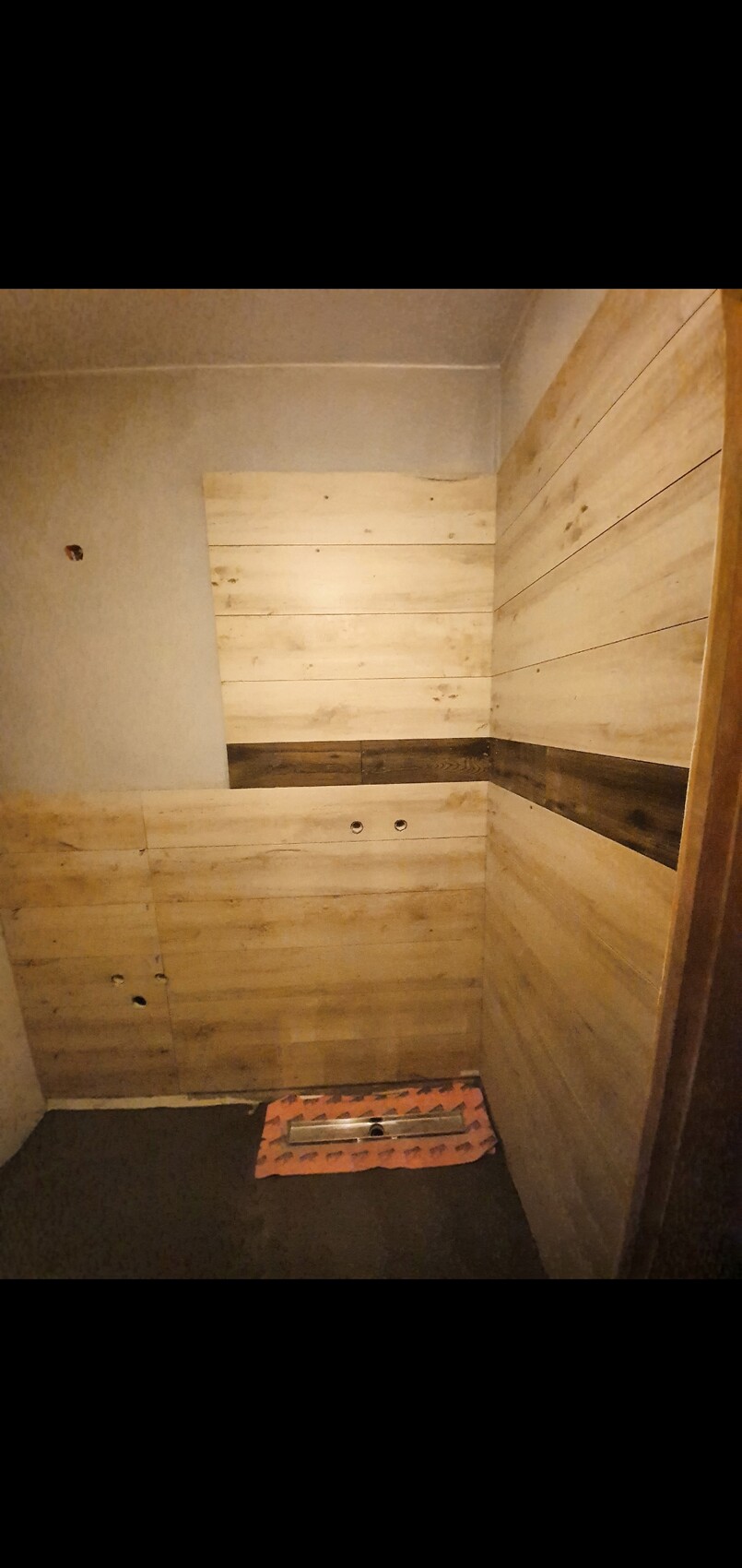
I hope to get some good advice here. Our tiler was supposed to install a level-access shower in our bathroom (a timber-framed house with only soil excavation underneath) that is fully tiled. Now he has finished, the channel and tiles are in place. However, the slope is not directed towards the drain but towards the bathroom door. I would like to find a practical solution to fix this.
We have considered several options: removing the bottom row of tiles, sealing everything, and installing a shallow tray. Or using a shower board made of polystyrene with a waterproof membrane already attached, placing it on the tiles, sealing it, and then creating a new screed. But I’m still not convinced if that will work. Do you have any advice on how to solve this properly, so I won’t have water issues later on?
Thanks for your help and best regards,
Rocco
 Winniefred14 Apr 2021 19:14
I also don’t see how this could be solved without simply doing it again. If you want a walk-in shower, it will be necessary.
hampshire schrieb:
Stress does not arise from the fact that mistakes happen, but from how they are handled. Often, it starts with an accusatory tone that turns project partners into opponents – which is unwise when the project's success is a shared goal. Workmanship errors are much easier to fix than a broken level of communication. Firm positions on the content can be enforced far more effectively and with fewer negative consequences through good communication rather than through raising voices and involving lawyers. And it’s less stressful for everyone involved.
Anyone who believes that, as a client, they can truly supervise and control everything is seriously overestimating themselves and will always lose in a confrontational relationship with their service providers – perhaps not legally or financially, but certainly in terms of stress and quality. So, what exactly is your suggestion then???
Why do you have to argue with the contractor first? They should be able to see themselves that it’s bad work – there’s nothing to complain about, right???
Why does the client have to work on finding a solution now???
If I make a mistake at my job, I fix it myself and not the neighboring department...

Besides the confusion about how this could happen 🤨, I’m a bit puzzled that this is supposed to be solely the tile installer’s fault?
We also have a tiled shower with a linear drain without a shower tray, and I just reviewed the construction photos again. I believe the slope towards the linear drain was already done with the screed. So, our tile installer laid the tiles on an existing slope.
Was it different in your case?
We also have a tiled shower with a linear drain without a shower tray, and I just reviewed the construction photos again. I believe the slope towards the linear drain was already done with the screed. So, our tile installer laid the tiles on an existing slope.
Was it different in your case?
I
Isokrates17 Apr 2021 10:21Snowy36 schrieb:
Why does the client now have to find a solution???Because tone is everything, which is probably what Hampshire was trying to express.
Unfortunately, in Germany, people often focus too much on assigning blame instead of constructively looking for a solution. But if you only focus on the problem, you don’t get any closer to a solution during that time.
If the final outcome of the process is that a demolition and complete rebuild is necessary to achieve the originally intended goal of a walk-in (curbless) shower, then so be it. However, that shouldn’t lead to immediately ruling out all other options and only seeing that the contractor made a mistake.
The tradesperson is more likely to carry out the work as agreed if their concerns (especially the significant effort involved) are acknowledged in a respectful and humane way. This means listening to their proposed solutions and discussing whether the suggested approach can meet the originally agreed requirements.
H
hampshire17 Apr 2021 11:08Snowy36 schrieb:
Yes, so what’s your suggestion then???
Why do you have to argue with the craftsman first? He should realize by himself that it’s a mess, there’s nothing to complain about, right???
Why should the homeowner have to find a solution now???
If I make a mistake at work, I fix it myself, not the neighboring department....Why so many question marks? Why such backward thinking?
What use are “should” considerations when the “is” situation is different from what you want?
Does it even matter for achieving the goal how you personally work?
The situation seems to be that the craftsman does not come up with the idea to redo the work on his own. The homeowner wants a proper solution. To reach that goal, he needs to lead the craftsman toward the desired outcome. This can be done in a productive conversation—without confrontation from the start, with clear focus on the result, and with mutual respect (as already mentioned). In 90% of cases, this works. If not, you can always consider other options.
 Hausbau081518 Apr 2021 08:03
hampshire schrieb:
The situation seems to be that the tradesperson does not think to offer rework on their own. The client wants a proper solution. To achieve this, they need to lead the tradesperson towards the desired outcome. This is possible through a focused conversation—without confrontation from the start, with clear results in mind and mutual respect (as already mentioned). This works about 90% of the time. If not, other options can still be considered. Which tradesperson admits to mistakes? I don’t know any. Even when politely asked if it really has to be that way, I was told that everything is correct and that it has always been done like this.
This is probably also their way of justifying it, since they have always done it that way—even if they have clearly done it wrong before. In my case, for example, window sealing or kitchen connections. Although the kitchen plan was available, the sink connection was installed 60cm (24 inches) too far to the right. When I asked why, I was brazenly told that the colleague who did it thought I wanted it that way. Confrontation arises immediately because the tradesperson fears extra work and naturally wants to avoid it. Often, the blame is shifted to the previous trade. But this is not right either. If a tradesperson discovers mistakes in the work of a previous trade, they must report these and may only continue working after these have been corrected.
Similar topics