
Hello,
Do you have LED or halogen spots?
How many watts do the individual spots have, and do you find their brightness sufficient?
What/how do you illuminate with how many watts (per spot)?
Does anyone use indirect lighting with LED? How many watts do you have per spot or how many spots, and how is the brightness for that?
-
Do you have LED spots in your kitchen directed at the countertop? How many watts do these have?
-> How many meters "should" a spot with a certain wattage cover, for example, one spot with 4W (approximate, of course) per meter?
Do you have 2700K, 3000K, or other color temperatures in your kitchen? Are you satisfied with the light color your spot has? If yes, which color temperature is it, and if not, which color temperature would you choose?
Would you say that one LED spot with 4W illuminating the countertop per meter is sufficient or rather too dark?
If you wanted or do illuminate indirectly with LED spots/spotlights, for example, a "classic floor lamp" that floods the wall and ceiling with light, how many watts would you use and what color temperature regarding LED?
-
Are these common 3W, 4W, or 5W LED spots bright or rather dim, or how should one imagine it?
For example, is a 3W LED spot rather dim and a 5W LED spot already provides quite a bit of light?
Feel free to share your experiences and similar insights with LED.
I could use some help.
Do you have LED or halogen spots?
How many watts do the individual spots have, and do you find their brightness sufficient?
What/how do you illuminate with how many watts (per spot)?
Does anyone use indirect lighting with LED? How many watts do you have per spot or how many spots, and how is the brightness for that?
-
Do you have LED spots in your kitchen directed at the countertop? How many watts do these have?
-> How many meters "should" a spot with a certain wattage cover, for example, one spot with 4W (approximate, of course) per meter?
Do you have 2700K, 3000K, or other color temperatures in your kitchen? Are you satisfied with the light color your spot has? If yes, which color temperature is it, and if not, which color temperature would you choose?
Would you say that one LED spot with 4W illuminating the countertop per meter is sufficient or rather too dark?
If you wanted or do illuminate indirectly with LED spots/spotlights, for example, a "classic floor lamp" that floods the wall and ceiling with light, how many watts would you use and what color temperature regarding LED?
-
Are these common 3W, 4W, or 5W LED spots bright or rather dim, or how should one imagine it?
For example, is a 3W LED spot rather dim and a 5W LED spot already provides quite a bit of light?
Feel free to share your experiences and similar insights with LED.
I could use some help.
G
garfunkel7 Sep 2016 20:04Does anyone know of suitable fixtures or housings for GU10 spotlights that are very small and/or discreet?
I want to mount the housing along with the spotlight onto a purlin (so not recessed) to illuminate the exposed roof structure. I was thinking of those triangular spotlight housings often seen under kitchen wall cabinets. However, they usually have a switch, are limited to 3 or 4 units, and are not adjustable.
Alternatives are therefore welcome.
I want to mount the housing along with the spotlight onto a purlin (so not recessed) to illuminate the exposed roof structure. I was thinking of those triangular spotlight housings often seen under kitchen wall cabinets. However, they usually have a switch, are limited to 3 or 4 units, and are not adjustable.
Alternatives are therefore welcome.
G
garfunkel7 Sep 2016 21:44I have now ordered pond spotlights. They offer the most options regarding adjustment angles and so on. They are also not particularly large, can handle high wattage, are matte black, and I could even operate them up to 10m (33 feet) underwater.
G
garfunkel8 Sep 2016 19:03Question about LED strips.
I need them in a length of about 50–70cm (20–28 inches). I’ve seen that they can be cut, so lengths of around 50 or 75cm (20 or 30 inches) would be fine.
Now about the performance... I tried an RGB light strip from a hardware store, but the brightness wasn’t enough for my purpose. I want to use it to illuminate the sloped ceilings in my bedroom. The light strip will be hidden behind cladding panels and from there light up the sloped ceiling.
Here is a sketch.
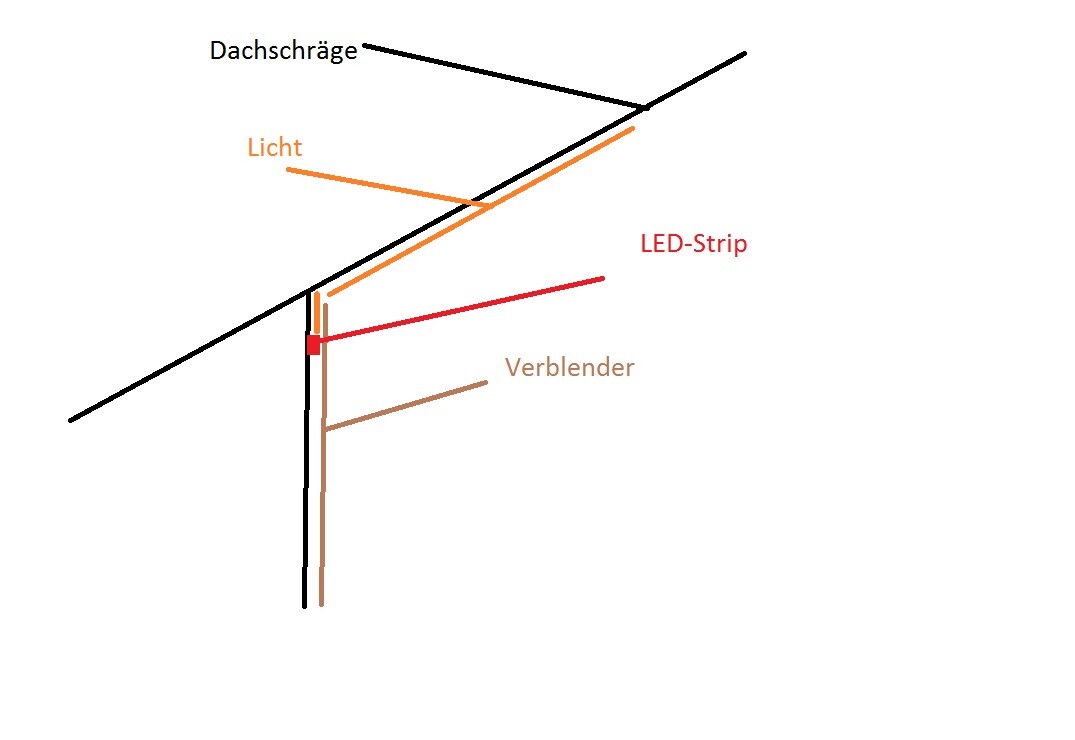
Since the light comes at an angle, it needs to have a decent lumen output. What do you think, around 400–500 lumens (too bright is not a problem)?
Color is very important for me. I think an adjustable color option offers more possibilities. However, the light strip from the hardware store didn’t offer enough color range. I want the color to resemble candlelight—a strong yellow tone with good “depth.”
I need them in a length of about 50–70cm (20–28 inches). I’ve seen that they can be cut, so lengths of around 50 or 75cm (20 or 30 inches) would be fine.
Now about the performance... I tried an RGB light strip from a hardware store, but the brightness wasn’t enough for my purpose. I want to use it to illuminate the sloped ceilings in my bedroom. The light strip will be hidden behind cladding panels and from there light up the sloped ceiling.
Here is a sketch.
Since the light comes at an angle, it needs to have a decent lumen output. What do you think, around 400–500 lumens (too bright is not a problem)?
Color is very important for me. I think an adjustable color option offers more possibilities. However, the light strip from the hardware store didn’t offer enough color range. I want the color to resemble candlelight—a strong yellow tone with good “depth.”
D
daniels8712 Sep 2016 11:52If color is important to you, go for RGBW. Otherwise, there are also light strips with warm/cool white combined on one strip, where you can adjust the color temperature.
Or you can simply choose a very bright warm white strip and then dim it to the desired brightness if needed.
Or you can simply choose a very bright warm white strip and then dim it to the desired brightness if needed.
Similar topics