
G
goldfisch13812 Mar 2025 19:44Hello everyone,
I am currently working on the lighting design for my living/dining area and would like to include cove lighting. In addition to downlights for the living area, I plan to install a pendant light above the dining table.
We are about to install the drywall sheets and need to take the aluminum profiles into account for this.
General questions:
My current plan is to install the coves in a U-shape from the fireplace wall to the start of the sliding door element. However, I’m unsure how this will look and could also imagine placing them only on walls 1 and 3. Due to the length of the cove, we will likely need to use 24V LED strips.
The other light fixtures are recessed ceiling spots in the kitchen and the mentioned downlights in the living area.
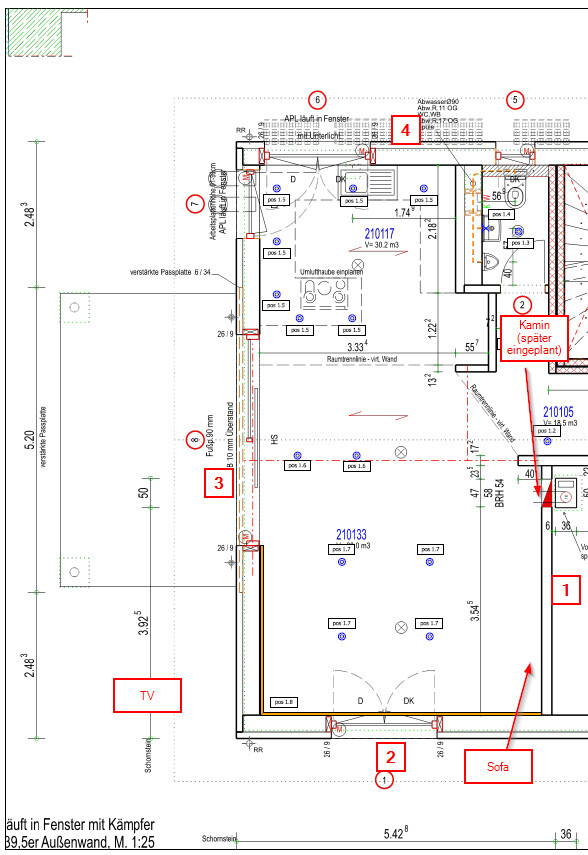
Thanks in advance for your opinions and advice.
I am currently working on the lighting design for my living/dining area and would like to include cove lighting. In addition to downlights for the living area, I plan to install a pendant light above the dining table.
We are about to install the drywall sheets and need to take the aluminum profiles into account for this.
General questions:
- Has anyone here installed cove lighting before? What should one watch out for?
- Does anyone have a similar floor plan in their living/dining area?
My current plan is to install the coves in a U-shape from the fireplace wall to the start of the sliding door element. However, I’m unsure how this will look and could also imagine placing them only on walls 1 and 3. Due to the length of the cove, we will likely need to use 24V LED strips.
The other light fixtures are recessed ceiling spots in the kitchen and the mentioned downlights in the living area.
Thanks in advance for your opinions and advice.
W
wiltshire13 Mar 2025 19:09Basically, it’s an LED strip with a cover and a driver/power supply installed out of sight.
With LED strips, it’s important to keep the voltage drop low because as voltage decreases, the light becomes dimmer, which doesn’t look good. 24V systems are better suited for longer strips. Transistor-controlled strips reduce brightness loss by minimizing voltage drop along the length. I would recommend using no more than 75% of the specified maximum length.
The color temperature is a matter of personal preference – you can also choose RGB or RGBW strips if you want color effects. If you don’t use RGB, make sure to get a high CRI (Color Rendering Index). Besides color temperature, the way light affects the appearance of objects is important for comfort. The CRI expresses this as a number, and I’d suggest at least 95.
If you use strips that are too bright, keep in mind that dimming may cause flickering. Increasing power (W/meter) is not a solution in this case.
The shorter the distance between LEDs, the more even the light, but this often means higher power consumption. Larger gaps between LEDs can be visually and in terms of brightness softened with a frosted glass cover (or frosted plastic).
Remember that drivers/power supplies need space and some airflow around them for cooling.
It’s better to avoid 230V LED strips in silicone indoors. They usually have poor color quality, large LED spacing, and tend to flicker. These are more suitable for outdoor use.
With LED strips, it’s important to keep the voltage drop low because as voltage decreases, the light becomes dimmer, which doesn’t look good. 24V systems are better suited for longer strips. Transistor-controlled strips reduce brightness loss by minimizing voltage drop along the length. I would recommend using no more than 75% of the specified maximum length.
The color temperature is a matter of personal preference – you can also choose RGB or RGBW strips if you want color effects. If you don’t use RGB, make sure to get a high CRI (Color Rendering Index). Besides color temperature, the way light affects the appearance of objects is important for comfort. The CRI expresses this as a number, and I’d suggest at least 95.
If you use strips that are too bright, keep in mind that dimming may cause flickering. Increasing power (W/meter) is not a solution in this case.
The shorter the distance between LEDs, the more even the light, but this often means higher power consumption. Larger gaps between LEDs can be visually and in terms of brightness softened with a frosted glass cover (or frosted plastic).
Remember that drivers/power supplies need space and some airflow around them for cooling.
It’s better to avoid 230V LED strips in silicone indoors. They usually have poor color quality, large LED spacing, and tend to flicker. These are more suitable for outdoor use.
 Malle Zwabber14 Mar 2025 11:49
Depending on how the coving is designed, I would recommend COB LED strips. This might eliminate the need for diffusers. In my apartment, I used recessed shadow gaps throughout.
Similar topics