
ᐅ Difference Between Lifting Stations and Pump Stations: Is It Really Necessary?
Created on: 1 Oct 2022 21:41
H
HTPProXyHello everyone,
I am building a turnkey single-family house with a basement on a sloped plot. When I signed the contract, a macerator pump system for 2,750€ was included in the offer because the black water has to be pumped into the sewer, which is located above the basement level.
The day before yesterday, I received an email from the construction company asking me to confirm the additional cost for sanitary installations. The attached PDF showed that the macerator pump system was removed from the offer and replaced by a pumping station, which is significantly more expensive at 11,000€.
When I asked why this is suddenly required, I received the following explanation:
The following feedback: Due to the building’s position and the site conditions, it is not possible, as usual and included in the contract, to drain from the building by natural slope (sewer pipe slope to the inspection chamber).
Instead, a pressure pump system must be installed: all wastewater from the house is collected in a chamber and then pumped under pressure through a pressure line into the sewer.
Reason: The channel of the existing site inspection chamber is higher than the sewer pipes, which come out of the basement wall at frost-proof height.
Is a macerator pump system not a pressure pump system, whereas a pumping station is? The model proposed to me was described on the manufacturer’s website as follows:
No more performance is possible. In the wet installation variant, the XYZ can handle very large amounts of sewage-containing wastewater and is especially suitable for commercial and industrial use.
That made me a bit suspicious. What I am building is a single-family house with a basement apartment, so there will be 2 kitchens and 2 bathrooms, plus 1 guest WC. Doesn’t the pumping station sound a bit ‘oversized’ for that?
Now the last point, where I am unsure: The originally planned macerator pump system was to be installed in the basement floor slab. The new pumping station is to be installed in an external chamber instead. Does installation in the chamber offer any advantages? On the one hand, I would then have the chamber lid in the garden, right(!) next to the terrace, and on the other hand, the chamber apparently needs to be vented from time to time. If it were installed in the floor slab, nothing would protrude from the ground and venting would then be done via the roof. Wouldn’t installation in the floor slab be more practical for me?
For what it’s worth: the basement is being constructed as a watertight concrete structure (“white tank” method).
Thank you for your help!
Stefan
I am building a turnkey single-family house with a basement on a sloped plot. When I signed the contract, a macerator pump system for 2,750€ was included in the offer because the black water has to be pumped into the sewer, which is located above the basement level.
The day before yesterday, I received an email from the construction company asking me to confirm the additional cost for sanitary installations. The attached PDF showed that the macerator pump system was removed from the offer and replaced by a pumping station, which is significantly more expensive at 11,000€.
When I asked why this is suddenly required, I received the following explanation:
The following feedback: Due to the building’s position and the site conditions, it is not possible, as usual and included in the contract, to drain from the building by natural slope (sewer pipe slope to the inspection chamber).
Instead, a pressure pump system must be installed: all wastewater from the house is collected in a chamber and then pumped under pressure through a pressure line into the sewer.
Reason: The channel of the existing site inspection chamber is higher than the sewer pipes, which come out of the basement wall at frost-proof height.
Is a macerator pump system not a pressure pump system, whereas a pumping station is? The model proposed to me was described on the manufacturer’s website as follows:
No more performance is possible. In the wet installation variant, the XYZ can handle very large amounts of sewage-containing wastewater and is especially suitable for commercial and industrial use.
That made me a bit suspicious. What I am building is a single-family house with a basement apartment, so there will be 2 kitchens and 2 bathrooms, plus 1 guest WC. Doesn’t the pumping station sound a bit ‘oversized’ for that?
Now the last point, where I am unsure: The originally planned macerator pump system was to be installed in the basement floor slab. The new pumping station is to be installed in an external chamber instead. Does installation in the chamber offer any advantages? On the one hand, I would then have the chamber lid in the garden, right(!) next to the terrace, and on the other hand, the chamber apparently needs to be vented from time to time. If it were installed in the floor slab, nothing would protrude from the ground and venting would then be done via the roof. Wouldn’t installation in the floor slab be more practical for me?
For what it’s worth: the basement is being constructed as a watertight concrete structure (“white tank” method).
Thank you for your help!
Stefan
With a lifting station, the pump essentially pushes the water upwards, and then it drains normally. In the case of a pumping station, there is a pressure pipe connected directly to the sewer or inspection chamber. From the pumping station onwards, no gradient is necessary.
To determine what you need or to check if someone is misleading you, a drainage plan and a height profile are necessary.
The reasoning sounds plausible at first. In my experience, the additional costs also make sense.
What do you do with the rainwater?
To determine what you need or to check if someone is misleading you, a drainage plan and a height profile are necessary.
The reasoning sounds plausible at first. In my experience, the additional costs also make sense.
What do you do with the rainwater?
Hello teh_M,
thank you for your reply. I just took a look at the plans; attached is a section of the basement:
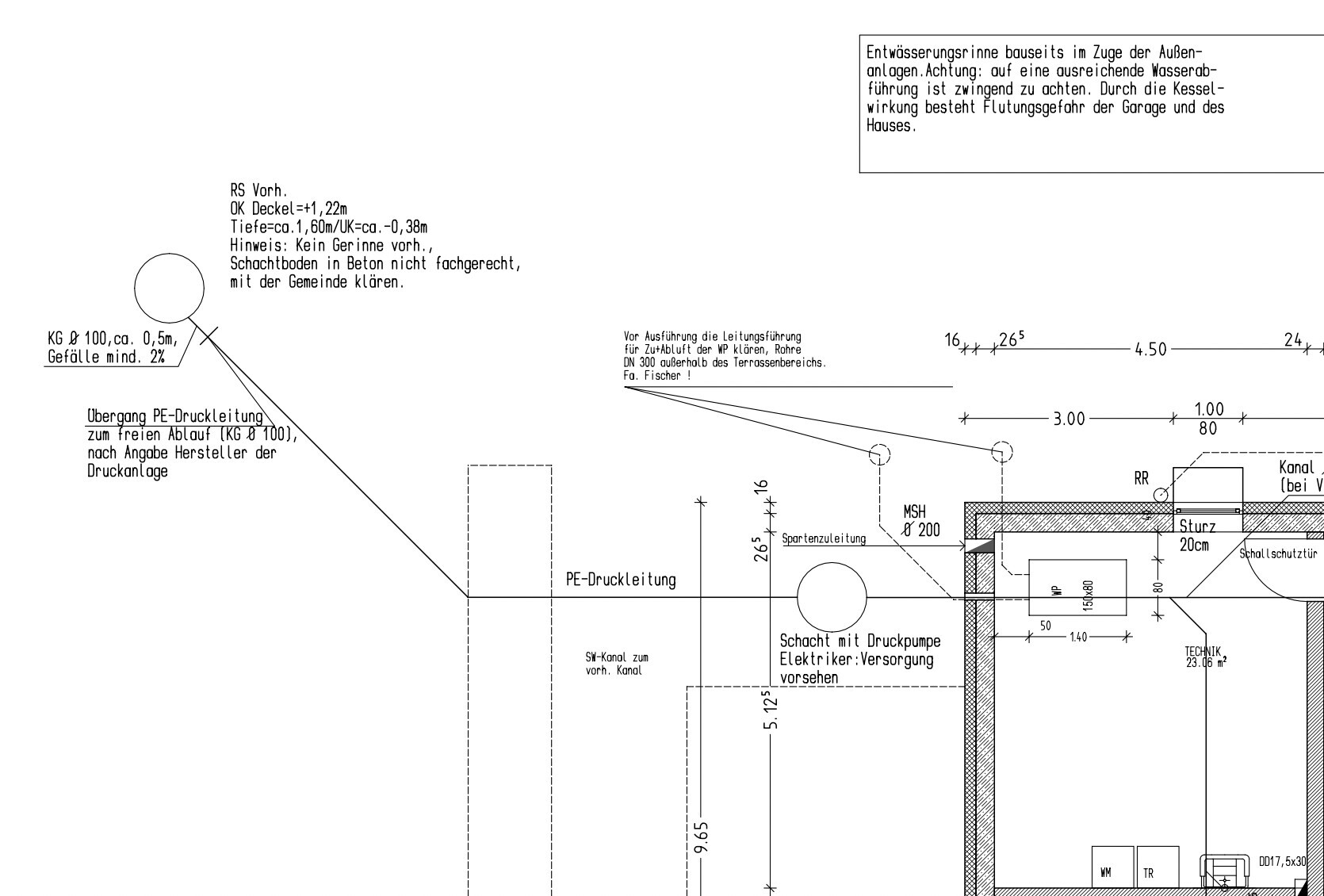
If I’m not completely mistaken, the height differences refer to the ground floor level, as the basement is at -2.6m (-8.5 feet). This would mean that the existing shaft in the upper left ends almost 2m (6.6 feet) above the basement floor slab, so significantly higher.
In this respect, the pumping station there would probably be correct. Regarding rainwater, I wasn’t informed of anything, but according to the plan, there is a soakaway pit to the east, connected to the rain gutters.
Is there a specific reason for choosing underground pumping stations instead of installing them directly in the floor slab? Somehow, I can accept the additional shaft next to the terrace if everything could also be placed under the basement.
Best regards,
Stefan
thank you for your reply. I just took a look at the plans; attached is a section of the basement:
If I’m not completely mistaken, the height differences refer to the ground floor level, as the basement is at -2.6m (-8.5 feet). This would mean that the existing shaft in the upper left ends almost 2m (6.6 feet) above the basement floor slab, so significantly higher.
In this respect, the pumping station there would probably be correct. Regarding rainwater, I wasn’t informed of anything, but according to the plan, there is a soakaway pit to the east, connected to the rain gutters.
Is there a specific reason for choosing underground pumping stations instead of installing them directly in the floor slab? Somehow, I can accept the additional shaft next to the terrace if everything could also be placed under the basement.
Best regards,
Stefan
K
k-man20212 Oct 2022 11:24That sounds reasonable to me. However, it could have been clear from the start, as the situation isn’t exactly unexpected…
We have the same setup with an external shaft and two pumps that alternate activation at a certain level. It has been working smoothly for 20 years except for a minor defect. In our case, this system is called a lifting station…
We have the same setup with an external shaft and two pumps that alternate activation at a certain level. It has been working smoothly for 20 years except for a minor defect. In our case, this system is called a lifting station…
Hello k-man,
thank you for your reply. I also find it a bit unfortunate that the significantly higher costs for the pump station have only come to light shortly before construction begins. However, I’m not sure if one can reasonably expect the construction company to have taken everything into account during the quotation phase, such as the sewer depth. It is what it is now, so I suppose I will have to bear the costs.
I am still torn between installing it underground or within the slab, as it seems every source online has a different opinion on this matter 🙂
Does your ventilation discharge through the roof?
thank you for your reply. I also find it a bit unfortunate that the significantly higher costs for the pump station have only come to light shortly before construction begins. However, I’m not sure if one can reasonably expect the construction company to have taken everything into account during the quotation phase, such as the sewer depth. It is what it is now, so I suppose I will have to bear the costs.
I am still torn between installing it underground or within the slab, as it seems every source online has a different opinion on this matter 🙂
Does your ventilation discharge through the roof?
K
k-man20212 Oct 2022 12:52We’re glad the installation is NOT in the foundation slab... you definitely don’t want the smell inside the house if it ever needs to be opened! Also, the pumps are quite powerful, and you wouldn’t want to hear them running throughout the entire house. We don’t have any ventilation, and there is no odor.
I would make sure that two pumps are installed for the price... otherwise, you’ll have a problem if one pump fails, or you’ll have to pay for emergency service. Our system is the ABS Synconta, which I can recommend. The control unit should be kept frost-free, for example in the basement. The distance between the control unit and the sewage pit should be as short as possible due to the type of level measurement used.
I would make sure that two pumps are installed for the price... otherwise, you’ll have a problem if one pump fails, or you’ll have to pay for emergency service. Our system is the ABS Synconta, which I can recommend. The control unit should be kept frost-free, for example in the basement. The distance between the control unit and the sewage pit should be as short as possible due to the type of level measurement used.
Similar topics