

Hello,
after a long time, I am back with a less pleasant topic. The order was Q4 finish and painting with clay paint.
The following issues:
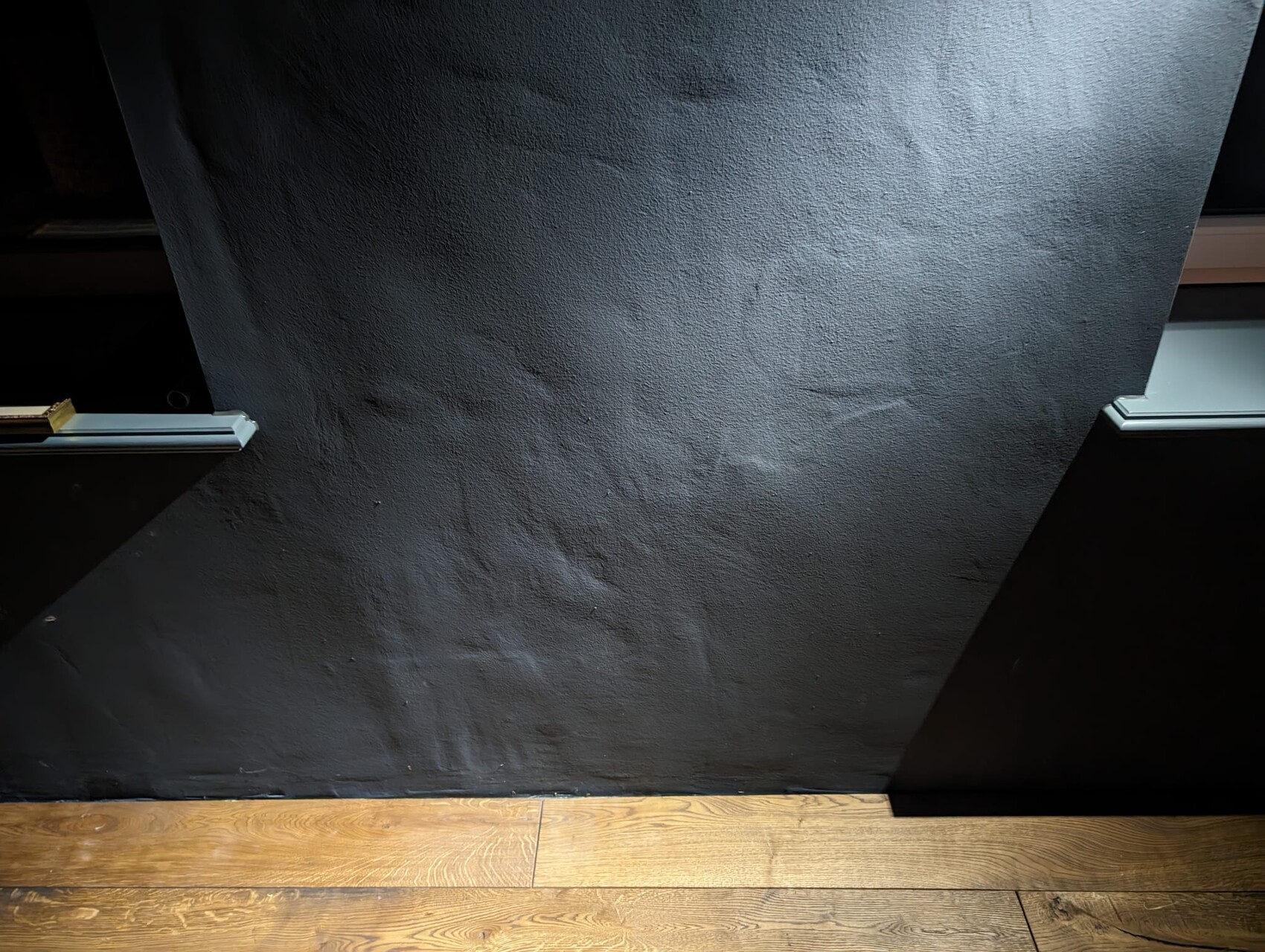
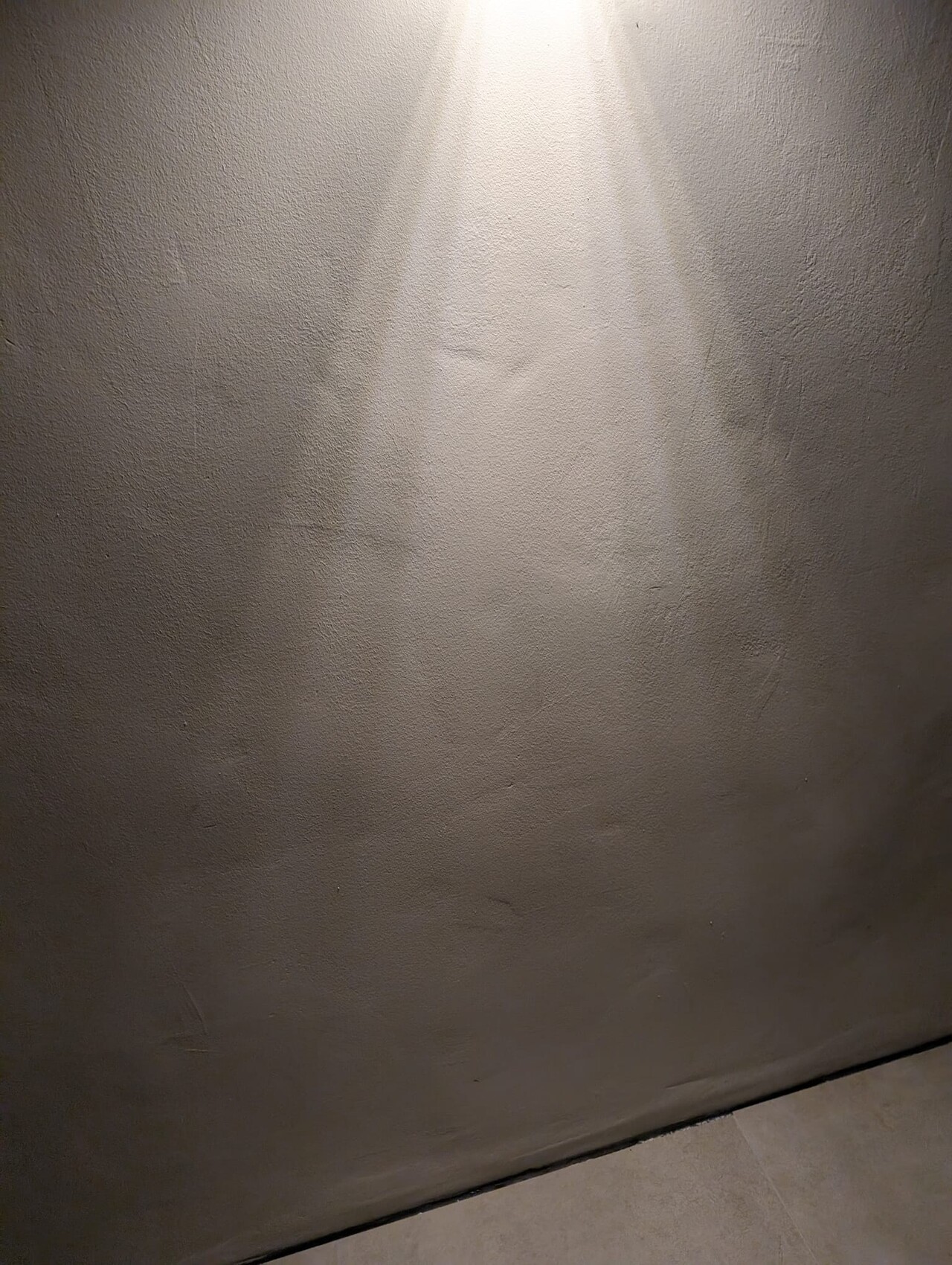
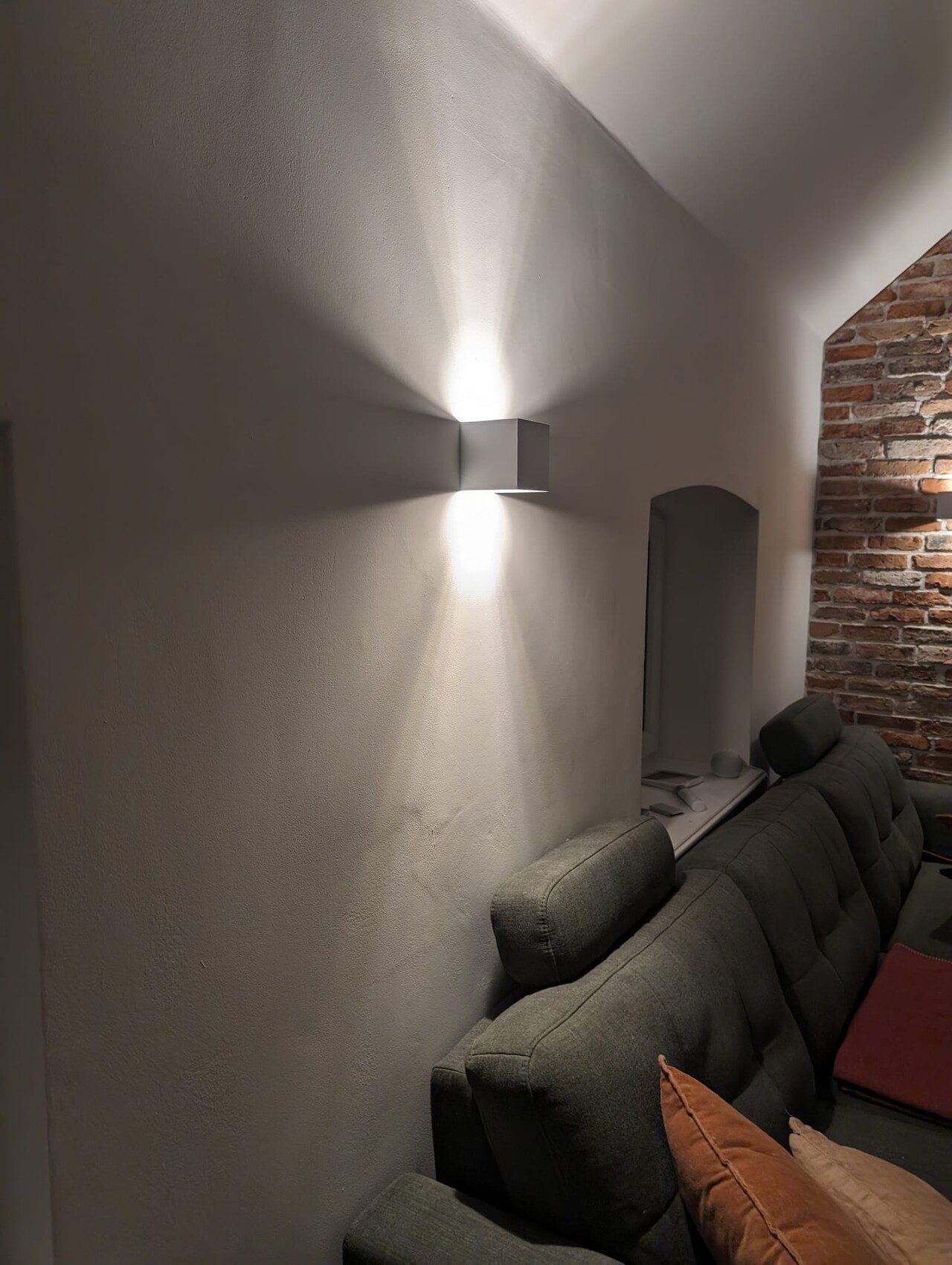
1. Even without (natural) grazing light, the walls are clearly not perfectly smooth. I can basically accept that, although I would still interpret the dents as not meeting Q4 standards. In grazing light (sunlight), the walls are sometimes really bad; under artificial grazing light, almost unacceptable. I know that artificial grazing light is not really the standard for assessing the work. The photos in the darker areas are unfortunately a bit “over-contrasted” from the phone and not a bit less bad. Do you also see this as a defect? (As far as the pictures allow, I will try to take new ones)
2. Unfortunately, the painter did not inform us that a dark clay paint is not a good idea because, as with other dark paints, stains are very visible but cannot be cleaned (well). Whether dry or wet, the paint flakes off. Not abrasion-resistant; we should have realized that this is not sensible with dark color. However, a warning would have been helpful. We then spoke with the painter; he gave us silicate paint, which we applied ourselves over the clay paint. However, he did not inform us that we might need to wash the clay paint beforehand or that a primer would be necessary. Well, the silicate paint flakes off now just like the clay paint, and with wet abrasion, the white plaster underneath becomes visible again. We might also have needed to anticipate this. I suppose there is little room for remediation here?
3. The painter suggested a primer using the dark clay paint before wallpapering (one wall in a dark room). He said it would look better if a seam were to come loose at some point. I thought that was a good suggestion. After looking into the matter, it now seems to me, due to poor adhesion, that this is not a good idea. But the wallpaper is holding so far.

after a long time, I am back with a less pleasant topic. The order was Q4 finish and painting with clay paint.
The following issues:
1. Even without (natural) grazing light, the walls are clearly not perfectly smooth. I can basically accept that, although I would still interpret the dents as not meeting Q4 standards. In grazing light (sunlight), the walls are sometimes really bad; under artificial grazing light, almost unacceptable. I know that artificial grazing light is not really the standard for assessing the work. The photos in the darker areas are unfortunately a bit “over-contrasted” from the phone and not a bit less bad. Do you also see this as a defect? (As far as the pictures allow, I will try to take new ones)
2. Unfortunately, the painter did not inform us that a dark clay paint is not a good idea because, as with other dark paints, stains are very visible but cannot be cleaned (well). Whether dry or wet, the paint flakes off. Not abrasion-resistant; we should have realized that this is not sensible with dark color. However, a warning would have been helpful. We then spoke with the painter; he gave us silicate paint, which we applied ourselves over the clay paint. However, he did not inform us that we might need to wash the clay paint beforehand or that a primer would be necessary. Well, the silicate paint flakes off now just like the clay paint, and with wet abrasion, the white plaster underneath becomes visible again. We might also have needed to anticipate this. I suppose there is little room for remediation here?
3. The painter suggested a primer using the dark clay paint before wallpapering (one wall in a dark room). He said it would look better if a seam were to come loose at some point. I thought that was a good suggestion. After looking into the matter, it now seems to me, due to poor adhesion, that this is not a good idea. But the wallpaper is holding so far.
D
derdietmar21 Apr 2024 21:42Hello,
Raking light can reveal surface imperfections at any quality level. However, in my opinion, what you are showing here is really poor and barely meets Q2 standards.
Best regards
Raking light can reveal surface imperfections at any quality level. However, in my opinion, what you are showing here is really poor and barely meets Q2 standards.
Best regards
Thank you for the replies.
Yes, that's correct, raking light is not a valid basis for assessment. I will try to take some pictures during the day. However, unevenness is definitely visible even without direct lighting.
And yes, ypg, I also thought it looked like an old wall, where unevenness is part of the charm. However, there is a new internal insulation underneath, made of aerated concrete with a lime-cement plaster finish. I don’t want to judge how well the lime-cement plaster (Q2) was applied. However, the painter did not report any issues with it.
What do you think about the second point? It feels like I might have given bad advice, but in reality, probably nothing needs to be done?
Yes, that's correct, raking light is not a valid basis for assessment. I will try to take some pictures during the day. However, unevenness is definitely visible even without direct lighting.
And yes, ypg, I also thought it looked like an old wall, where unevenness is part of the charm. However, there is a new internal insulation underneath, made of aerated concrete with a lime-cement plaster finish. I don’t want to judge how well the lime-cement plaster (Q2) was applied. However, the painter did not report any issues with it.
What do you think about the second point? It feels like I might have given bad advice, but in reality, probably nothing needs to be done?
N
nordanney22 Apr 2024 00:00South schrieb:
Yes, that's correct, grazing light is not a valid basis for assessment. I will try to take pictures during the day. However, unevenness is definitely visible even without direct light incidence. No discussion. This is NOT Q4. Far from it. Cement-lime render will not be as perfectly smooth as gypsum plaster, but dents, marks, and indentations are a no-go.
Q3 already means that processing marks, such as trowel lines, are largely avoided. Q4 adds a mandatory (!!!) full-surface rework using suitable filler or smoothing plaster material (I assume a smoothed render; rubbed or floated would be treated differently—usually a two-step refinement with a finishing coat).
O
Oberhäslich22 Apr 2024 08:39I also think this is a disaster, especially since the areas with the dark paint are far from Q3/Q4 quality. Our Q2 plaster doesn’t even look like that; it’s almost completely smooth. I can’t see at all that the painter used a trowel there. I’m not a professional, but I have looked into it a bit. I can’t imagine that clay plaster can’t be smoothed properly. I’m more wondering how it’s even possible to achieve such a poor surface finish—I would be furious, if I weren’t going to pay for it 🙂
Similar topics