
ᐅ Ventilation System in a Single-Family Home Not Working – Planning Mistake?
Created on: 1 Feb 2021 19:35
J
jeti79
Hello everyone,
We have now been living for 2 years (since November 2018) in our detached house with a pitched roof, built according to the 2016 energy saving regulations, equipped with a central ventilation system (Wolf CWL300). Unfortunately, we have not been satisfied with the "performance" of the ventilation system from the start. We repeatedly called our installer in the beginning, but after about the eighth visit, he gave up and simply said, "The building is full of moisture at the beginning, so it’s normal for the air quality to be poor for two years." We consider this a poor excuse.
Our dissatisfaction mainly comes from the fact that we have had the chance to compare with neighboring houses (all in the same development with similar new build standards), where the air quality is usually significantly better than in our house. This means: despite the ventilation system running continuously (on occupancy mode at about 190 m³/h [190 cubic meters per hour]), the air in our house is almost always stuffy, whether we are home or not. Although the installer advised against it, we have actually been leaving the windows open every night lately because the air in the bedroom feels used up after 3-4 hours. It’s the same situation in the children's rooms.
Even when we come to the ground floor in the morning (where nobody has been all night), the air quality is anything but good. So, as we did before, we immediately open the windows in the morning.
Of course, I assume that we might be making some mistakes ourselves, but I would like to find out if there might also be (major?) planning errors in our system? Is it even possible to determine that remotely? What information would you need from us?
I have attached a layout showing how the supply and exhaust valves are installed on the upper and ground floors. The system is installed in the attic. I change the filters regularly every month (because it’s a new development), and the chimneys on the roof are the required >2.5 m (over 8 feet) apart from each other.
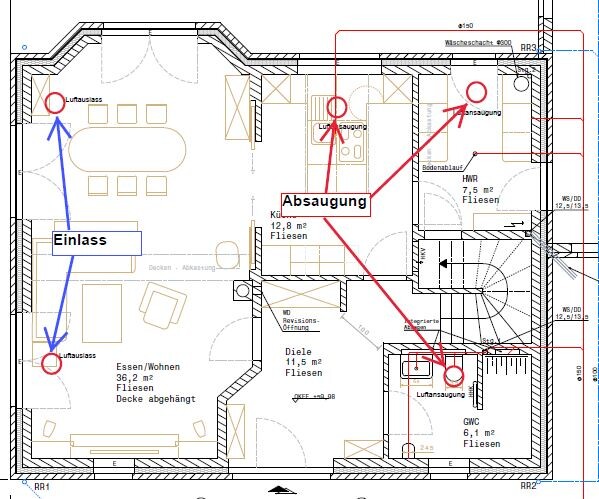
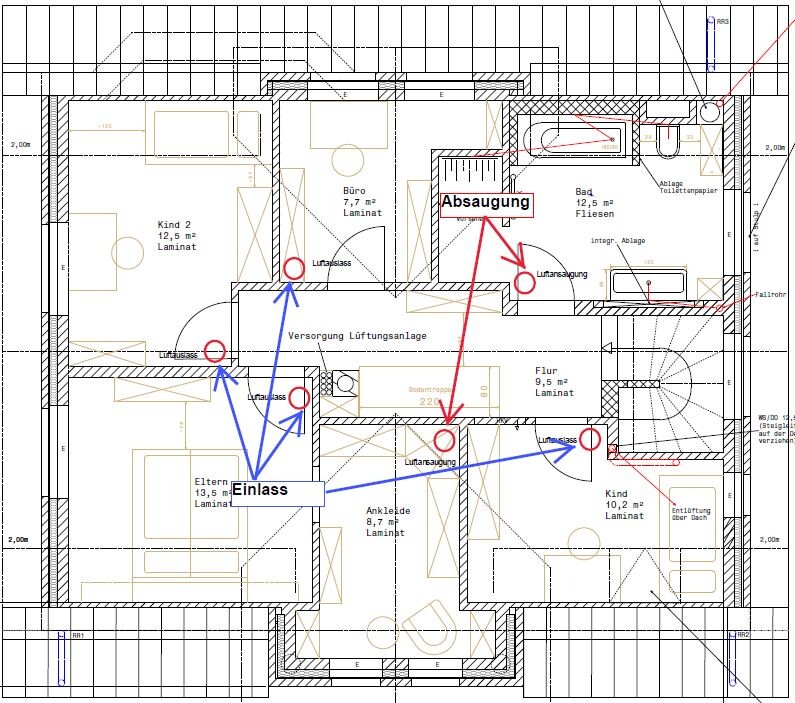
We have now been living for 2 years (since November 2018) in our detached house with a pitched roof, built according to the 2016 energy saving regulations, equipped with a central ventilation system (Wolf CWL300). Unfortunately, we have not been satisfied with the "performance" of the ventilation system from the start. We repeatedly called our installer in the beginning, but after about the eighth visit, he gave up and simply said, "The building is full of moisture at the beginning, so it’s normal for the air quality to be poor for two years." We consider this a poor excuse.
Our dissatisfaction mainly comes from the fact that we have had the chance to compare with neighboring houses (all in the same development with similar new build standards), where the air quality is usually significantly better than in our house. This means: despite the ventilation system running continuously (on occupancy mode at about 190 m³/h [190 cubic meters per hour]), the air in our house is almost always stuffy, whether we are home or not. Although the installer advised against it, we have actually been leaving the windows open every night lately because the air in the bedroom feels used up after 3-4 hours. It’s the same situation in the children's rooms.
Even when we come to the ground floor in the morning (where nobody has been all night), the air quality is anything but good. So, as we did before, we immediately open the windows in the morning.
Of course, I assume that we might be making some mistakes ourselves, but I would like to find out if there might also be (major?) planning errors in our system? Is it even possible to determine that remotely? What information would you need from us?
I have attached a layout showing how the supply and exhaust valves are installed on the upper and ground floors. The system is installed in the attic. I change the filters regularly every month (because it’s a new development), and the chimneys on the roof are the required >2.5 m (over 8 feet) apart from each other.
matte1987 schrieb:
That basically sounds reasonable.
The filter inside the unit is not certified, so what? A filter is just a resistance; the fan doesn’t care whether the part is certified or not.
On another note: do you regularly replace the filters, whether inside the unit or at the exhaust vents? It’s about the dust in the ducts – he suggested that it might be (but doesn’t have to be) that they are not effective enough to filter out all the dust. Combined with the airflow, this could cause dust to build up or accumulate.
Yes, I change them almost every month because after one month here in the new development area they are already significantly darkened. I originally received a fleece roll from the installer.
T
T_im_Norden3 Feb 2021 07:16There should be no dust or only minimal amounts inside the ducts.
Were all openings sealed during the construction phase?
When was the mechanical ventilation system installed?
When was it put into operation?
Were all openings sealed during the construction phase?
When was the mechanical ventilation system installed?
When was it put into operation?
T_im_Norden schrieb:
There should be little to no dust in the ducts.
Were all the openings sealed during the construction phase?
When was the mechanical ventilation system installed?
When was it put into operation? Yes, during the construction phase in 2017/2018 they were sealed. The mechanical ventilation system was installed at the end of 2018 and put into operation at the beginning of 2019 because we still had some work to do that would generate dust.
Snowy36 schrieb:
There shouldn’t be any dirt inside at all! We opened ours after 2 years: there’s nothing. Yes, that’s what I would have expected too – but unfortunately, there are clearly noticeable dust deposits around the exhaust vents.
On February 18th we have an appointment with a Wolf field service technician, who initially couldn’t identify any major issues with the system from a distance. I’m curious about that.
Yesterday, the Netatmo climate meter arrived, and I have to say, I’m a bit surprised:
according to the device, our indoor air quality is from good to excellent at night (1100–900 ppm CO2 during the night and in the morning, when the ventilation system is running, at 600–700 ppm). Now, with no one in the room but the ventilation system clearly audible (running at 190 m³/h [112 cfm]), the value currently stands at around 450 m³/h ([265 cfm]), which would actually be amazingly good. The device is placed on my nightstand, which is far from the door. (The zero value was due to a short power outage)
I wouldn’t say the air feels very stale at the moment, but I also wouldn’t claim it’s particularly good. Of course, this is purely subjective...
Are we maybe expecting too much from the ventilation system?! I also think that the air quality is noticeably worse in summer than it is now in winter. Unfortunately, I can’t really test that right now.
B
BBaumeister5 Feb 2021 09:01Do you still have items in the house that might be off-gassing? New furniture, for example? Some things do give off a certain smell. Have you measured the humidity level in the rooms? In the bathrooms, for instance, we still ventilate quite thoroughly by hand after showering or bathing; otherwise, the moisture tends to drift into the bedroom and lingers noticeably there. What about cooking odors?
We have a similar unit (Wolf CWL 400) and are satisfied with it. One factor in your case is likely that the valves upstairs are not located in the corners of the rooms. That should be corrected.
We have a similar unit (Wolf CWL 400) and are satisfied with it. One factor in your case is likely that the valves upstairs are not located in the corners of the rooms. That should be corrected.
Similar topics