
ᐅ Ventilation System in a Single-Family Home Not Working – Planning Mistake?
Created on: 1 Feb 2021 19:35
J
jeti79
Hello everyone,
We have now been living for 2 years (since November 2018) in our detached house with a pitched roof, built according to the 2016 energy saving regulations, equipped with a central ventilation system (Wolf CWL300). Unfortunately, we have not been satisfied with the "performance" of the ventilation system from the start. We repeatedly called our installer in the beginning, but after about the eighth visit, he gave up and simply said, "The building is full of moisture at the beginning, so it’s normal for the air quality to be poor for two years." We consider this a poor excuse.
Our dissatisfaction mainly comes from the fact that we have had the chance to compare with neighboring houses (all in the same development with similar new build standards), where the air quality is usually significantly better than in our house. This means: despite the ventilation system running continuously (on occupancy mode at about 190 m³/h [190 cubic meters per hour]), the air in our house is almost always stuffy, whether we are home or not. Although the installer advised against it, we have actually been leaving the windows open every night lately because the air in the bedroom feels used up after 3-4 hours. It’s the same situation in the children's rooms.
Even when we come to the ground floor in the morning (where nobody has been all night), the air quality is anything but good. So, as we did before, we immediately open the windows in the morning.
Of course, I assume that we might be making some mistakes ourselves, but I would like to find out if there might also be (major?) planning errors in our system? Is it even possible to determine that remotely? What information would you need from us?
I have attached a layout showing how the supply and exhaust valves are installed on the upper and ground floors. The system is installed in the attic. I change the filters regularly every month (because it’s a new development), and the chimneys on the roof are the required >2.5 m (over 8 feet) apart from each other.
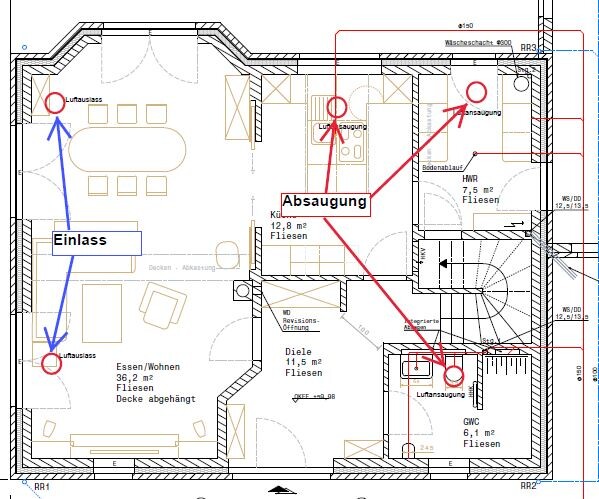
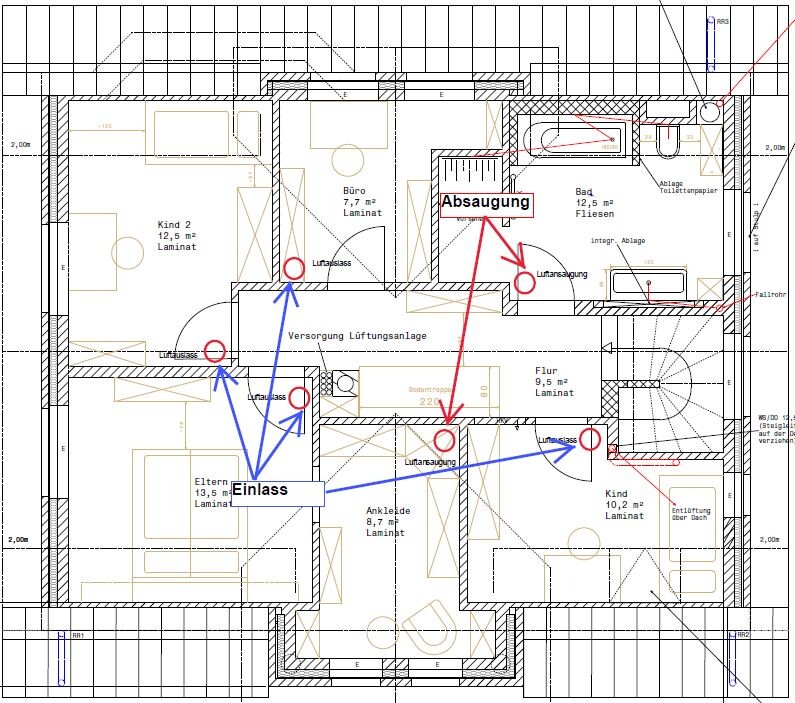
We have now been living for 2 years (since November 2018) in our detached house with a pitched roof, built according to the 2016 energy saving regulations, equipped with a central ventilation system (Wolf CWL300). Unfortunately, we have not been satisfied with the "performance" of the ventilation system from the start. We repeatedly called our installer in the beginning, but after about the eighth visit, he gave up and simply said, "The building is full of moisture at the beginning, so it’s normal for the air quality to be poor for two years." We consider this a poor excuse.
Our dissatisfaction mainly comes from the fact that we have had the chance to compare with neighboring houses (all in the same development with similar new build standards), where the air quality is usually significantly better than in our house. This means: despite the ventilation system running continuously (on occupancy mode at about 190 m³/h [190 cubic meters per hour]), the air in our house is almost always stuffy, whether we are home or not. Although the installer advised against it, we have actually been leaving the windows open every night lately because the air in the bedroom feels used up after 3-4 hours. It’s the same situation in the children's rooms.
Even when we come to the ground floor in the morning (where nobody has been all night), the air quality is anything but good. So, as we did before, we immediately open the windows in the morning.
Of course, I assume that we might be making some mistakes ourselves, but I would like to find out if there might also be (major?) planning errors in our system? Is it even possible to determine that remotely? What information would you need from us?
I have attached a layout showing how the supply and exhaust valves are installed on the upper and ground floors. The system is installed in the attic. I change the filters regularly every month (because it’s a new development), and the chimneys on the roof are the required >2.5 m (over 8 feet) apart from each other.
 Neubauling2 Feb 2021 07:50
matte1987 schrieb:
although I would never place an exhaust vent directly above the stove. Why not? As a layperson, that seems like a good spot to me to prevent odors. Or do you mean it would interfere with the range hood?
Because you’re contaminating the duct.
The range hood is intended for cooking—when used as a recirculating system with an activated carbon filter, it also helps reduce odors. Any remaining smells are removed by the mechanical ventilation with heat recovery anyway, regardless of where the vent is located. It just takes a bit longer.
Kitchen ventilation is a topic on its own. Mechanical ventilation with heat recovery is not suitable for this purpose, neither in terms of airflow rates nor materials used.
Much more important than the vent placement in the kitchen is the use of filters in the exhaust vents. My ventilation installer didn’t want to install anything there at first, but I convinced him. At least part of the horror stories about moldy ducts are often related to this.
For comparison: my range hood has a free-blowing fan capacity of 630m³/h (370 CFM). Our mechanical ventilation with heat recovery supplies/extracts about 200m³/h (120 CFM), but this is distributed across all the vents. So when comparing the kitchen exhaust vent to the range hood, the difference in airflow is roughly a factor of 10 to 15.
The range hood is intended for cooking—when used as a recirculating system with an activated carbon filter, it also helps reduce odors. Any remaining smells are removed by the mechanical ventilation with heat recovery anyway, regardless of where the vent is located. It just takes a bit longer.
Kitchen ventilation is a topic on its own. Mechanical ventilation with heat recovery is not suitable for this purpose, neither in terms of airflow rates nor materials used.
Much more important than the vent placement in the kitchen is the use of filters in the exhaust vents. My ventilation installer didn’t want to install anything there at first, but I convinced him. At least part of the horror stories about moldy ducts are often related to this.
For comparison: my range hood has a free-blowing fan capacity of 630m³/h (370 CFM). Our mechanical ventilation with heat recovery supplies/extracts about 200m³/h (120 CFM), but this is distributed across all the vents. So when comparing the kitchen exhaust vent to the range hood, the difference in airflow is roughly a factor of 10 to 15.
matte1987 schrieb:
How is your ceiling above the upper floor constructed? Is it a wooden ceiling with drywall? If so, you could simply relocate the outlets on the upper floor. Anything else won’t achieve the desired effect.Yes, exactly – our ceiling is built that way. Unfortunately, I’ve already worked in the attic, connected the vapor barrier foil, installed the tongue and groove boards, and added walls – all of that would need to be removed again. But I’m willing to take on the effort. I’m not a fan of spending thousands of euros on something that then doesn’t (properly) work.matte1987 schrieb:
It’s fine on the ground floor – although I would never place an exhaust vent directly above the stove.Where would the exhaust vent be better placed? Unfortunately, there is a concrete ceiling there – we can’t change that anymore. The stove has an integrated exhaust system (venting to the outside).I have now installed exhaust filters everywhere because dust is coming out of the vents and settles right next to the supply air valves.
K
knalltüte2 Feb 2021 08:41jeti79 schrieb:
Where would the exhaust air be better directed? Unfortunately, there is a concrete ceiling there – so we can’t make any changes. The stove has an integrated exhaust system (vented outside).
I have now installed exhaust filters everywhere because dust is coming out of the inlets and settles right next to the supply air vents.Exhaust venting to the outside and controlled ventilation systems do not necessarily exclude each other, but in my opinion, special requirements need to be met (such as window contacts). You can hardly blow out 600 m³/h (about 353 cfm) through the exhaust hood and ignore the controlled ventilation system.Is the exhaust / supply air definitely connected correctly in terms of direction?
On the ground floor, I consider the position of the vents acceptable. On the upper floor, however, there is certainly much room for improvement (long-throw nozzles or significantly changing the vent positions).
We have window contacts installed on all windows (so far used only for alarm and comfort functions).
Unfortunately, we haven’t done any calculations ourselves and left everything to the plumbing professional. I can’t really say much about that, sorry.
I haven’t questioned that so far – that should be pretty easy to check, right? Switch on intensive ventilation and (if a simple anemometer isn’t available) hold a piece of paper under it!?
superzapp schrieb:
You can’t really ignore pushing out 600 m³/h (about 353 cfm) through the exhaust hood and the mechanical ventilation system, can you?
Unfortunately, we haven’t done any calculations ourselves and left everything to the plumbing professional. I can’t really say much about that, sorry.
superzapp schrieb:
Is the exhaust and supply air definitely connected the right way?
I haven’t questioned that so far – that should be pretty easy to check, right? Switch on intensive ventilation and (if a simple anemometer isn’t available) hold a piece of paper under it!?
Similar topics