
ᐅ Wolf ventilation system CWL-2 325 insufficient airflow amount
Created on: 3 Sep 2024 21:59
P
Paradiddel
Good evening,
a ventilation system from the company Wolf, model CWL-2 325, was installed in our new build.
We moved into the house in June 2024 and are disappointed with the performance of the ventilation system.
The company that installed the ventilation system visited again and found that less air was reaching the rooms than was set. Although the system was set to deliver 160 m³/h (94 CFM), only about 120 m³/h (71 CFM) actually reaches the rooms.
In some rooms, only about 7 m³/h (4 CFM) arrives, even though 20 m³/h (12 CFM) is specified in the ventilation plan.
The company could not really help us and referred us and our general contractor to Wolf.
We face the risk that if this is not a warranty case, we will have to cover the service visit costs ourselves. The basic service charge at Wolf alone is almost €500, plus hourly rates and so on.
It is unclear to us whether the cause of the missing airflow lies with the ventilation unit itself or with the duct system to the rooms. In the latter case, it would not be a warranty issue for Wolf.
We are uncertain how to proceed.
We also noticed something else about the ventilation system that does not seem quite right.
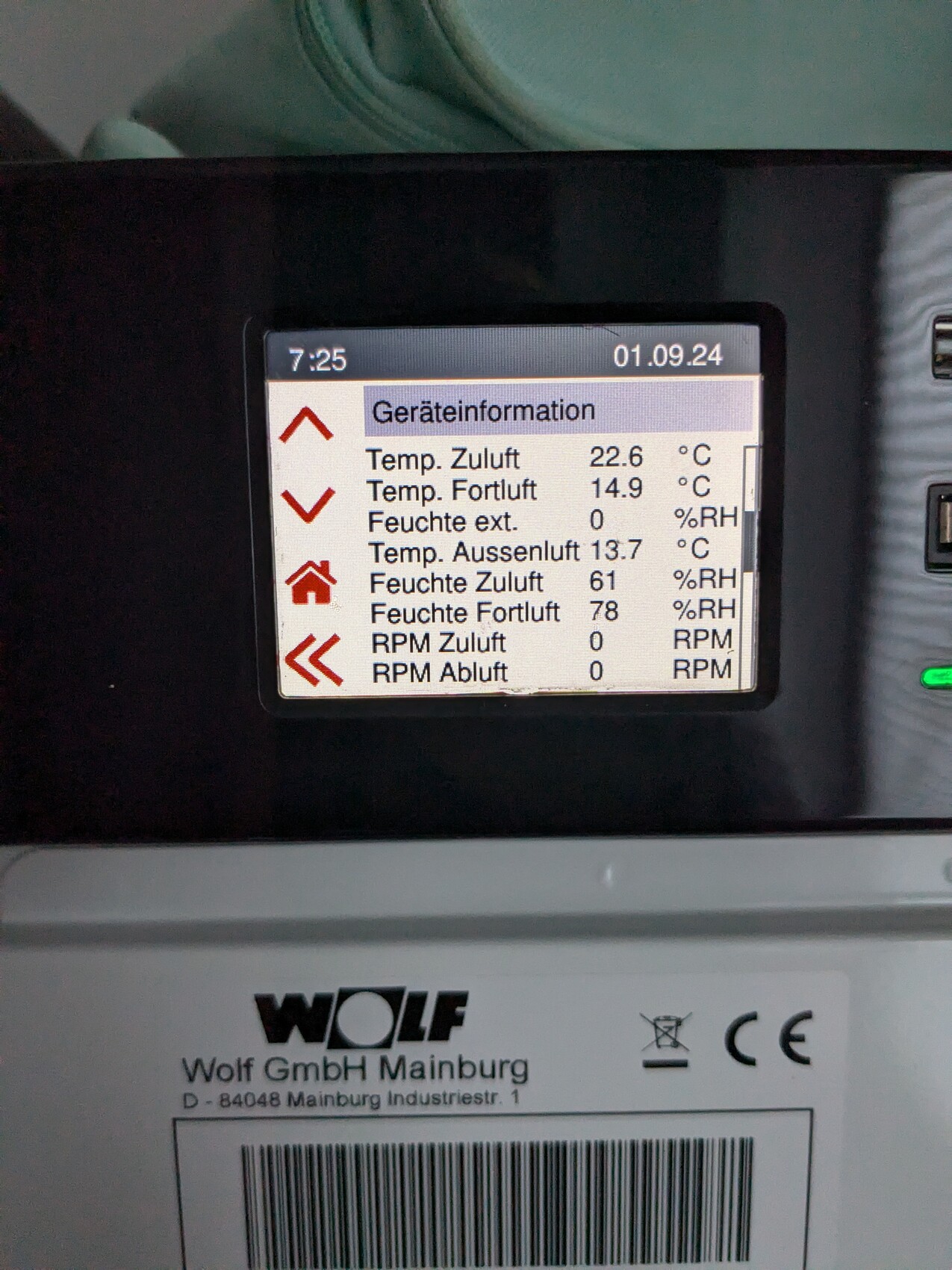
At an outdoor temperature of 13.7°C (56.7°F) at 7:30 in the morning, the supply air temperature was 22.6°C (72.7°F), and the exhaust air temperature was 14.9°C (58.8°F). Could the supply and exhaust air temperatures have been swapped? The bypass was open.
If so, this would definitely be a warranty case, and Wolf would not come out for no reason.
a ventilation system from the company Wolf, model CWL-2 325, was installed in our new build.
We moved into the house in June 2024 and are disappointed with the performance of the ventilation system.
The company that installed the ventilation system visited again and found that less air was reaching the rooms than was set. Although the system was set to deliver 160 m³/h (94 CFM), only about 120 m³/h (71 CFM) actually reaches the rooms.
In some rooms, only about 7 m³/h (4 CFM) arrives, even though 20 m³/h (12 CFM) is specified in the ventilation plan.
The company could not really help us and referred us and our general contractor to Wolf.
We face the risk that if this is not a warranty case, we will have to cover the service visit costs ourselves. The basic service charge at Wolf alone is almost €500, plus hourly rates and so on.
It is unclear to us whether the cause of the missing airflow lies with the ventilation unit itself or with the duct system to the rooms. In the latter case, it would not be a warranty issue for Wolf.
We are uncertain how to proceed.
We also noticed something else about the ventilation system that does not seem quite right.
At an outdoor temperature of 13.7°C (56.7°F) at 7:30 in the morning, the supply air temperature was 22.6°C (72.7°F), and the exhaust air temperature was 14.9°C (58.8°F). Could the supply and exhaust air temperatures have been swapped? The bypass was open.
If so, this would definitely be a warranty case, and Wolf would not come out for no reason.

Paradiddel schrieb:
Here, the exhaust air is at room temperature rather than outside temperature; attached are also pictures [...] Or could it be that only the sensors are swapped?1. Are the exhaust air, supply air, extract air, and outside air really connected correctly to the manifold? There should be a diagram in the user or installation manual. 2. The pairs supply air/extract air and outside air/exhaust air should have approximately the same temperatures.
3. Depending on the set target temperature, it is quite possible that the exhaust air is warmer than the supply air. In our system, the bypass opens when the extract air is warmer than the target temperature. What target temperature is set on your system, and is it confirmed that the damper is actually closed? This can take a while.
4. How are the supply and extract air ducts installed? Are there any pictures from the construction phase? In our case, the ducts are located within the thermal envelope but run directly along the exterior wall. Unfortunately, this means that depending on the season, significant cooling or heating occurs, but this cannot be changed now.

Paradiddel schrieb:
I wonder if this could also be the reason why the system has a too low airflow rate. Wolf systems (like others) always measure the resistance during startup or recalibration at every filter change. It can happen that if the pressure caused by the length of the ducts, valve settings, etc., is too high, the system reduces the air volume output as a self-protection measure. For example, instead of the maximum specified 325 m³/h (191 cfm), it might only deliver 250 m³/h (147 cfm) — the exact amount is determined by the device itself and is directly proportional to the pressure in the ducts/system. Accordingly, less air will reach the house at the end.
A new measurement and recalibration of the valves and filters can help, as well as a check for any leaks or tightness issues.
What does the valve situation look like at the exterior wall (or roof)? Errors could have occurred there as well.
At your temperature levels, I don’t see any problems with the system functioning correctly. The bypass is usually automatic anyway, meaning it’s possible you took the readings while it was closed.
 schubert7928 Sep 2024 15:42
Have the company come and take a look. Something isn’t right!
P
Paradiddel1 Oct 2024 16:33Thank you very much for your help!
An employee from the company Wolf has already been on site and corrected the sensors and their assignment.
The self-protection function is very interesting. The device also measures the flow rate. The measured air volume of the device matches the set value, as shown in the pictures above. When the device switches to self-protection mode, does it then display the actual flow rate measurement—for example, changing from a setting of 325 m³ (11,478 ft³) to 250 m³ (8,829 ft³)—or is this adjusted as well?
An employee from the company Wolf has already been on site and corrected the sensors and their assignment.
The self-protection function is very interesting. The device also measures the flow rate. The measured air volume of the device matches the set value, as shown in the pictures above. When the device switches to self-protection mode, does it then display the actual flow rate measurement—for example, changing from a setting of 325 m³ (11,478 ft³) to 250 m³ (8,829 ft³)—or is this adjusted as well?
Similar topics