
ᐅ Ventilation System in a Single-Family Home Not Working – Planning Mistake?
Created on: 1 Feb 2021 19:35
J
jeti79
Hello everyone,
We have now been living for 2 years (since November 2018) in our detached house with a pitched roof, built according to the 2016 energy saving regulations, equipped with a central ventilation system (Wolf CWL300). Unfortunately, we have not been satisfied with the "performance" of the ventilation system from the start. We repeatedly called our installer in the beginning, but after about the eighth visit, he gave up and simply said, "The building is full of moisture at the beginning, so it’s normal for the air quality to be poor for two years." We consider this a poor excuse.
Our dissatisfaction mainly comes from the fact that we have had the chance to compare with neighboring houses (all in the same development with similar new build standards), where the air quality is usually significantly better than in our house. This means: despite the ventilation system running continuously (on occupancy mode at about 190 m³/h [190 cubic meters per hour]), the air in our house is almost always stuffy, whether we are home or not. Although the installer advised against it, we have actually been leaving the windows open every night lately because the air in the bedroom feels used up after 3-4 hours. It’s the same situation in the children's rooms.
Even when we come to the ground floor in the morning (where nobody has been all night), the air quality is anything but good. So, as we did before, we immediately open the windows in the morning.
Of course, I assume that we might be making some mistakes ourselves, but I would like to find out if there might also be (major?) planning errors in our system? Is it even possible to determine that remotely? What information would you need from us?
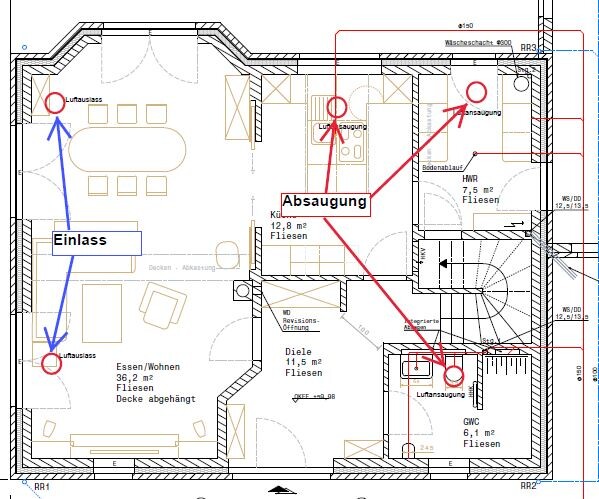
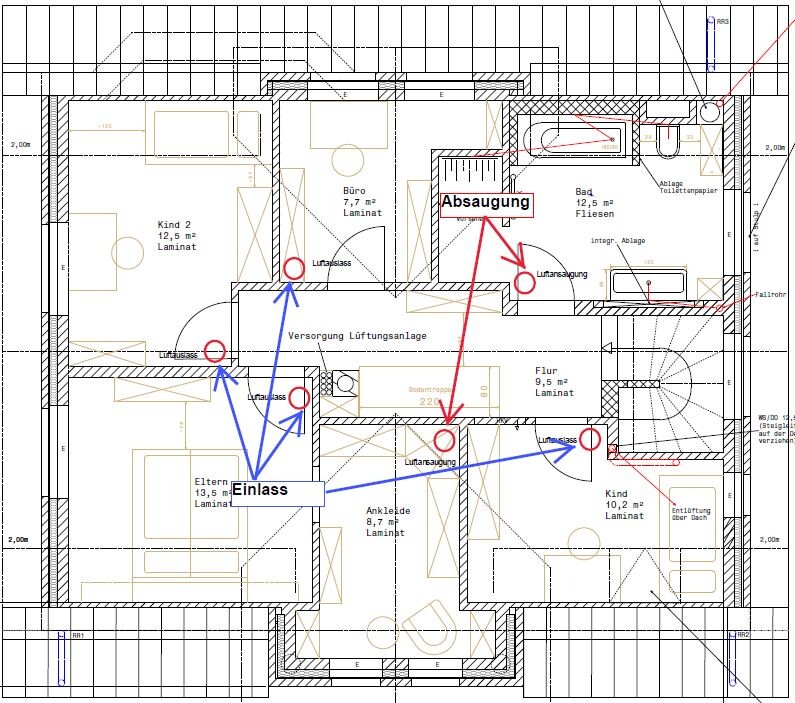
I have attached a layout showing how the supply and exhaust valves are installed on the upper and ground floors. The system is installed in the attic. I change the filters regularly every month (because it’s a new development), and the chimneys on the roof are the required >2.5 m (over 8 feet) apart from each other.
We have now been living for 2 years (since November 2018) in our detached house with a pitched roof, built according to the 2016 energy saving regulations, equipped with a central ventilation system (Wolf CWL300). Unfortunately, we have not been satisfied with the "performance" of the ventilation system from the start. We repeatedly called our installer in the beginning, but after about the eighth visit, he gave up and simply said, "The building is full of moisture at the beginning, so it’s normal for the air quality to be poor for two years." We consider this a poor excuse.
Our dissatisfaction mainly comes from the fact that we have had the chance to compare with neighboring houses (all in the same development with similar new build standards), where the air quality is usually significantly better than in our house. This means: despite the ventilation system running continuously (on occupancy mode at about 190 m³/h [190 cubic meters per hour]), the air in our house is almost always stuffy, whether we are home or not. Although the installer advised against it, we have actually been leaving the windows open every night lately because the air in the bedroom feels used up after 3-4 hours. It’s the same situation in the children's rooms.
Even when we come to the ground floor in the morning (where nobody has been all night), the air quality is anything but good. So, as we did before, we immediately open the windows in the morning.
Of course, I assume that we might be making some mistakes ourselves, but I would like to find out if there might also be (major?) planning errors in our system? Is it even possible to determine that remotely? What information would you need from us?
I have attached a layout showing how the supply and exhaust valves are installed on the upper and ground floors. The system is installed in the attic. I change the filters regularly every month (because it’s a new development), and the chimneys on the roof are the required >2.5 m (over 8 feet) apart from each other.
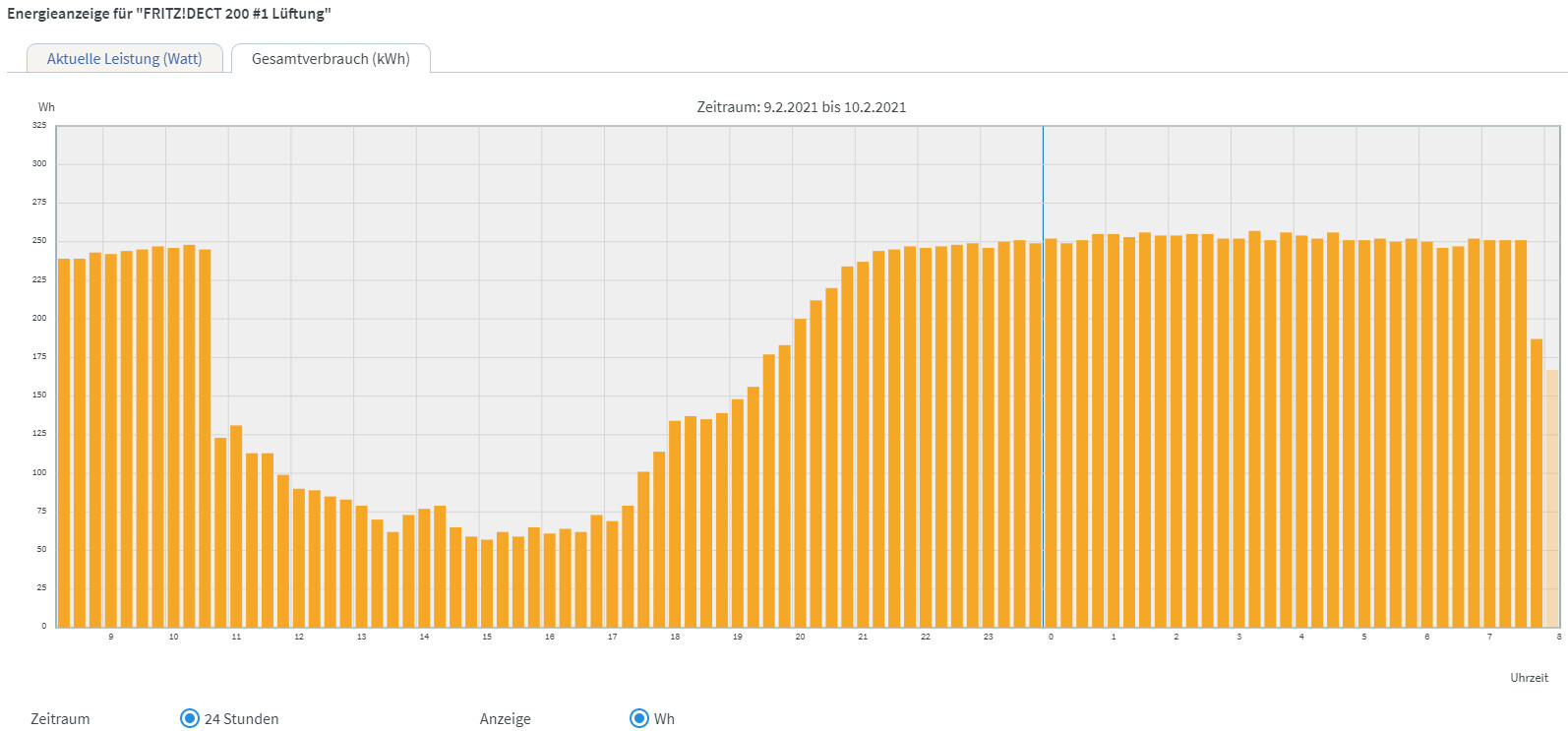
That’s right – I hadn’t considered the preheating coil... However, this makes me even more certain that the ventilation system cannot save energy throughout the year through electricity or gas consumption. On average, the unit otherwise consumes around 50-60 W/h, which adds up to considerable costs over the year (approximately 120-130€ plus what is added during the cold days).
Yes, I have connected Fritz.Dect smart plugs to the system – I find it interesting that the electricity consumption pattern is nearly identical, and I am wondering if I have made a user error in operation.

Yes, I have connected Fritz.Dect smart plugs to the system – I find it interesting that the electricity consumption pattern is nearly identical, and I am wondering if I have made a user error in operation.
Mycraft schrieb:
The gas boiler shouldn’t really consume more than usual, at most a few percent extra. The preheater coil in the controlled ventilation system is probably to blame.Yes, that’s what I thought too – I can understand the gas consumption rising significantly at very low temperatures – but the electricity usage!? I think I must have done something wrong – that doesn’t make sense. Especially since the values are almost the same…I have a suspicion and will have a look in the attic shortly ;-)

jeti79 schrieb:
That actually makes me even more certain that the ventilation system cannot save energy through electricity or gas consumption over the course of the year. In general terms, a mechanical ventilation system with heat recovery reduces losses from airing by about 10-12%. In other words, you save around 10-12% on energy costs annually—that’s roughly equivalent to one month’s gas payment. You can then offset this against the electricity costs of running the ventilation system. However, the main purpose of such a system is not primarily to save money, but to increase comfort, with energy savings being a minor benefit.
Constant fresh air and no unpleasant odors, as well as less dust and no need for frequent manual ventilation—these are the main functions of a mechanical ventilation system with heat recovery.
Yes, that is certainly the main purpose—assuming it works properly. However, I don’t understand why it is considered an “energy-saving” measure for meeting standards like the 2016 energy-saving regulations if it consumes more energy than it saves. For example, we didn’t have to install solar thermal systems or similar solutions because, according to calculations, the controlled residential ventilation alone was sufficient.
But okay—this shouldn’t be my biggest concern right now; first and foremost, it should function properly. I could imagine that it would use significantly less electricity if it were correctly sized and designed.
But okay—this shouldn’t be my biggest concern right now; first and foremost, it should function properly. I could imagine that it would use significantly less electricity if it were correctly sized and designed.

The issue with your electricity consumption is your preheating coil.
A larger system can run at a lower setting and save some energy, but the initial investment is higher.
You do save energy through heat recovery, but as @Mycraft already mentioned, the biggest advantage is comfort.
With such an airtight house, manual ventilation is no longer sufficient.
In very large systems, the preheating coil hardly runs at all because sufficiently warm air passes over the heat exchanger.
We have a very large system. The supply and exhaust air intake are located on the opposite side of the property. The air is routed about 35 meters (115 feet) through the ground at a depth of 5 meters (16 feet). Our system features a special heat exchanger that is frost-resistant down to minus 20°C (minus 4°F). Currently, the outside air at -5°C (23°F) is warmed to +2°C (36°F) by the controlled ventilation system.
So far, even in freezing temperatures, no additional heating has been required.
The system is currently running on the lowest setting (1000 m³/h) with approximately 250 W.
At full capacity with reheating, it’s almost 8 kW :p. Just ventilation at full power is about 1.5 kW.
A larger system can run at a lower setting and save some energy, but the initial investment is higher.
You do save energy through heat recovery, but as @Mycraft already mentioned, the biggest advantage is comfort.
With such an airtight house, manual ventilation is no longer sufficient.
In very large systems, the preheating coil hardly runs at all because sufficiently warm air passes over the heat exchanger.
We have a very large system. The supply and exhaust air intake are located on the opposite side of the property. The air is routed about 35 meters (115 feet) through the ground at a depth of 5 meters (16 feet). Our system features a special heat exchanger that is frost-resistant down to minus 20°C (minus 4°F). Currently, the outside air at -5°C (23°F) is warmed to +2°C (36°F) by the controlled ventilation system.
So far, even in freezing temperatures, no additional heating has been required.
The system is currently running on the lowest setting (1000 m³/h) with approximately 250 W.
At full capacity with reheating, it’s almost 8 kW :p. Just ventilation at full power is about 1.5 kW.
jeti79 schrieb:
I don’t understand why it should be sufficient as an "energy-saving" measure to meet standards like the Energy Saving Ordinance 2016, if it consumes more energy than it saves.That’s often the case with so-called "energy-saving" measures. Electric cars only break even after several years. Cars with aluminum bodies are lighter and save fuel, but they almost never reach the break-even point because the energy used in manufacturing exceeds what the car could ever save.Individual room control in many houses today consumes more energy than it saves.
And so on—the list could be extended further.
Controlled mechanical ventilation systems typically save about 10% compared to manual ventilation, which justifies their use. However, it is naturally assumed that they are properly sized, correctly installed, and operated efficiently.
If any one of these three factors is less than ideal, the calculation no longer adds up. It’s like always driving a car in second gear and wasting fuel—it’s not the manufacturer’s fault.
Electric pre-heating elements, however, are a quick and easy way for manufacturers to avoid responsibility. They should actually be banned. There are better passive methods regarding energy saving, but these increase the system costs and are therefore rare, as homebuyers, builders, and general contractors usually focus only on price.
Similar topics